

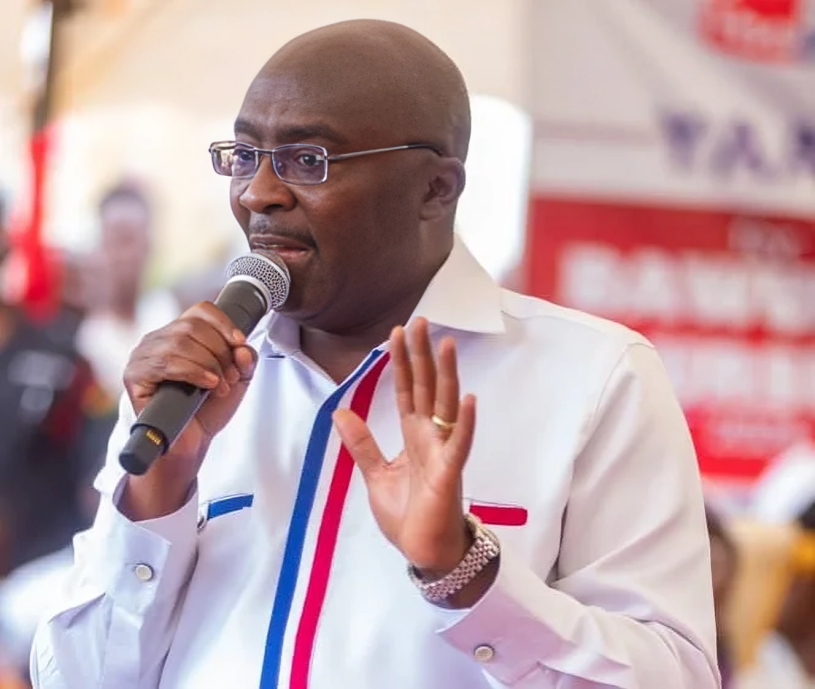
Bawumia To lose 2028 To any NDC Rival as Party’s Big Guns Battle For Mahama’s Crown
By Prince Ahenkorah
A new nationwide poll by Global InfoAnalytics paints a stark picture for the opposition New Patriotic Party’s 2028 ambitions, suggesting its flagbearer, Dr. Mahamudu Bawumia, would lose decisively to any of the leading figures vying to succeed President John Mahama within the governing National Democratic Congress.
The survey, conducted on 31 December 2025 and covering over 11,000 respondents across 83 constituencies, reveals a consistent electoral weakness for Bawumia, who has struggled to galvanise support beyond the NPP’s core base following the party’s heavy 2024 defeat.
More critically, the data provides the first detailed snapshot of the intensifying and still fluid battle to lead the NDC into the post-Mahama era.
In four hypothetical head-to-head matchups, each of the main NDC contenders outperforms Bawumia by significant margins. The results indicate a structural disadvantage for the NPP candidate, irrespective of his eventual opponent.
The most damaging scenario for Bawumia pairs him with the current Minority Leader and MP for Tamale South, Dr. Cassiel Ato Forson, who secures 58% to Bawumia’s 38%. The former Majority Leader, Haruna Iddrisu, also commands a strong lead of 56% to 40%.
Even NDC National Chairman Johnson Asiedu Nketia, whose potential candidacy has been met with internal skepticism in some quarters, polls 53% against Bawumia’s 43%. The closest contest features former Chief of Staff Julius Debrah, who still edges Bawumia 50% to 46%.
These figures suggest that the NDC’s incumbency advantage and the perceived failures of the previous Akufo-Addo-Bawumia administration are weighing heavily on the NPP standard-bearer, overriding individual voter reservations about specific NDC hopefuls.
The NDC’s Crowded Succession Arena
Beyond the general election projections, the poll illuminates a tightly packed and volatile NDC succession race. No potential candidate holds a commanding lead, pointing to a potentially divisive primary ahead.
Haruna Iddrisu currently holds a narrow lead with 26% support among NDC respondents, though this represents a decline from 29% in October 2025. He is closely trailed by Dr. Ato Forson, whose support has surged from 18% to 23%, signalling a rapid rise in his stock following his performance as Minority Leader. Asiedu Nketia holds third place at 22%, a slight dip from 24%.
Other figures trail significantly: former running mate Prof. Jane Naana Opoku-Agyemang polls 11%, Julius Debrah 7%, and North Tongu MP Samuel Okudzeto Ablakwa 6%.
The poll also tested a hypothetical scenario excluding Iddrisu, Opoku-Agyemang, Debrah, and Ablakwa from the contest. In this streamlined field, Dr. Ato Forson emerges as the clear frontrunner with 48%, against Asiedu Nketia’s 41%. This suggests that while the race is currently fragmented, Forson is consolidating support as a leading choice for the party’s future.
The Global InfoAnalytics data presents a dual challenge for Ghana’s two major parties. For the NPP, it confirms the daunting scale of Bawumia’s task to rehabilitate the party’s image and expand its appeal, with the poll indicating he starts from a position of profound vulnerability.
For the NDC, the numbers reveal a succession process that remains wide open. The absence of a dominant heir apparent to President Mahama sets the stage for a fiercely competitive internal campaign. While the poll suggests the party would enter the 2028 election as favourite regardless of who wins the nomination, a bruising primary could drain resources and create internal fissures that Bawumia might yet exploit.
The poll’s core finding, however, remains the consistent weakness of the NPP’s candidate. It underscores that the NDC’s path to retaining power in 2028 may depend less on who they choose and more on the NPP’s inability to overcome its own internal divisions and legacy of governance.