


By Godson Bill Ocloo
The recent terrorist attack in Burkina Faso that claimed the lives of Ghanaian tomato traders is more than a tragic incident, it is a stark warning. This attack signals a dangerous evolution in West Africa’s conflict landscape, where economic lifelines, civilian livelihoods, and cross-border trade corridors are increasingly under deliberate threat.Across the Sahel, violence is no longer confined to military or governmental targets. Markets, farms, and informal trade routes, the arteries of regional economies, have become prime targets for armed groups.
This shift from conventional conflict to the civilianization of violence exposes ordinary people to unprecedented risk and directly threatens human security. According to the Global Terrorism Index 2024, the Sahel region accounts for nearly half of all terrorism-related deaths worldwide. Burkina Faso consistently ranks among the most affected countries. Over two million people are currently internally displaced within the country, and more than five million require humanitarian assistance.
These figures underscore the scale of the crisis and the human cost of insecurity.But beyond statistics, this attack illustrates the profound human security implications. Economic actors, farmers, transport operators, and traders, are being targeted to disrupt regional livelihoods, destabilize communities, and weaken confidence in governance structures. The Ghanaian tomato traders were not just victims; they represented the backbone of cross-border trade, supporting families and food systems in both Burkina Faso and Ghana.West Africa’s economy relies heavily on informal cross-border trade, which constitutes 30–40% of intra-regional commerce, according to the World Bank (2020).
Women make up a significant proportion of these traders. Agricultural commodities such as tomatoes move daily across borders, sustaining urban markets, rural households, and broader food systems. When such corridors are attacked, the ripple effects are immediate and wide-ranging —Loss of household income for traders and transporters, Disruption to food distribution networks, Volatility in commodity prices, Increased transport costs and security premiums and Heightened regional economic uncertainty.
In short, this is economic destabilization weaponized, a calculated attempt to undermine livelihoods and create fear among civilian populations.Ghana, historically regarded as a pillar of stability in West Africa, shares a deeply interconnected border economy with Burkina Faso.
Northern Ghana’s markets are heavily reliant on Sahelian agricultural flows. Analysts, including the United Nations Office for West Africa and the Sahel (UNOWAS, 2023), have repeatedly warned of potential spillover risks toward coastal states. The buffer zone between the Sahel’s high-intensity conflict areas and West Africa’s coastal economies is narrowing.
Without proactive measures, attacks on economic actors could contract cross-border trade, escalate food prices, increase humanitarian burdens, and strain local governance systems.This is why a human security lens is essential. Human security, first articulated in the UNDP Human Development Report (1994), emphasizes protecting individuals and their livelihoods over territorial or state-centric approaches. It is built on three pillars: freedom from fear, freedom from want, and the preservation of dignity.
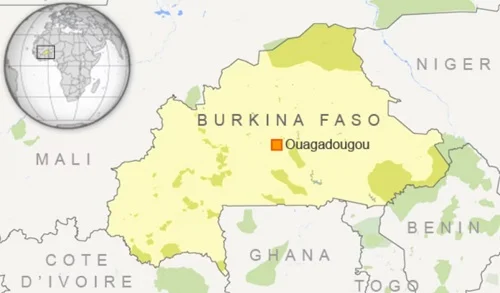
The Burkina Faso attack undermines all three: traders lost their safety, households face sudden financial vulnerability, and entire communities are forced to operate under fear. At ACHSEM, we assert that economic actors are not peripheral to security, they are central. Protecting trade corridors is, fundamentally, protecting lives.
Policy Recommendations for West Africa
Institutionalize Economic Corridor Protection
ECOWAS must develop a structured Economic Corridor Protection Mechanism, integrating coordinated patrols, risk mapping, intelligence-sharing, and contingency protocols along high-risk trade routes. Protection must extend beyond military measures to include community engagement and transport oversight
Integrate Traders into Early Warning Systems
Trader associations, transport unions, and agricultural cooperatives are frontline observers of emerging risks. Formal integration into regional early warning systems enhances real-time reporting and improves preventive responses.
Implement Compensation and Risk Mitigation Mechanisms
Given the scale of informal cross-border trade, governments and regional institutions should explore micro-insurance schemes and compensation frameworks. These tools can shield vulnerable traders from economic collapse after attacks, reducing the long-term human security impact.
Invest in Border Community Resilience
Economic marginalization increases vulnerability to extremist influence. Targeted investment in youth employment, agricultural value chains, infrastructure, and local governance can enhance resilience and reduce the appeal of armed groups.
Adopt Intelligence-Led Civilian Protection
Predictive analytics, route surveillance, and structured intelligence-sharing across Sahelian and coastal states are necessary to preempt attacks on traders. Civilian protection should be treated as strategically equal to military counterterrorism efforts.
Why Action Cannot Wait
If attacks on traders and economic corridors become normalized, West Africa faces cascading consequences: contraction of intra-regional trade, increased food insecurity, erosion of public trust in governance, and a widening humanitarian crisis. The Sahel crisis has already displaced millions and destabilized rural economies; allowing insecurity to penetrate economic lifelines will amplify these effects. The attack on Ghanaian tomato traders is not just a tragic event — it is a wake-up call for human security in West Africa. It is a reminder that peace and stability are inseparable from the protection of livelihoods, markets, and communities.
Conclusion
Trade is more than commerce, it is life. Protecting trade is protecting people. Protecting people is protecting peace.
West Africa must act decisively. Economic corridors must be safeguarded. Human security must be operationalized. Failure to do so risks allowing violence to dictate who can earn a living, who can eat, and who can survive in one of the world’s most vulnerable regions. The Burkina Faso attack calls for action now, not later. Regional leaders, institutions, and communities must ensure that livelihoods are protected as fiercely as borders, because the future of West African stability depends on it.
References
Institute for Economics & Peace. (2024). Global Terrorism Index 2024. Sydney: IEP. – UNHCR. (2024). Burkina Faso situation operational update. Geneva: UNHCR. – OCHA. (2024). Burkina Faso humanitarian needs overview 2024. United Nations. – World Bank. (2020). Informal cross-border trade in Africa: Implications and policy recommendations. Washington, DC: World Bank. – UNDP. (1994). Human Development Report 1994: New Dimensions of Human Security. New York: Oxford University Press. – UNOWAS. (2023). Reports of the Secretary-General on the Activities of the United Nations Office for West Africa and the Sahel. United Nations.
The writer is the Executive Director, Africa Centre for Human Security and Emergency Management (ACHSEM)