


By Leo Nelson||TNR Business
Addressing a high-level audience at the opening of the Kwahu Business Forum 2026, the Eastern Regional Minister, Rita Akosua Adjei Awatey has redefined the sophisticated city, signaling that the era of Kwahu being viewed solely through the lens of seasonal tourism is over.
The Regional Minister noted that the powerful business forum marks a transition of the Eastern Region into a primary industrial corridor, underpinned by a mandate to scale local enterprises into regional export champions.
“It is refreshing to see such a distinguished gathering of business leaders, investors, policymakers, innovators. Kwahu is not only a centre of tourism, but a symbol of entrepreneurship, innovation and hard work with determination.
“It is therefore fitting to host you for this all-important forum at a time when our nation accelerates efforts to build a resilient and self-sustaining economy.”
The Minister’s address was a roadmap for regional economic decentralization, which moved the conversation from “dialogue to action,” highlighting how the Eastern Regional Coordinating Council (RCC) is positioning itself as a proactive investment facilitator.
The theme of the Kwahu Business Forum 2026, “The Future of Business: Scaling Up Local Enterprises,” was a direct call for the financial sector to re-evaluate the risk profile of Eastern Regional SMEs, particularly those involved in high-value agribusiness and light manufacturing.
Adjei Awatey explained that the Eastern Region has long been the “quiet giant,” of the Ghanaian economy, possessing the richest agricultural land and a proximity to Accra that offers unparalleled logistical advantages. However, the potential for value addition has remained largely untapped.
In 2026, the region’s strategy seeks to correct this by creating an “enabling environment,” that specifically targets the processing of the region’s raw outputs like cocoa, oil palm, and minerals, into finished goods. The Minister described this as the region’s contribution to Ghana’s economic ambitions..
The Regional Minister emphasized that the Regional Coordinating Council is ready to provide administrative “fast-tracking” for investors who commit to building factories rather than just trading hubs in the region for tangible outcomes. This is a move toward industrial growth, where the Eastern Region becomes the engine room for Ghana’s non-traditional exports.
Adjei Awatey further addressed that the presence of the financial sector at the Kwahu Easter Forum was not accidental, noting that for local enterprises to scale, they require patient capital – long-term financing that matches the biological and industrial cycles of agribusiness and manufacturing.
She invited the “captains of industries,” and “development partners,” in an explicit request for a new type of financial partnership – where investors who are willing to enter into Joint Ventures (JVs) with established local entrepreneurs, blending international capital with local operational expertise, connect with the RCC for implementation.
“The objective of this forum is clear, to provide a platform for dialogue, networking and investment promotion. It is an opportunity for us to identify key sectors for growth, address challenges confronting businesses and develop attainable strategies that will enhance development and capabilities.”
Emphasising that such collaborations will “unlock the full potential of the region’s local economy,” whether through providing equipment leasing for agro-processors or green bonds for sustainable mining initiatives, the Minister opened the door for the financial sector to lead the region’s business transition.
She called for addressing the cost of credit and the infrastructure gap, even as partcipants patronise bespoke products and producers from the Eastern Region’s unique industrial mix.
The most significant operational announcement during her address was the upcoming Expo 2026 – a week-long investment drive is intended to be the closing room for the deals initiated at the Kwahu Easter Forum – organized by the RCC in collaboration with Nananom (traditional authorities) and other stakeholders.
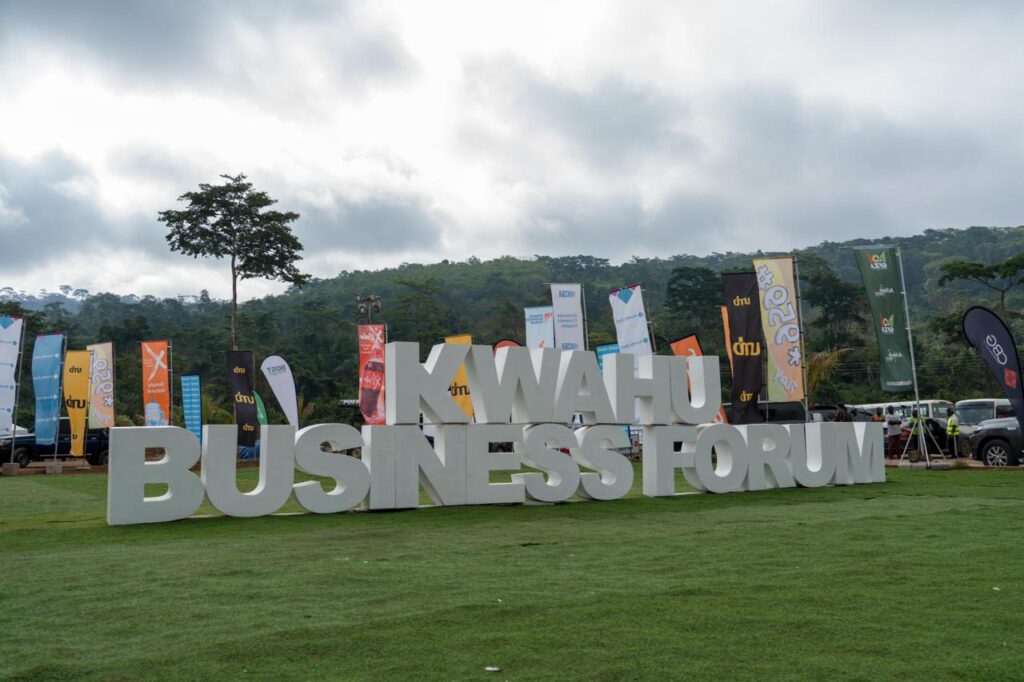
For the region, the Expo 2026 represents a formal “marketplace for opportunities,” where SMEs will be projected directly to global development partners. The inclusion of traditional authorities and the “big men,” of the Eastern Region is a masterstroke in land and social governance expected to ensure that land acquisition and community relations – the two biggest hurdles for foreign investors – are streamlined.
Minister Awatey’s special invitation to investors to consider the Eastern Region as their preferred investment destination is backed by this tripartite alliance of the state, the private sector, and traditional leadership.
Ultimately, the Eastern Region’s industrial pivot is about improved livelihoods. The Minister was clear that insight must translate into “real investment, job creation, and wealth creation,” that scales local enterprises and builds a resilient middle class in Koforidua, Kwahu, and beyond.
This will prevent “brain drain,” to the capital and ensure that the wealth generated from the region’s resources stays within the region. As the Mahama administration pushes for a self-sustaining economy, the Eastern Region is positioning itself as the model for regional excellence.
Rita Akosua Adjei Awatey laid down the steps: the Eastern Region is open for business, it is secure for investment, and it is ready to lead the nation’s industrial charge.