

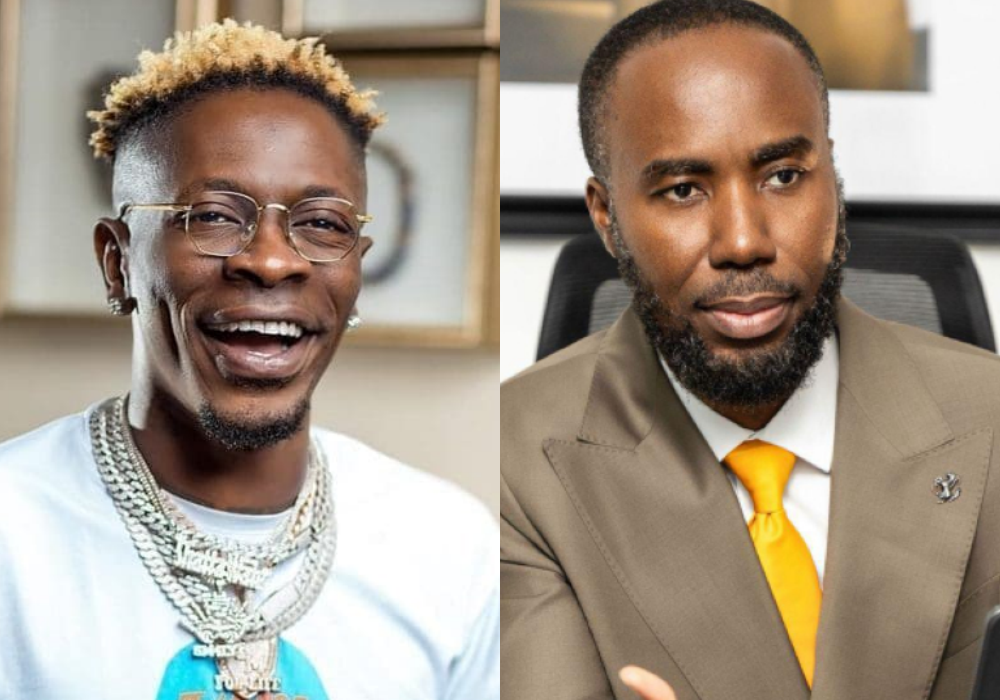
A revealing tale of how an embattled Spy Agency Chief’s Lamborghini ended up with Shatta Wale
By Prince Ahenkorah
The yellow Lamborghini Urus that dancehall artiste Shatta Wale has fought to keep is not merely a celebrity status symbol caught in an international fraud net. Court documents and investigative sources now link the vehicle to Kwabena Adu Boahene, the embattled former Director General of the National Signal Bureau, who is already facing trial in Ghana on multiple corruption charges.
The connection transforms the case from a simple asset forfeiture into a web of alleged fraud, political connections, and what accusers describe as a deliberate celebrity smokescreen designed to protect a man with far more to lose.
The Former Signal Bureau Chief
Adu Boahene is no stranger to controversy. Before his involvement in the Lamborghini saga, he served as head of the National Signal Bureau, a sensitive intelligence-related agency. He is currently awaiting trial on corruption charges—allegations that independent observers say involve the misuse of state resources and suspected diversion of public funds.
According to broadcaster Blakk Rasta, who has obtained what he describes as official correspondence from the U.S. Department of Justice, the Lamborghini was part of a larger pattern. Adu Boahene, he alleges, operated a parallel business empire while heading a state security institution a fleet of luxury vehicles leased to prominent clients through a company called Moving Peak.
The vehicles, Blakk Rasta claims, were acquired with funds whose origins are now being scrutinized by both Ghanaian and American authorities.
The Kentucky Trail
The specific Lamborghini now at the center of the case was originally purchased by a man identified as Nana Amuah. Court records from the U.S. Attorney’s Office for the Eastern District of Kentucky show that Amuah was convicted for his role in a business email compromise scheme that defrauded victims of nearly one million dollars. He is currently serving a prison sentence in the United States.
When American authorities traced assets acquired with the stolen funds, they followed the money to Ghana. The Lamborghini was among the assets they identified. Under the United Nations Convention Against Transnational Organized Crime, the U.S. formally requested mutual legal assistance.
The trail led to Moving Peak and, eventually, to Adu Boahene a man already under scrutiny in Ghana for entirely separate corruption allegations.
This is where Shatta Wale enters the narrative. By the time EOCO’s Surveillance and Asset Recovery Unit was ready to act, the vehicle had moved from Adu Boahene’s orbit to the dancehall artiste’s driveway. Shatta Wale has consistently maintained that he purchased the car legitimately that he bought it “from the street” with his own money and had no knowledge of any illicit history.
Blakk Rasta tells a different story. The broadcaster alleges that Shatta Wale was aware of the vehicle’s connection to Adu Boahene but initially denied any link. More significantly, he suggests that the artiste’s very public campaign accusing authorities of intimidation, framing the seizure as celebrity persecution served to draw attention away from the man at the center.
“If Shatta Wale had simply said, ‘I bought this car, I didn’t know its history, cooperate with investigators,’ the story would have been about due diligence,” Blakk Rasta said on his programme. “Instead, he made it about himself. And while the public argued about whether he was being victimized, the question of how a sitting intelligence official came to possess fraud-tainted assets faded into the background.”
The Protective Network
The narrative took a further turn when media personality Captain Smart of Onua TV entered the fray, claiming that EOCO’s Acting Executive Director Raymond Archer had written directly to the FBI inviting them to Ghana to seize the vehicle. The implication was clear: Ghanaian officials were begging foreigners to target a local celebrity.
Blakk Rasta has strongly rejected this framing. The initiative, he insists, came from U.S. authorities following established international protocols. But the damage was done. By shifting the narrative to foreign interference and celebrity victimization, Shatta Wale’s defenders succeeded in muddying the waters.
The Consent Document
On February 24, 2026, the legal situation reached a critical juncture. Sammy Flex, Public Relations Manager of the Shatta Movement, confirmed that the group had received a court document seeking Shatta Wale’s consent to ship the Lamborghini to the United States.
The document has been referred to Shatta Wale’s legal team. The artiste now faces a choice: consent to the shipment, effectively ending his involvement, or contest the request and force a legal battle that would inevitably surface more details about the vehicle’s journey including its connection to Adu Boahene.
The Embattled Official
For Adu Boahene, the Lamborghini case adds another layer to an already precarious legal position. Already facing trial on corruption charges related to his tenure at the National Signal Bureau, he now confronts allegations that he operated a luxury vehicle business using assets potentially acquired with fraud proceeds.
The question investigators are reportedly asking: Was Moving Peak a separate enterprise, or was it connected in any way to Adu Boahene’s official position? Did his role at the Signal Bureau provide cover or resources for his private business interests?
Adu Boahene has not commented on the Lamborghini allegations. His legal team is focused on the existing corruption charges, which remain pending before Ghanaian courts.
The Due Diligence Defense
Shatta Wale’s defenders have consistently argued that even if the vehicle’s origins are tainted, the artiste purchased it in good faith and should not suffer for the sins of those who came before.
Blakk Rasta rejects this reasoning. “If you buy an item allegedly acquired with stolen funds, does that purchase automatically cleanse it of its origins?” he asked. His answer is no and he argues that in high-value transactions, buyers bear responsibility for due diligence.
The legal principle at stake is not unique to Ghana. International forfeiture laws increasingly allow authorities to seize assets from good-faith purchasers if those assets can be traced to crime proceeds. The remedy for the purchaser is not to keep the asset but to seek compensation from the seller.
What Remains Unanswered
Several questions remain unresolved as the case moves toward its next phase:
Did Shatta Wale know about the vehicle’s connection to Adu Boahene before purchase? If so, at what point did he become aware?
What role did Moving Peak play in the vehicle’s movement from Amuah to Adu Boahene to Shatta Wale?
Why has public attention focused so heavily on the celebrity possessor while the embattled former intelligence official remains in the background?
And for Adu Boahene, already facing trial on corruption charges, does the Lamborghini case represent a separate criminal exposure or will it be folded into the existing proceedings?
The yellow car that once symbolized status now represents something else entirely: a paper trail connecting a convicted fraudster in Kentucky, an embattled intelligence official awaiting trial in Accra, and a dancehall star who, according to his accuser, became an unwitting—or perhaps not so unwitting shield for a man with far more to hide.