…..as critical sandblasting works restore plant integrity
By Prince Ahenkorah
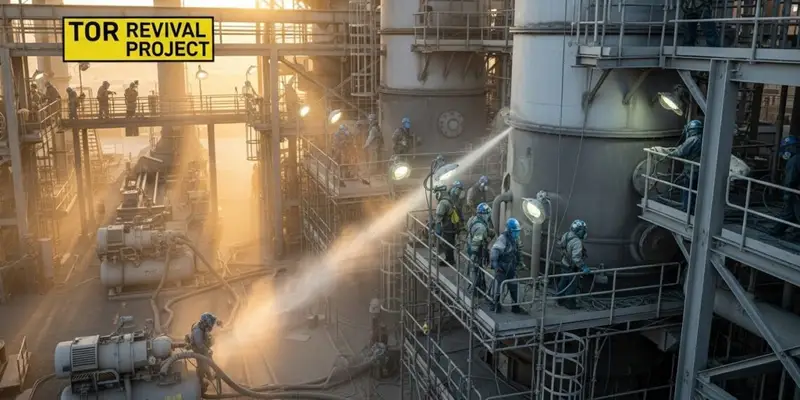
The ongoing revival of the Tema Oil Refinery (TOR) has reached a significant technical milestone following the successful completion of extensive sandblasting works across critical sections of the plant.
According to the refinery’s management, the exercise forms a central part of a broader rehabilitation programme aimed at restoring TOR to safe, efficient and sustainable operations.
Corporate Affairs Officer of TOR, Godwin Mahama, described the sandblasting exercise as one of the most important maintenance interventions undertaken during the refinery’s revival journey, noting that it lays the foundation for long-term equipment performance and operational safety.
“Sandblasting is a critical maintenance activity that ensures deep cleaning of metal and other surfaces by removing rust, old paint, and surface contaminants.”
According to him, the process creates the proper surface conditions needed for new protective coatings to adhere effectively, reducing the risk of corrosion and premature equipment failure.
He added that by improving adhesion and protecting exposed metal, sandblasting plays a vital role in extending the lifespan of plant equipment.
Beyond durability, the exercise also has important safety implications. Mr. Mahama noted that well-maintained surfaces reduce the likelihood of leaks, structural weaknesses and operational hazards, thereby enhancing overall safety and performance within the refinery.
Scope of Work Across the Plant
Whisk
As part of TOR’s revival works, sandblasting was carried out comprehensively on all required sections of the plant, following a carefully sequenced and methodical approach. Mr. Mahama explained that preparatory works were necessary before sandblasting could begin.
“Before the exercise, all insulation materials were stripped off, including the removal of rockwool around the metal surfaces.”
This step, he explained, ensured that metal components were fully exposed, allowing for thorough and effective sandblasting to bare, clean surfaces.
Once the sandblasting process was completed, the refinery moved swiftly to restore the protective systems around the equipment.
“After completion, the equipment was re-insulated with new rockwool and finished with aluminium cladding to restore full thermal and protective integrity.”
One of the key components highlighted during the exercise was the refinery’s boiler system, which plays a central role in plant operations. Mr. Mahama pointed to the sandblasting of the boiler as a clear example of the technical depth involved in the revival works.
“Attached is an example of the sandblasting work on the boiler. In simple terms, a boiler is used to generate pressurised steam for plant operations.”
The restoration of such equipment, he added, is critical to ensuring the refinery’s readiness to resume full-scale operations.
Industry experts say that refurbishing core systems like boilers is essential for refineries that have experienced prolonged downtime, as corrosion and material degradation can significantly compromise safety and efficiency if left unaddressed.
Deliberate Planning Behind the Revival
Mahama stressed that the progress made at TOR is the result of deliberate planning and technical execution, rather than chance. According to him, the refinery’s leadership adopted a clear, step-by-step strategy grounded in engineering best practices to guide the revival process.
“TOR’s revival did not happen by chance. It was the result of deliberate, intensive, and highly technical work.”
He added that management had a clear understanding of the challenges confronting the facility and the interventions required to address them.
The completion of the sandblasting works is seen as a strong signal of progress in TOR’s broader rehabilitation agenda, which aims to restore the refinery’s role in Ghana’s downstream petroleum sector.
As TOR continues its revival journey, the sandblasting milestone underscores the importance of technical discipline, preventive maintenance and long-term planning in bringing critical national assets back to life.
For many observers, the work completed so far represents a renewed commitment to ensuring that Ghana’s only refinery operates safely, efficiently and sustainably for years to come.