

By Nelson Ayivor
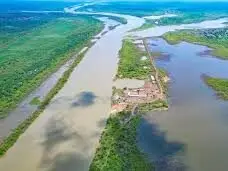
The Ghana Infrastructure Investment Fund (GIIF) has revealed during a strategic investment mission to the People’s Republic of China, a comprehensive industrial blueprint aimed at transforming the Volta Lake Basin into a multimodal logistics spine and a global hub for agribusiness.
Nana Dwemoh Benneh, the Chief Executive Officer (CEO) of GIIF, speaking in an interview, detailed plans to leverage the world’s largest man-made lake to drive a massive import substitution agenda.
According to Benneh, the project, which targets the cultivation and processing of millions of hectares of arable land, represents one of the most significant infrastructure undertakings under the current administration’s 24H+ Programme and the Accelerated Export Development initiative.
“The Volta Lake offers a key corridor to create significant economic activity. There is about 8 million hectares of arable land around the lake, which we want to transform into commercial farms and agri-processing hubs.
“The logistics to have that done is another area where we are looking for investors to participate in, specifically in terms of port building, ships, and terminals which will be able to run the logistics effectively,” Nana Dwemoh clarified.
Nana Dwemoh Benneh explained that the “Volta Lake Economic Corridor,” is designed to solve the perennial bottleneck of agricultural modernization in Ghana. Despite vast natural resources, the sector has historically been hampered by poor post-harvest logistics and a reliance on rain-fed, subsistence models.
By inviting Chinese partners to co-invest, GIIF aims to create a seamless link between the productive northern savannah zones and the industrial processing hubs in the south.
This “water-highway,” is expected to drastically reduce the cost of moving bulk agricultural commodities while fostering the development of new industrial townships along the lake’s periphery, Benneh noted.
Industrial Bottleneck
A critical component of this master plan is the shift from primary production to high-value manufacturing. Mr. Benneh revealed that during high-level discussions with investors in Beijing, he highlighted that Ghana’s economic transformation is contingent on retaining a greater share of the global profit pool.
Using the examples of cocoa and coffee, where African producers often retain less than five percent of total market value, GIIF pitched for the establishment of processing facilities that can handle everything from cocoa value-addition to textile manufacturing and machinery assembly.
“What is driving this new vision is the need to address the bottlenecks in our industry. We are one of the world’s largest producers of cocoa, but most exports are in a primary state. There is a push to do more value-adds before the product leaves, and that requires manufacturing capability.”
The GIIF CEO further noted that the 24-hour economy vision provides the operational framework for these hubs to function at maximum efficiency.
By providing the necessary bulk infrastructure – including dedicated energy solutions and modern transport links – the government aims to attract investors who can bring both the capital and the technical expertise required to build a self-sustaining industrial ecosystem.
For Benneh, the Volta Lake project is not merely a domestic initiative but a strategic move toward regional integration. As a gateway to the Sahelian countries and the broader West African market, the corridor serves as a vital transit point for landlocked neighbors.
The GIIF boss emphasized that Ghana’s current “reset” era prioritizes sustainable and viable business models, and is seeking investors who view Ghana as a long-term manufacturing base rather than just a source of raw materials.
He noted that this approach aligns with China’s own economic pivot toward high-end manufacturing and precision technology, offering a unique opportunity for technology transfer and local industrial growth.
“We have moved past the old colonial system where we were directed in a particular direction. We are opening ourselves more, and empirical evidence shows that as we have opened ourselves, we have come up with a better variety of business models.”
Benneh also noted that the project also addresses national food security by prioritizing the production of staple crops that currently drive Ghana’s high import bill.
“We are looking very much at agric and agri-processing because we are keen to develop import substitution. At the moment, Ghana is heavily import-driven, and we believe that economic transformation should lead to self-sustenance and an increase in exports.”
He underscored that the logistics backbone of the Volta Lake will allow for the large-scale movement of rice, maize, and soy to processing centers, effectively replacing imports with locally grown alternatives.
For Ghana, this focus on “self-sustenance” is being viewed as the cornerstone of the national economic transformation.