

By Leo Nelson
A high-stakes political and economic drama is unfolding along the Volta corridor, where the success of President John Dramani Mahama’s flagship agricultural policy now rests in the hands of traditional rulers.
The Millennium Development Authority (MiDA), tasked with implementing the president’s ambitious 24-Hour Plus Programme, has issued a direct appeal to chiefs: release the land, or the project stalls.
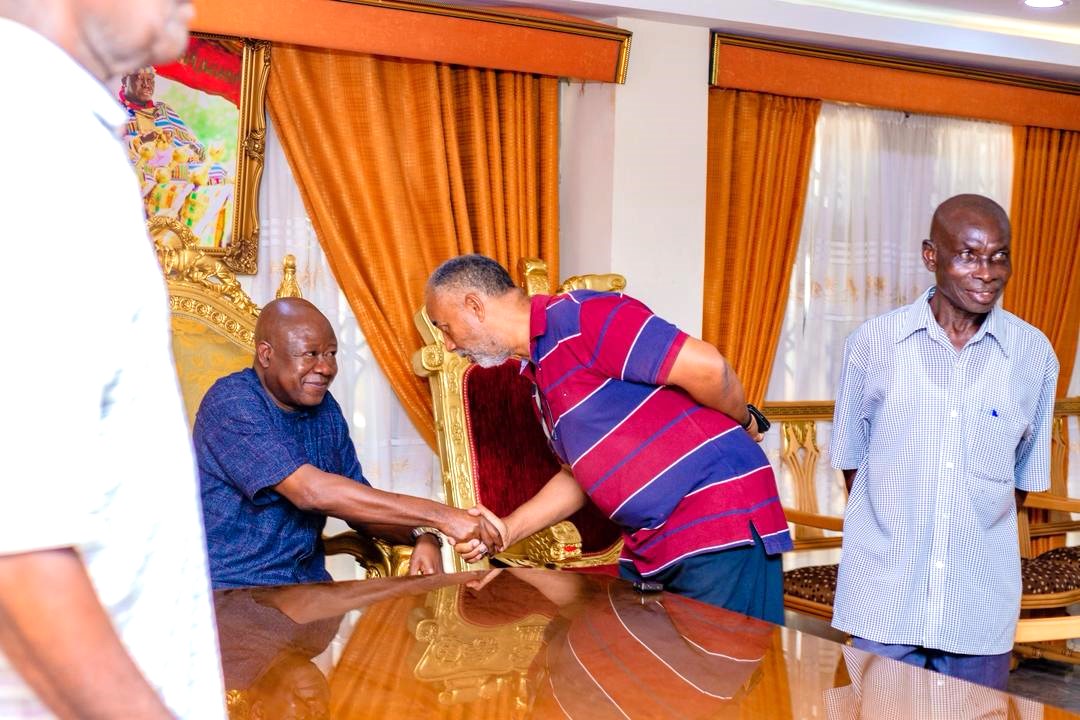
Leading a high-powered inspection tour of the White and Black Volta basins, MiDA Board Chairman Dr Charles Abugre and CEO Alexander Kofi-Mensah Mould delivered a stark message to the Worawora Traditional Council. Without access to vast tracts of land for large-scale Agro-Ecological Parks (AEPs), they argued, the entire agricultural transformation agenda risks becoming a theoretical exercise.
“The success of the 24-hour agricultural programme depends heavily on land availability,” Mould told the assembled chiefs, framing the request as a partnership between the modern state and customary authority. “We are counting on you to help unlock the agricultural potential of this area.”
In a move that will be watched closely by other traditional areas, Daasebre Sarfro Baah III, Chief of Worawora, offered a tangible commitment. Thousands of acres, he announced, have already been set aside for the commercial cultivation of ginger, chilli pepper, and rice aimed at export markets. It is precisely the kind of backing Accra needs to demonstrate momentum.
Yet the chief’s support came with its own demands. He urged the government to back its rhetoric with hard infrastructure irrigation systems and farm inputs to truly scale production. It was a reminder that land alone is not enough; water and capital must follow.
The MiDA tour, however, revealed a more troubling picture beneath the surface optimism. Despite the proximity of many communities to the vast Lake Volta, irrigation remains a pipe dream. Farmers continue to rely on erratic rainfall, a glaring vulnerability for a project premised on 24-hour productivity.
“Water is flowing beside these communities, yet farmers depend on rain,” Mould observed, pointing to a paradox that has long plagued Ghanaian agriculture.
Even more politically sensitive were the findings in parts of the Northern Region, where the much-vaunted One Village One Dam initiative came under fire. What MiDA officials encountered were not the reservoirs of ruling party propaganda, but what Mould bluntly described as “dugouts masquerading as dams.” For a government promising transformation, such infrastructure failures are not just technical setbacks they are political ammunition for critics who argue that grand schemes often mask local neglect.
Amid the challenges, MiDA has identified a potential lifeline. The community of Kubungu is being eyed as a cold chain logistics hub, linked to Tamale Airport, to support the export of fruits, vegetables, and nuts. If realised, the hub could provide the critical infrastructure needed to connect northern farmers to international markets, bypassing the post-harvest losses that currently cripple the sector.
For President Mahama, the Agro-Ecological Parks represent more than an economic policy they are a test of his administration’s ability to deliver tangible results. The reliance on traditional authorities for land access introduces a delicate political calculus. Chiefs, who wield significant influence in rural Ghana, must be persuaded that releasing communal lands will yield benefits for their subjects, not just profits for Accra-based cronies.
MiDA is now expected to submit a comprehensive technical report in the coming months, which will guide investment decisions and inter-agency coordination. But as The New Republic understands, the real negotiation is not happening in boardrooms it is unfolding in the palaces of the Volta corridor, where the fate of Mahama’s agricultural revolution hangs in the balance.