

Close Menu
THE NEW REPUBLIC
    Recent

    Herdsman, 33, jailed 40 years for highway robberies, kidnapping

    November 28, 2026

    Illegal Mining Is ‘Criminal Terrorism’ — Minister Warns Perpetrators Must Not Be Shielded From Prosecution

    November 28, 2026

    ‘Stop The Ecocide’: Stakeholders Demand Urgent Action As Ghana Launches Water Restoration Framework

    November 28, 2026
    Facebook X (Twitter) Instagram YouTube
    Saturday, November 28
    THE NEW REPUBLIC
    Facebook X (Twitter) Instagram YouTube
    • HOME
    • GENERAL
    • POLITICS
    • BUSINESS
    • ECONOMIC INTELLIGENCE
    • SHOWBIZ
    • SPORTS
    • CRIME
    • PODCASTS
    THE NEW REPUBLIC
    Home»World»Attack on Mali village ‘kills 100’

    Warning: Trying to access array offset on value of type bool in /home/u427095036/domains/thenewrepublicgh.com/public_html/wp-content/themes/smart-mag/partials/single/featured.php on line 78

    Attack on Mali village ‘kills 100’

    0
    By TNRgh on June 10, 2019 World
    Share
    Facebook Twitter LinkedIn Email WhatsApp Copy Link
    Listen to this article

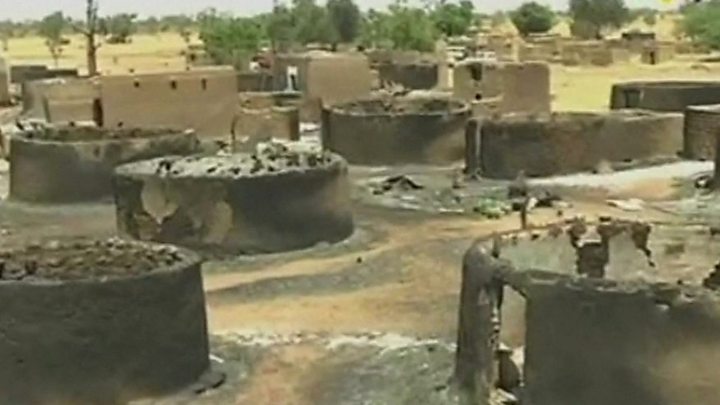
    Dogon villages often follow a traditional way of life photo: Getty images[/caption]

    Nearly 100 people have been killed in an attack in a village in central Mali inhabited by the Dogon ethnic group, officials say.

    The attack happened in Sobame Da, near Sanga town in the Mopti region. The search for bodies is ongoing, but officials say 95 people have been found dead, with many of the bodies burned. There have been numerous attacks in Mali in recent months, some ethnically driven, some carried out by jihadist groups. Clashes between Dogon hunters and semi-nomadic Fulani herders are frequent. Mali’s government said “suspected terrorists” had attacked the village at around 03:00 local time. At least 19 people were still missing, it said. But the mayor of nearby Bankass, Moulaye Guindo, told Reuters news agency that Fulanis from that district had attacked Sobane-Kou after nightfall. “About 50 heavily armed men arrived on motorbikes and pickups,” a survivor who called himself Amadou Togo told the AFP agency. “They first surrounded the village and then attacked – anyone who tried to escape was killed.” “No-one was spared – women, children, elderly people,” he added. No group has officially said it was responsible for the attack. “Right now we have 95 dead civilians. The bodies are burned, we are continuing to look for others,” a local official told AFP.

    What is the Dogon-Fulani conflict?

    The Dogon people have lived in central Mali for centuries, and live a largely traditional way of life as settled farmers. Many Fulani, on the other hand, are semi-nomadic herders who move across large distances in West Africa.
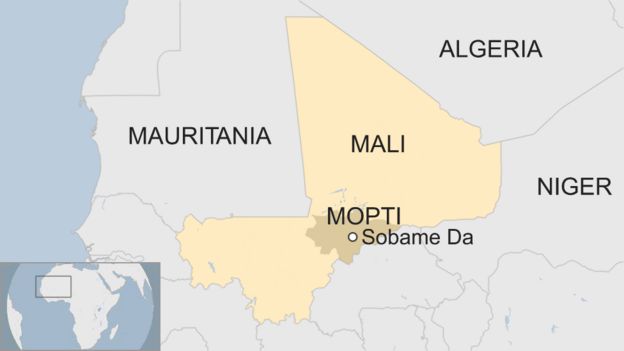

    A map shows the approximate location of Sobame Da inside of the Mopti region in Mali
    Friction between farmers and the roaming herders over resources is long-standing – but clashes between them have increased since a militant Islamist uprising in northern Mali in 2012. Both sides accuse the other of carrying out attacks amid the unrest. The Fulani, a largely Muslim ethnic group, have been accused of having links with the Islamist uprising. But for their part, the Fulani accuse a Dogon self-defence association, Dan Na Ambassagou, of attacks on them.
    Presentational grey line

    Analysis: A crisis getting worse

    By Louise Dewast, West Africa correspondent There is a growing view in Mali that the (mostly military) response to this multi-faceted crisis is ineffective and even counter-productive. Despite having a large UN peacekeeping mission and French forces deployed since 2013, insecurity has worsened in some parts of the country. According to the International Crisis Group, there were four times more attacks in May 2019 compared to May 2016. In their latest report on the country, the group urges the government to engage in dialogue with militants to negotiate local ceasefires and facilitate humanitarian access to civilians in need. After another massacre of Fulanis in March, senior officials were sacked, people took to the streets – and the entire government resigned in April.
    Presentational grey line

    Is this attack unusual?

    The attack on Sobame Da has killed about a third of its inhabitants. In the same region in March, more than 130 Fulani villagers were killed by armed men wearing traditional Dogon hunters’ clothing.
    [caption id="" align="alignnone" width="720"] In March, more than 130 people were killed in an attack on the villages of Ogossagou and Welingara[/caption]
    After the attack, the Dogon Dan Na Ambassagou was banned by Mali’s government. But the organisation, which insists it is a self-defence group and had nothing to do with the killings, refused calls to lay down its arms. The United Nations mission in Mali, in a report dated 31 May, said the security situation in central Mali “continued to deteriorate”. It said that clashes between the Dogon and Fulani had been “exacerbated by the presence of extremist groups”, and that the central region had recorded the highest number of attacks against civilians. Hundreds of people have been killed so far this year.

    What effect did the Islamist uprising have?

    There are several Islamist groups based in northern Mali. In 2013, they seized half of the country and were advancing on the capital, Bamako. France, the former colonial power in Mali, and some neighbouring African countries, intervened – and pushed the Islamist groups back towards their strongholds in the Sahara desert. Before the unrest, disagreements between the Fulani and Dogon were often settled through negotiation. But the uprising – which had spread to the centre of Mali by 2015 – decreased government control and increased the availability of weapons. Source: 3news.com | Ghana]]>

    Share. Facebook Twitter WhatsApp LinkedIn Email Copy Link

    Related Posts

    We’re prepared to counter terrorists; National Security assures religious groups

    May 17, 20193 Mins Read
    Add A Comment
    Leave A Reply Cancel Reply

    Top Posts
    Herdsman, 33, jailed 40 years for highway robberies, kidnapping
    November 28, 20261 Min Read
    Illegal Mining Is ‘Criminal Terrorism’ — Minister Warns Perpetrators Must Not Be Shielded From Prosecution
    November 28, 20263 Mins Read
    ‘Stop The Ecocide’: Stakeholders Demand Urgent Action As Ghana Launches Water Restoration Framework
    November 28, 20267 Mins Read
    GES Recruitment Portal Not Shut Down — Haruna Iddrisu Dismisses Reports
    November 27, 20262 Mins Read
    Don't Miss
    Crime

    Herdsman, 33, jailed 40 years for highway robberies, kidnapping

    By Gifty BoatengNovember 28, 20261 Min Read

    A 33-year-old herdsman, Bube Gariba, has been sentenced to 40 years’ imprisonment by the Kibi…

    Illegal Mining Is ‘Criminal Terrorism’ — Minister Warns Perpetrators Must Not Be Shielded From Prosecution

    November 28, 2026

    ‘Stop The Ecocide’: Stakeholders Demand Urgent Action As Ghana Launches Water Restoration Framework

    November 28, 2026

    GES Recruitment Portal Not Shut Down — Haruna Iddrisu Dismisses Reports

    November 27, 2026
    Stay In Touch
    • Facebook
    • Twitter
    • Instagram
    • YouTube
    © 2026 THE NEW REPUBLIC GH.
    Facebook X (Twitter) WhatsApp Instagram

    About | Contact | Privacy Policy

    Type above and press Enter to search. Press Esc to cancel.