

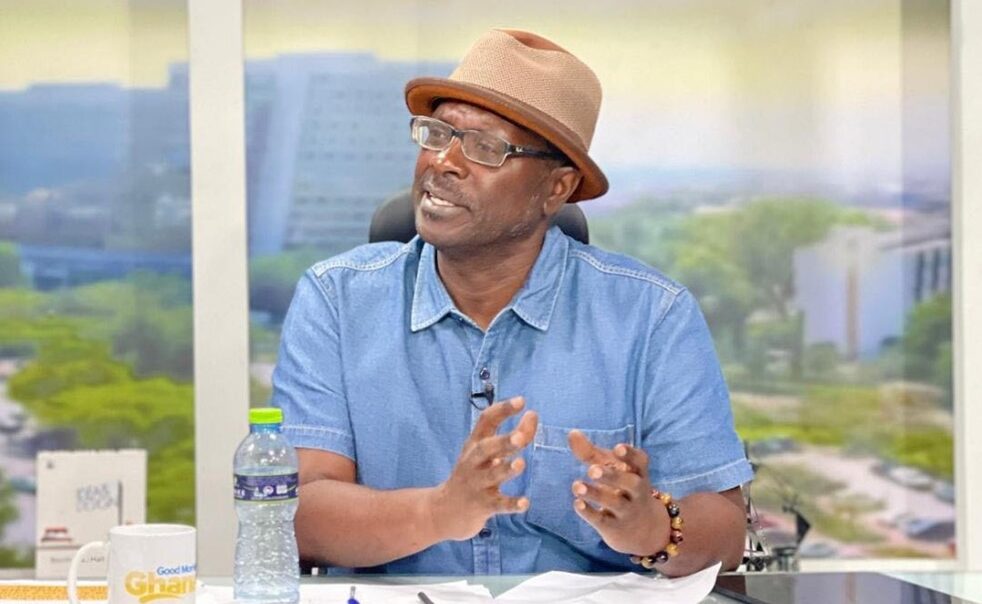
— Kwaku Azar Demands Freeze on Ofori-Atta’s Assets
By Nelson Ayivor
Professor Stephen Kwaku Asare, a CDD-Ghana Fellow and prominent legal scholar has issued a blistering critique of attempts to fault the Office of the Special Prosecutor (OSP) for the alleged escape of former Finance Minister Ken Ofori-Atta, insisting that responsibility lies squarely with the former minister himself.
In a strongly worded statement, Prof. Asare argued that the country must stop shifting blame and instead confront the reality that an individual once entrusted with managing the nation’s finances “has fled the nation’s justice.”
He described the growing public commentary that seeks to interrogate why the OSP did not restrain Ofori-Atta from leaving the country as nothing more than “blame-shifting gymnastics” designed to distract from the heart of the matter.
“Let’s stop dancing around the obvious. The OSP cannot be blamed because someone packed his bags and bolted in anticipation of being held accountable.
“That blame-shifting gymnastics is tired. It is childish. And it is dangerous for a Republic that claims to take corruption seriously.”
According to him, no credible accountability system can function if suspects can simply evade investigation and public debate then descends into questioning the capacity of the prosecuting authority rather than the conduct of those under scrutiny.
“When a suspect runs, the problem is not the prosecutor. The problem is the runner. We must keep the spotlight where it belongs: A man entrusted with the nation’s resources has fled the nation’s justice.”
A Grave Constitutional Breach:
Prof. Asare insisted that the situation reflects a grave constitutional breach, one that signals a disregard for national institutions and the principle that public office holders must always be answerable for their stewardship. “That is the story. That is the scandal. That is the constitutional crime,” he declared.
In his view, the former minister’s alleged decision to leave the jurisdiction at a time when questions surround his management of public funds is not a neutral act. On the contrary, it speaks volumes. “In every serious country, flight from justice is an admission of fear: fear of the evidence, fear of the questions, fear of the courtroom,” he said.
Yet, Prof. Asare lamented that in Ghana, the instinct has been to fault the OSP for not physically preventing Ofori-Atta’s departure. He dismissed such suggestions as both unrealistic and damaging to the nation’s justice system.
“Only here do we twist ourselves into knots asking: ‘Why didn’t the OSP prevent him from fleeing?’ Really? Should the OSP handcuff suspects at the airport? Should the OSP chase ministers through boarding gates?” he quizzed.
The legal scholar stressed that the obligation to face the law rests solely with the former minister, who must return, confront the allegations, and clear his name through lawful processes. He added that attempts to treat evasion as a minor issue undermine the very idea of equal justice.
“The villain is the escapee, not the institution doing its job. The burden is on him to come back, face the charges, clear his name if he can, and let due process speak. Running is not a defense. Hiding is not exoneration. And silence in exile is not innocence.”
Assets Freeze Non-Negotiable:
Prof. Asare stated firmly that while the former minister remains outside the reach of the investigative system, one measure is absolutely imperative: the freezing of all his assets.
He described this as a non-negotiable safeguard. “Freeze the assets,” he demanded. “Every pesewa. Every property. Every account.
A man cannot flee the Republic and still enjoy the Republic’s spoils. That is not justice. That is sponsoring impunity.”
He emphasized that asset-freezing is not intended to punish but to protect the state’s interest and to preserve the integrity of the investigation. Such action, he noted, prevents the loss of potentially critical evidence and stops the dissipation of wealth that may be material to a prosecution.
“Freezing assets is not punishment; it is protection. It preserves the evidence, prevents tampering, and stops asset flight and ensures that the Republic does not lose twice — first the money, then the suspect,” he said.
The scholar reiterated that the measure is reversible and poses no legal harm to anyone who is eventually cleared of wrongdoing. “If he is innocent, the courts will say so, and everything will be restored,” he said. “But until then, the nation must secure what belongs to the nation.”
Prof. Asare concluded with a stern warning about the broader implications of allowing powerful individuals to sidestep accountability. He cautioned that when leaders face no consequences for evading investigation, democratic institutions quickly erode.
“He has fled justice. He must return to face justice. And the assets must be locked down until he does. A Republic that allows powerful men to vanish whenever the law bites is not a Republic it is a playground,” he cautioned.
Professor Stephen Kwaku Asare’s
remarks add to growing calls for firm and transparent institutional action as concerns mount over the state’s ability to hold high-ranking public officials to account.