

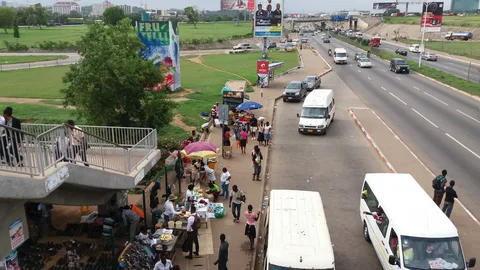
Street hawking, a common form of trading in Ghana, is drawing renewed public concern as its activities expand beyond the traditional sale of goods to include alleged involvement in illicit practices such as drug peddling.
Instead of selling within established market centres, hawkers move through streets and traffic intersections, offering goods directly to motorists and pedestrians.
Although trading is a legal means of livelihood in Ghana, hawking as practiced on busy streets has long been regarded as unacceptable by city authorities due to safety, sanitation, and traffic concerns.
Over the years, metropolitan authorities in major cities such as Accra and Kumasi have undertaken exercises to remove hawkers from busy roads and intersections.
These decongestion campaigns were intended to improve traffic flow and reduce risks associated with street trading.
As part of efforts to provide alternative trading spaces, the government constructed the Odawna Pedestrian Shopping Mall at Kwame Nkrumah Circle in Accra. The facility was intended to accommodate hawkers and informal traders who previously operated along the streets.
Authorities hoped the new market would encourage traders to relocate from roadways into safer and more organized spaces while eventually enabling them to operate under proper licensing systems.
However, many hawkers reportedly returned to the streets after a short period, with only a limited number choosing to remain at the facility.
Despite repeated government interventions, the number of street hawkers continues to increase across major intersections in Accra. Observers note that both adults and underage children are now involved in the practice.
Many hawkers operate along heavily congested roads, weaving through moving vehicles to sell goods balanced on their heads or carried in trays.
While the activity provides a source of income for many individuals facing economic hardship, road safety advocates warn that it exposes hawkers to significant risks, including road accidents.
Beyond safety concerns, some observers claim that certain hawkers may be using street trading as cover for illegal activities.
In some cases, hawkers appear to sell everyday items such as chewing gum, artefacts, walking sticks, or snacks. However, some witnesses suspect that transactions taking place between hawkers and drivers may involve the exchange of illicit substances.
Personal observation near the 37 Military Hospital area; a hawker approached a driver with artefacts but appeared to exchange a small black polythene package instead of any of the items on display.
The driver quickly concealed the item in the side door of the vehicle before instructing his mate to hand money to the trader.
Although such incidents are difficult to verify, concerns about hidden drug transactions on busy streets have been raised in past discussions about urban hawking.
In a 2013 article titled “Street Hawking, the Right to Survive and the Law,” published in the Daily Graphic, writer Zainabu Issah examined the motivations behind hawking and highlighted reports that some individuals involved in street trading engage in illegal sales alongside legitimate goods.
There are some female hawkers who combine street trading with sex work, particularly along busy transport corridors where commercial drivers frequently stop in traffic.
I have witnessed conversations between hawkers and drivers during traffic stops that appear to involve arrangements to meet later in the evening.
Along the Oyarifa-Accra highway, a water seller was heard negotiating a meeting location with a driver during a traffic stop at a signal intersection.
A separate incident at Ritz Junction in Madina allegedly involved a fruit seller and a commercial driver exchanging contact information before arranging to meet later.
Such incidents, while anecdotal, have fueled public debate about the hidden dimensions of street hawking and its potential social implications.
Public health advocates warn that the availability of drugs on the streets could contribute to the growing problem of substance abuse, particularly among young people.
Similarly, health experts often link unregulated sex work to increased risks of sexually transmitted infections, including HIV/AIDS, especially when protective measures are not consistently used.
Critics argue that the presence of such activities within the hawking environment complicates efforts to regulate the sector and protect both traders and the public.
Observers say addressing the issue requires a balanced approach that considers both economic realities and public safety concerns.
While many hawkers rely on the practice for survival, urban planners and policy analysts suggest that improved market infrastructure, stronger enforcement of city bylaws, and targeted social interventions could help reduce the risks associated with street trading.
As the debate continues, citizens and authorities alike face the challenge of ensuring that livelihoods are protected while also maintaining safe and orderly urban spaces.
Story by Dzomeku Calvin