

Fresh data from Global InfoAnalytics indicates a significant shift in Ghana’s political landscape, with declining affiliation for the New Patriotic Party and rising support for the National Democratic Congress.
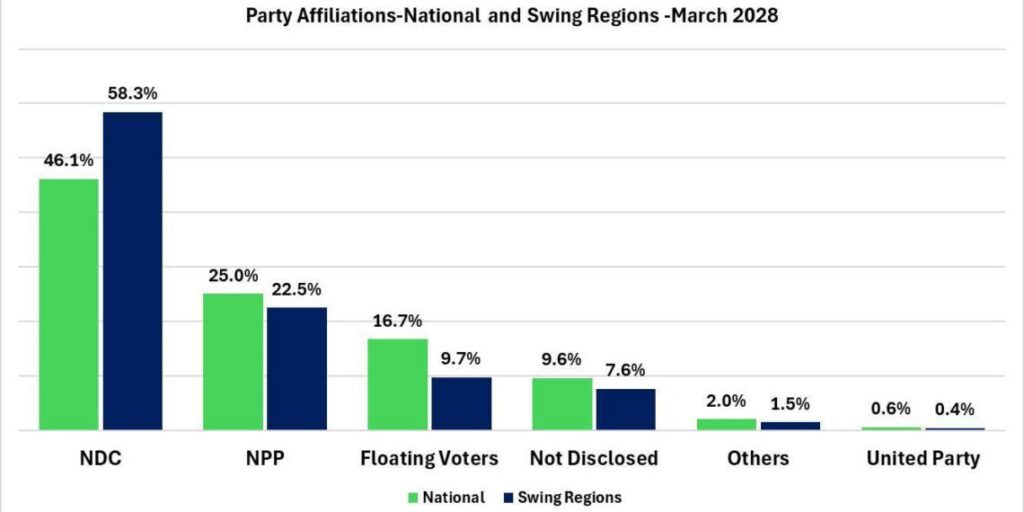
According to Executive Director Mussa Dankwa, an ongoing face to face tracking poll conducted in March 2026 shows that only 25 percent of voters now openly associate with the NPP, compared to 46 percent for the NDC.
This marks a notable change from the period before the 2024 general elections, when the NPP held 37 percent affiliation and the NDC stood at 33 percent.
The findings suggest a widening gap between the two dominant political parties, raising questions about voter sentiment and the evolving dynamics of Ghana’s democratic environment.
Swing Regions Show Strong NDC Advantage
The shift appears more pronounced in key battleground areas, particularly Greater Accra Region, Central Region, and Western Region. These regions, often decisive in national elections, show a strong tilt toward the NDC.
Data from the poll indicates that only 22 percent of respondents in these swing regions identify with the NPP, while a commanding 58 percent align with the NDC. This development underscores the scale of the challenge facing the opposition party as it seeks to rebuild its base and regain competitiveness.
Analysts note that voter behavior in these regions often reflects broader national trends, making the findings particularly significant for future electoral calculations.
Mussa Dankwa attributes part of the NPP’s declining support to recent political developments, including internal party processes and broader public controversies.
He pointed to issues following the party’s primaries and disputes within key economic sectors as factors contributing to what he described as a “hostile” political environment for the party.
“In the aftermath of NPP primaries, cocoa price issues and related concerns, the political environment still appears difficult for the opposition party.”
Despite these challenges, Mussa Dankwa emphasized that his analysis is intended to contribute constructively to democratic discourse rather than inflame partisan tensions.
Shifts Within Akan Dominated Regions
The poll also highlights changing patterns within traditionally influential voting blocs, particularly across Akan-dominated regions such as the Ashanti Region, Eastern Region, Western North Region, Bono Region, Bono East Region, and Ahafo Region.
Comparing data from December 2025 to March 2026, the NDC has made notable gains among voters in these areas. Its share increased from 34 percent to 41 percent, while the NPP recorded a marginal decline from 30 percent to 29 percent.
These regions have historically played a crucial role in shaping electoral outcomes, making any shifts in voter alignment particularly consequential. The data suggests that the NDC is consolidating support in areas where competition has traditionally been intense.
Decline in Floating Voters
One of the most significant trends identified in the poll is the movement of previously undecided or non aligned voters toward the NDC. According to Dankwa, a portion of floating voters and those who previously chose not to disclose their political preferences are now openly declaring support for the NDC.
This shift has contributed to the party’s expanding base and may reflect growing confidence among its supporters or changing perceptions about political alternatives.
The decline in undecided voters also suggests a more polarized political environment, where individuals are increasingly aligning with established parties rather than remaining neutral.
Implications for Ghana’s Political Landscape
The evolving data presents both opportunities and challenges for Ghana’s political actors. For the NDC, the upward trend in party affiliation signals momentum and a potential advantage in future electoral contests. For the NPP, the figures point to the need for strategic reassessment and renewed engagement with voters.
The party affiliation does not always translate directly into voting outcomes, but it remains a critical indicator of political sentiment and organizational strength.
The findings also reinforce the importance of addressing voter concerns, strengthening internal cohesion, and maintaining public trust in a competitive democratic system.
Mussa Dankwa reiterates that the purpose of releasing such data is to encourage informed debate and support democratic development. He stressed that polling insights should be used as a diagnostic tool to understand voter behavior and guide policy and political strategies.
“It is for God and country,” he remarked, underscoring his commitment to contributing to governance discussions through empirical evidence.
As Ghana continues to navigate its political and economic landscape, such data driven insights are expected to play an increasingly important role in shaping public discourse and policy direction.