

Integrating disaster risk governance into Ghana’s anti-illegal mining strategy
By Godson Bill Ocloo
Illegal mining, popularly known as galamsey, remains one of Ghana’s most pressing national challenges. Over the years, successive governments have introduced security operations, regulatory reforms, public education campaigns, and inter-agency interventions to curb the menace.
These efforts deserve recognition. Yet despite years of action, the problem continues to evolve.The reason is becoming increasingly clear: Ghana’s response has focused heavily on stopping illegal mining activities, but not sufficiently on managing the risks and disasters those activities create.
This is where an important national conversation must begin.Illegal mining is not only a law enforcement issue. It is not only an environmental issue. It is also a human security and disaster risk governance issue.Across many mining communities, the evidence is visible.
Abandoned pits have become death traps for children, farmers, and unsuspecting residents. Degraded lands have weakened local agriculture and increased poverty. Silted rivers and damaged drainage systems have heightened flood risks. Polluted water bodies threaten public health and livelihoods. Community tensions over land and resources continue to grow.These are not isolated side effects. They are structured risks with real human consequences.
Ghana’s mineral governance framework, under the Minerals and Mining Act, 2006 (Act 703), rightly places licensing and regulatory oversight within the Minerals Commission and the Environmental Protection Agency.
Security agencies also play a vital role in enforcing the law and protecting national assets. In recent years, technological responses have added new momentum. Systems such as National Intelligence and Monitoring Systems have helped identify hotspots, track activities, and improve intelligence for enforcement operations.
These interventions are important, but they remain incomplete. They address detection, enforcement, and regulation. They do not fully address the disaster risks already created on the ground, nor the vulnerabilities of communities living in affected areas.
This is why the role of the National Disaster Management Organisation must be elevated within Ghana’s anti-galamsey strategy.
Established under the National Disaster Management Organisation Act, 2016 (Act 927), the National Disaster Management Organisation is mandated to coordinate disaster prevention, preparedness, response, and recovery. This mandate naturally extends to hazards arising from illegal mining.In practical terms, NADMO can help Ghana move beyond enforcement to resilience.First, NADMO can lead risk mapping and hazard assessments in mining zones.
Using GIS tools, field intelligence, and inter-agency data, dangerous pits, unstable lands, flood-prone areas, and exposed settlements can be identified early.
Second, NADMO can coordinate targeted reclamation of abandoned pits and degraded sites in partnership with local authorities and technical agencies. Every reclaimed pit is a life potentially saved.
Third, NADMO can strengthen community preparedness and public awareness. Residents in mining areas need education on flood risks, land collapse, water contamination, and emergency response procedures.
Fourth, NADMO can play a central role in post-impact recovery, helping communities restore livelihoods, rebuild safer environments, and reduce repeated vulnerability.
Fifth, NADMO can serve as a bridge for whole-of-government coordination, linking enforcement agencies, regulators, district assemblies, traditional authorities, and civil society around a shared risk reduction agenda.
This is not about duplicating the work of other institutions. It is about completing the national system.No single agency can solve galamsey alone.
Enforcement without prevention creates cycles. Regulation without recovery leaves communities exposed. Intelligence without resilience only addresses part of the problem.
Ghana needs a smarter and more integrated framework. That framework should include stronger collaboration between National Disaster Management Organisation, the Minerals Commission, the Environmental Protection Agency, security agencies, MMDAs, and technology platforms such as National Intelligence and Monitoring Systems.
It should also mainstream disaster risk governance into Environmental Impact Assessments, district planning, reclamation programmes, and mining policy reviews.
The stakes are too high for a narrow approach. When rivers are poisoned, farms destroyed, pits left open, and floods worsened, the issue is no longer only illegal mining. It becomes national resilience, community safety, and sustainable development.
Ghana has shown determination in confronting galamsey. The next step is to deepen that strategy. The country must move beyond enforcement and embrace prevention, preparedness, recovery, and resilience.
That is where NADMO matters.Because the true victory against galamsey will not only be measured by excavators seized or arrests made. It will be measured by safer communities, restored ecosystems, protected livelihoods, and a future where development no longer comes at the cost of human security.
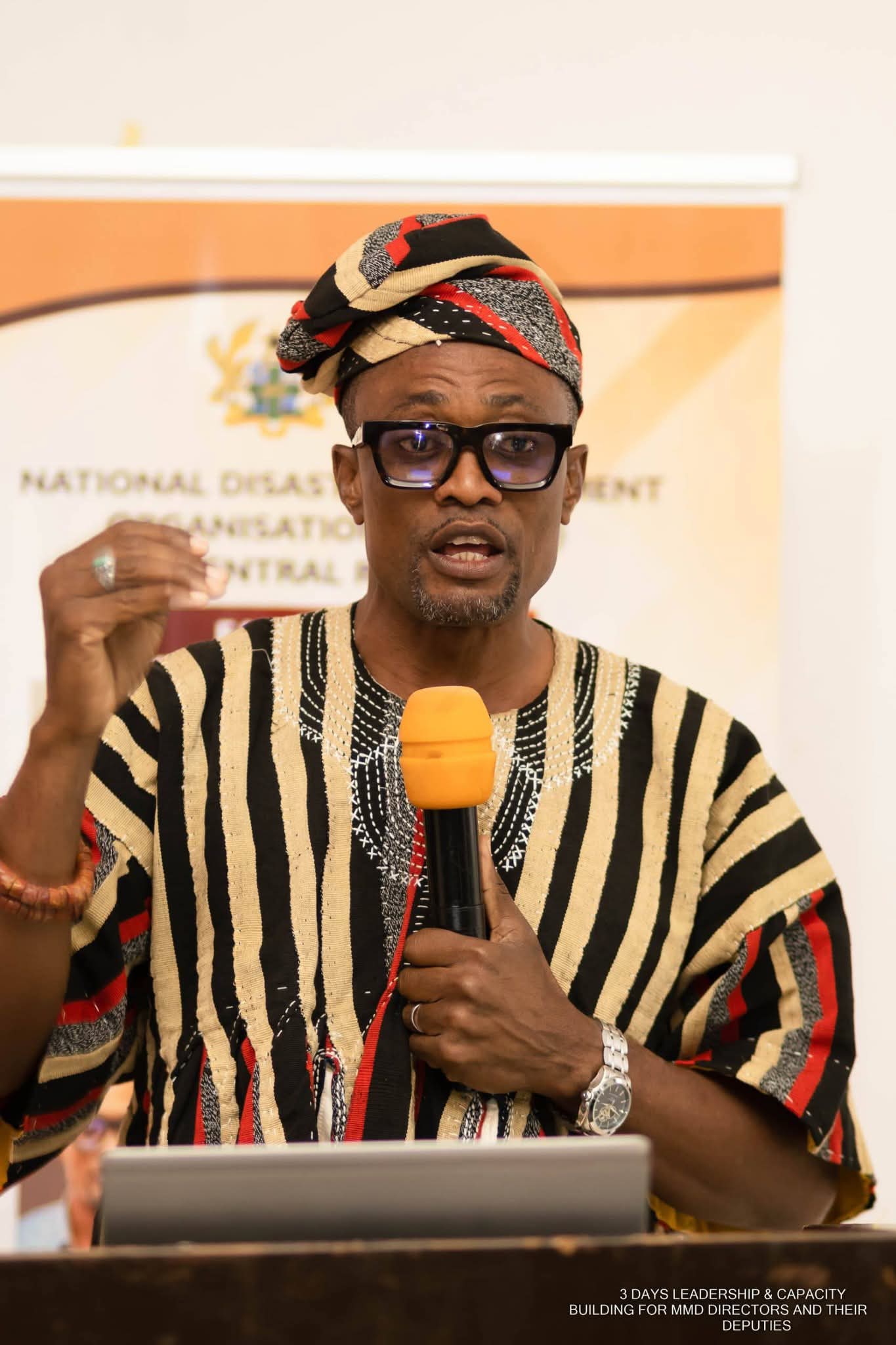
The writer is a Human Security Expert and Disaster Management Practitioner; Founder, Africa Centre for Human Security and Emergency Management (ACHSEM).