

By Gifty Boateng
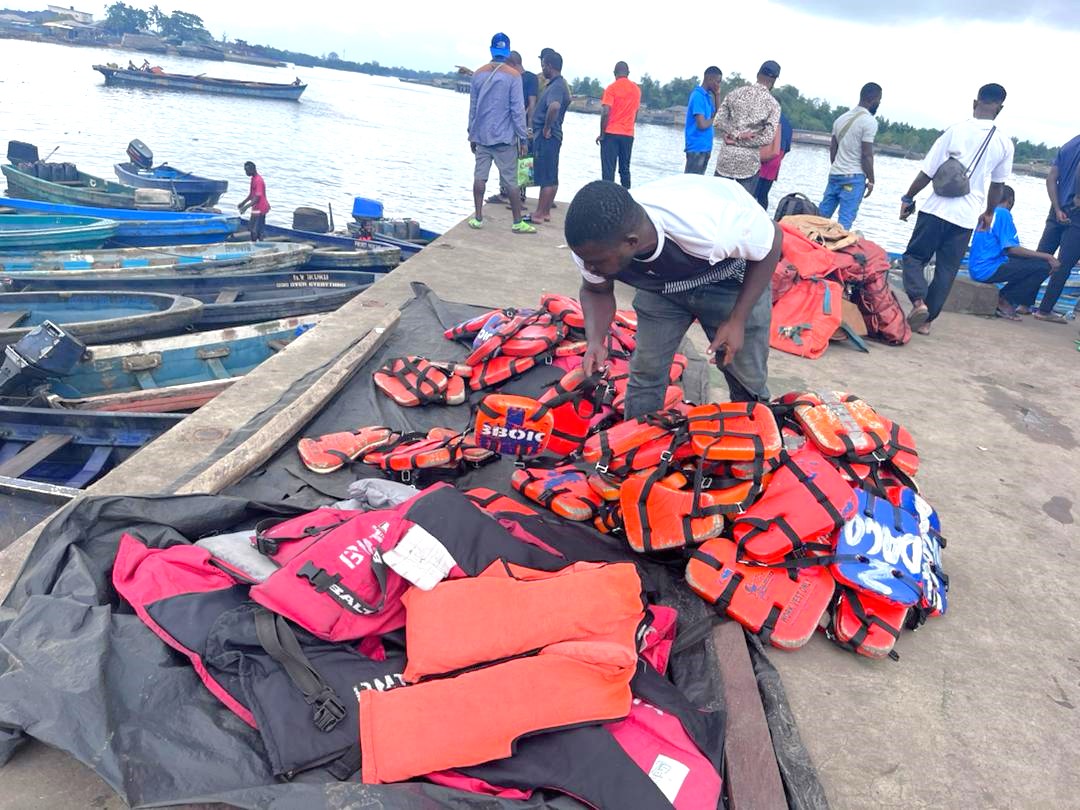
The Ghana Maritime Authority (GMA) has revealed it is readying itself to launch a project to make available thousands of life jackets to communities where boats, canoes and others are used as means of transportation and business.
The initiative which has been planned months back comes in the wake of the fatal boat accident on Volta Lake on Wednesday, April 9, 2026.
Seven people two women and five children have been confirmed dead, while five male passengers were rescued and taken for medical attention. Two others, a woman and a child, remain missing as search operations continue.
Preliminary findings indicate that severe weather conditions contributed to the accident, but authorities have also pointed to lapses in safety compliance, particularly the failure of passengers to wear life jackets.
The life jacket for safety and development project, will see the establishment of banks where these jackets will be kept for easy accessibility and usage.
The launch will be performed by President John Mahama with a total of 7, 000 of these life jackets given out at a reduced price and rental to passengers and operators.
Director-General of the GMA, Naval Captain Kamal Deen Ali, who disclosed this during a media encounter in Accra, said the initiative is aimed at helping curb accidents and ensure safety on the sea, rivers and lakes across the country.
He noted engagements have taken place to inform stakeholders enough life jackets for passengers and operators have been procured. At a cost of 2 cedis, one can have access to one for protection.
“Since coming to office we have engaged more and more on this and that is why we are leading to the life jacket at safety programme. The life jacket at safety programme that is going to be launched I am sure within 2 months by His Excellency the President. It is meant to first of all show from GMA and the government that the life jackets are available.
So in major centres across we will start putting life jacket banks and making them available. They are available to buy as an individual at a reduced price, they are available for you the operator to buy if you want to buy them and we expect you to buy them and we expect you to buy them”
Under the project authorities will make the jackets available to boat associations and engage operators, chiefs and assemblies by forming a Tripartite Committee to enforce compliance and prevent any push back.
“We are talking to the local assemblies and the boat operators and the chiefs in the areas. We are going to form a tripartite committee.
The life jacket are available for a rental for 2 cedis. If the boat operator doesn’t want to buy …. I have gone to certain places where some of the boat operators told us the challenges they have and that the jackets are not available to cross. Everyone must now be in line. I think that we will now have psychological right to enforce now because we cannot say that the life jackets are not available so that is something we are going to do”.
He stressed that the rental aspect has come in handy because during their engagements with operators, it emerged that sometimes an operator may carry as much as 60 passengers and may not have that number of jackets.
The DG was hopeful that, in the end “We would not be able to finally take away this issue but we hope that we will be attempting to solve the problem even if we are not able to eradicate all accidents”.
According to statistics, Ghana has close to 20, 000 boats in terms of inland and offshore stressing that “so that is substantial and we Ghana Maritime cannot be present everywhere just like the police are not present everywhere and we cannot be, that is impossible”.
Naval Captain Ali, also used the opportunity to shed light on the differences that exist between accidents on the sea and on land saying comparably there is a significant difference.
He said often, people become alarmed with accidents on the sea because it does not occur frequently unlike on the road but unfortunately when it comes to numbers, those on sea are insignificant regardless of the fact that every live is important.
“Let be assured that we have just about 2 percent of accidents that happen on land that happens at sea so that context is very important. Today in Ghana, we may have probably recorded 30 accidents on our roads so by the end of the year, Road Safety will tell us that consistently in the last 5 years that we have had nothing less than 2300 to 2500 and a maximum of 2700 accidents.
For every year, we have never gone beyond 30 accidents. So the boats accidents that we have are completely insignificant in number compared to what we have on land. The number of deaths that we record on land crashes also far far ahead. The maximum we have hit is about 40 in this country a year when it comes to boats accidents”, the DG explained.
Despite the insignificant numbers, the DG called for attitudinal change, intimating that over the years, the behavior of the Ghanaian when it comes to safety on the sea is the same culture exhibited by passengers and drivers on roads with respect to wearing seatbelts.
“It is just the same culture on land except that the nature of water is such that we see it more probably you go to the street now 70 percent of people are not on seat belts. If you go to our houses we play with basic safety issues from how we handle gas, to how we secure our homes. So safety culture is generally a big problem for all of us.
He also raised concern about how the boat business is viewed as artisanal which should not come under regulation or governed by rules. Contrary to this notion the D-G said the boat business is capital intensive and needs to be relooked.
“It is also because of the culture we have built over the years. We have also built a culture in this country that we see artisanal boats as things that should not be conforming and they have formed that attitude over the years. I am sure that most of us here don’t know or some of us here know that it doesn’t take anything less than 250, 000 to construct a boat.
So all the boats that you will find in Dambai, Kete Krachie, Kpando everywhere that you see them moving even the fishing boat that you see at James Town it doesn’t take less than 250, 000 to construct one. As a matter of fact when you see a fishing boat going to sea that is a business of not less than 1 million Ghana Cedis because it does not take less than GHc400, 000 to also have the net to go to sea to go to fish”.
He added “Yet somehow we have built a culture in this country where boat and boat operators are seen as subsistence, are seen as poor people in the minds of people and because of that we have had a culture of non-governance, a culture of reinforcing that in many ways from free premix fuel, to giving them free outboard motors, so it has made that industry very difficult to govern because psychologically they see themselves as people that are treated with kid gloves.
He did not understand why a boat operator is able to spend about GHc300, 000 to construct a boat and yet will not be prepared to have 10 life jackets on it.