

By Leo Nelson
Ghanaians Must Insist on Independent Public Prosecutor – Coalition of CSOs Must Insist on Independent Public Prosecutor – Coalition of CSOs
A coalition of Civil Society Organizations (CSOs) has called on Ghanaians to demand the establishment of an independent public prosecutor to strengthen the fight against corruption.
The groups expressed concern over recent legal developments affecting the Office of the Special Prosecutor, warning that the situation could undermine ongoing anti-corruption efforts.
The coalition noted that actions taken in court and by the Attorney General’s office have raised serious constitutional and institutional questions. They emphasized that these developments have immediate implications for the prosecution of corruption-related cases, potentially weakening accountability mechanisms in the country.
Court Decisions and Legal Disputes
The concerns follow a series of legal actions, including a case filed at the Supreme Court challenging aspects of the law that established the Office of the Special Prosecutor. The coalition pointed to a High Court ruling that declared the office’s prosecutorial powers unlawful without authorization from the Attorney General.
According to the groups, the ruling also directed that all cases being handled by the Special Prosecutor be taken over by the Attorney General and declared previous prosecutions invalid. They described the decision as far reaching, with significant consequences for ongoing cases.
The coalition further noted that the Special Prosecutor has indicated its intention to pursue legal remedies, citing conflicting decisions from different courts on similar matters. This, they said, highlights the complexity of the issue and the need for clarity at the highest judicial level.
Longstanding Demand for Independent Prosecution
The Civil Society Organizations argued that the demand for an independent public prosecutor is not new. They stated that for more than two decades, Ghanaians have consistently called for a prosecutorial system that is independent of political influence.
They explained that the current arrangement, where prosecutorial authority is largely vested in the Attorney General, creates potential conflicts of interest. As a political appointee, the Attorney General may face challenges in prosecuting members of the same government, particularly high level officials.
The coalition noted that past experience has often seen corruption prosecutions focus on officials from previous administrations, raising concerns about selective justice.
The groups defended the legal foundation of the Office of the Special Prosecutor, arguing that it was established in line with Ghana’s Constitution. They stated that the law creating the office drew authority from constitutional provisions that allow for delegation of prosecutorial powers.
They also highlighted that similar arrangements exist in other agencies where prosecutorial authority is exercised under delegated powers. Based on this, they rejected claims that the establishment of the Special Prosecutor is unconstitutional.
“We have therefore authorized Merton and Everett LLP, our lawyers, to apply to the Supreme Court as Amicus to enable us to submit a brief in support of the constitutionality of Act 959.”
While defending the current framework, the coalition also emphasized the need for long term reforms. They called for the entrenchment of an independent public prosecutor in the Constitution to remove any ambiguity about its authority.
They pointed to recommendations made by past constitutional review processes, which proposed strengthening anti corruption institutions through constitutional backing. According to them, this presents an opportunity for Ghana to fully implement reforms that have been under discussion for years.
They stressed that such reforms would align Ghana with its international obligations under conventions aimed at combating corruption and promoting transparency.
The coalition expressed concern that the recent developments have created uncertainty and eroded public confidence in the state’s commitment to fighting corruption. They warned that the inability to prosecute ongoing cases could have serious consequences for governance and public trust.
They also referenced estimates suggesting that corruption costs Ghana billions of dollars annually, underscoring the urgency of maintaining strong accountability institutions. According to them, weakening these institutions would reverse progress made over the years.
The groups urged political leaders and public officials to act in the national interest and avoid actions that could undermine anti corruption efforts.
Call to Citizen Action
Organizations called on citizens to remain vigilant and actively demand accountability from those in power. They emphasized that public engagement is essential in shaping policies that promote transparency and good governance.
They urged Ghanaians to support efforts aimed at strengthening institutions and ensuring that corruption is addressed effectively. According to them, the fight against corruption requires collective responsibility and sustained commitment from all stakeholders.
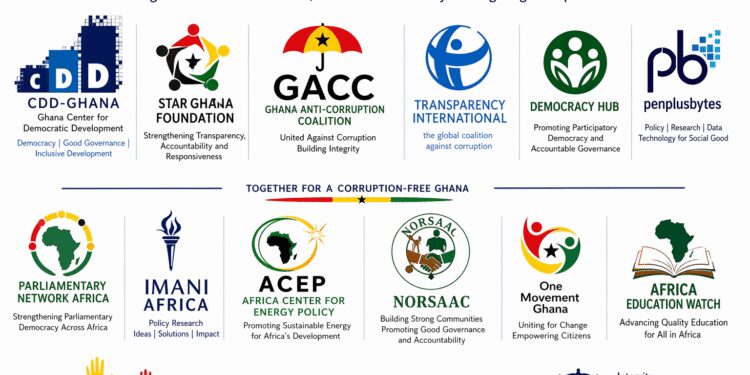
The coalition reaffirmed its dedication to promoting integrity, transparency, and accountability in public life. The statement was endorsed by several organizations, including Ghana Center for Democratic Development (CDD-Ghana), STAR Ghana Foundation, Ghana Anti-Corruption Coalition (GACC), Transparency International, Democracy Hub and Penplusbytes
Others include the Parliamentary Network Africa, IMANI Africa, Africa Center for Energy Policy (ACEP), NORSAAC, One Movement Ghana and Africa Education Watch.
They concluded that the current moment presents a critical opportunity for Ghana to strengthen its anti corruption framework and ensure that institutions tasked with enforcing accountability are protected and empowered.