

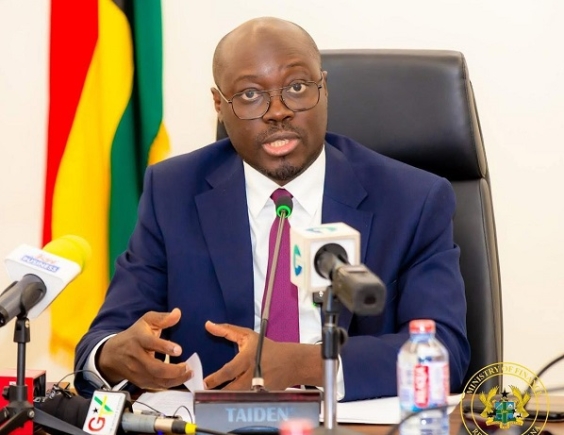
By Lawrence Odoom/Phalonzy
Allegations leveled by Kwesi Kwarteng that Finance Minister Dr. Cassiel Ato Forson is sabotaging Ghana’s education sector have imploded under the scrutiny of verifiable fiscal data enshrined in the 2026 national budget. The group Youth for Resetting Agenda contends that a forensic appraisal of recent disbursements exposes not sabotage, but a calculated renaissance , a sector galvanized by unprecedented investment, surgical reforms, and uncompromising political will.
“What we are witnessing is not decline; it is deliberate reconstruction. The ledger has spoken, and it exonerates Ato Forson of every accusation,” Eric Tachie a spokesperson for Youth for Resetting Agenda declared.
The 2026 fiscal blueprint articulates an unambiguous commitment. The Ministry of Education has been assigned a historic GH¢33.3 billion, fortified by an additional GH¢9.9 billion from GETFund. These are not ornamental figures. On April 20, 2026, GETFund liquidated GH¢199.47 million in arrears for perishable food supplies under the Free SHS and TVET programmes, cementing operational stability and preserving nutritional lifelines for thousands of students.
“These releases are not projections on paper; they are liquidity in the system, food in dining halls, and continuity in classrooms,” a senior Finance Ministry official asserted. “To call this sabotage is to divorce language from meaning.”
Under Hon. Ato Forson’s stewardship, the “No Fees Stress” policy designed to annihilate financial barriers for first-year tertiary students has migrated from pledge to performance. By March 2026, the Students Loan Trust Fund had validated data for 160,735 students, with the Finance Ministry deploying the requisite liquidity to ensure seamless disbursement of academic fees.
Teacher training has experienced a parallel revival. A dedicated GH¢207.8 million has been ring-fenced for Teacher Trainee Allowances, with corroborated reports confirming that all legacy arrears have been extinguished under Ato Forson’s tenure.
“We inherited arrears that demoralized trainees. Today, those debts are history. That is not sabotage; that is stewardship,” a Finance Ministry source affirmed.
At the foundational level, the evidence is irrefutable. GH¢157 million has been earmarked for the Capitation Grant, emancipating schools from the stranglehold of unpaid obligations. Concurrently, GH¢1.98 billion has been committed to the School Feeding Programme, underwriting an upward revision in the per-child grant that directly amplifies nutrition and attendance.
“The evidence is on the plates of our wards,”_ an education stakeholder remarked. “Unprecedented food abundance and the massive extension of school feeding to institutions previously neglected under the administration Mr. Kwarteng served as PRO , that is the passionate commitment of this Finance Ministry.”
The indictment of the facts is searing: Can Mr. Kwarteng cite any epoch during his tenure as PRO when capitation grants were disbursed with this velocity and fidelity? Why the studious silence when arrears asphyxiated schools and teachers, yet thunderous condemnation now that those very debts are being erased?
“If clearing arrears, expanding feeding, and financing 160,000 tertiary students constitutes sabotage, then we must urgently redefine the term,” a policy analyst observed. “What we have is not destruction, but decisive restitution.”
The verdict of the data is unequivocal. The education sector is not being undermined. It is being rebuilt, refinanced, and reinforced. Under Ato Forson, the architecture of recovery is not rhetorical, it is fiscal, functional, and formidable.
In the contest between propaganda and proof, the ledger does not lie. Facts, not tantrums, are fortifying Ghana’s classrooms.