

By Leo Nelson
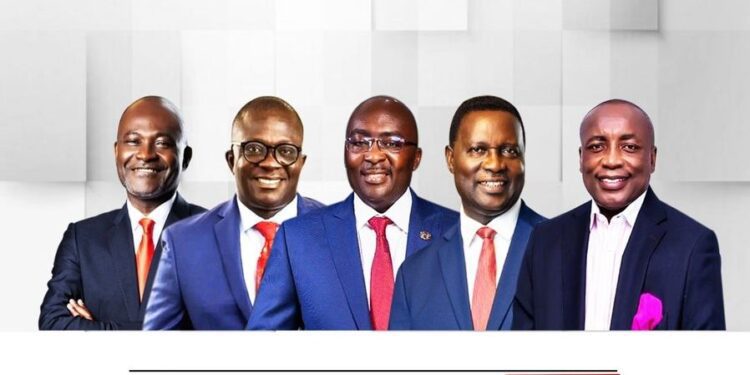
In a strategic move aimed at promoting unity within its rank and file, Flagbearer of the New Patriotic Party (NPP), Dr Mahamudu Bawumia, has appointed all four of his former presidential primary rivals as co-chairpersons of newly established policy committees within the party ahead of the 2028 general elections.
The appointments, announced on May 8, 2026, are being viewed by political analysts as a strategic move aimed at promoting unity within the NPP while consolidating support bases across the party following the presidential primaries.
According to a statement issued by the Bawumia Campaign on Facebook, the newly constituted committees are expected to help the party develop “clear, costed, and credible” policy alternatives capable of positioning the NPP strongly ahead of the next election cycle.
“Dr. Bawumia wants a party that does not just criticise. He wants a party that can present Ghanaians with a clear, costed, and credible alternative at any point in time.”
The committees are expected to conduct independent research, engage stakeholders, and formulate policy proposals across key sectors of the economy and governance.
Former Rivals Assigned Key Roles
Under the new arrangement, former presidential aspirants who contested Dr. Bawumia during the NPP flagbearership race have each been assigned leadership responsibilities within major policy sectors.
The former MP for Assin Central, Kennedy Ohene Agyapong, has been appointed Co-Chair of the Employment and Jobs Policy Committee, a sector expected to focus on youth employment, enterprise development, and economic opportunities.
The MP for Abetifi and former Minister of Agriculture, Bryan Acheampong, will serve as Co-Chair of the Defence and Interior Policy Committee, where attention is expected to focus on national security, policing, and internal governance issues.
Former Education and MP for Bosomtwe Minister Yaw Osei Adutwum has been named Co-Chair of the Education Policy Committee, while former NPP General Secretary Kwabena Agyei Agyepong will co-chair the Housing and Urban Development Policy Committee.
Political analysts say the appointments are significant because they integrate some of the party’s most influential figures into a unified political structure following what was considered a competitive internal contest. The move could help reduce internal tensions while strengthening collaboration ahead of the 2028 elections.
Kojo Oppong Nkrumah to Lead Overall Structure
The NPP has also appointed Kojo Oppong Nkrumah to chair the overall NPP Policy Committee at the apex of the newly established structure. According to the party, the committee will coordinate policy development across all thematic areas and ensure coherence in the NPP’s policy direction.
Kwasi Nyame Baafi has also been appointed Secretary to the committee and is expected to provide administrative coordination and policy support.
The party says the committee structure is intended to strengthen intellectual engagement within the NPP while producing practical policy alternatives across sectors including healthcare, energy, education, infrastructure, and the economy.
Analysts say the creation of specialized committees reflects increasing efforts by political parties to strengthen policy based campaigns rather than relying solely on political rhetoric.
Focus on Research and Policy Alternatives
According to the Bawumia Campaign, the policy committees will undertake independent research and stakeholder consultations to help the NPP develop evidence-based proposals.
The committees are expected to produce what party officials describe as costed and credible alternatives capable of addressing Ghana’s current economic and social challenges.
Political analysts note that the approach may help the opposition party sharpen its policy positioning as it seeks to regain political momentum ahead of the 2028 elections.
The committees are also expected to engage professionals, industry players, academics, and civil society organizations as part of broader consultations on national development priorities.
Analysts say the emphasis on data driven policy proposals may become increasingly important as voters continue demanding more detailed economic and governance solutions from political parties.
Unity Ahead of 2028 Elections
The appointments are being interpreted by many within political circles as part of broader efforts by Dr. Bawumia to maintain cohesion within the NPP after the presidential primary contest.
By assigning prominent roles to former rivals, the NPP leadership appears to be signaling an intention to bring together different factions and support bases under a common political agenda.
Political commentators say this strategy could help strengthen grassroots mobilization while preventing internal divisions from affecting the party’s preparations toward the next elections.
The inclusion of influential personalities such as Kennedy Agyapong and Bryan Acheampong is also expected to broaden the appeal and reach of the party’s policy engagement efforts. The policy committees may eventually shape the core ideas and proposals that will define the NPP’s future campaign strategy.
Party Seeks Policy Driven Opposition Role
The Bawumia Campaign stressed that the objective of the new structure is not simply to criticize the government but to offer practical and implementable policy alternatives to Ghanaians.
Political analysts say the statement reflects an attempt by the NPP to reposition itself as a policy focused opposition party capable of offering detailed governance alternatives.
With the 2028 elections still several years away, the establishment of the committees suggests the NPP is already beginning long term strategic preparations aimed at rebuilding public confidence and consolidating internal unity.