

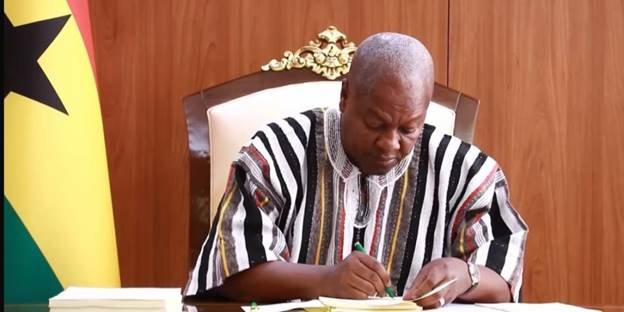
President John Dramani Mahama has assented to 10 Bills passed by Parliament during the Second Meeting of the Second Session of the Ninth Parliament, giving legal effect to a series of legislative reforms covering taxation, revenue mobilisation, justice administration, national defence, maritime regulation and the cocoa sector.
The Bills were among 12 pieces of legislation approved by Parliament during the meeting, which ended on July 31, 2026.
The President’s assent formally transforms the approved Bills into laws, paving the way for the relevant institutions and agencies to begin implementing their provisions.
The newly enacted laws are the Customs Act, 2026; Community Service Act, 2026; Tribunals Act, 2026; Maritime and Related Offences Act, 2026; National Defence University, Ghana Act, 2026; Income Tax (Amendment) Act, 2026; Energy Sector Levies (Amendment) Act, 2026; Ghana Cocoa Board Act, 2026; Value Added Tax (Amendment) Act, 2026; and Excise Act, 2026.
The legislation covers several key areas of national development and is expected to impact government revenue, taxation, trade, justice delivery, national security and the regulation of important economic activities.
Four of the newly enacted laws are particularly significant to Ghana’s revenue mobilisation efforts.
The Income Tax (Amendment) Act, 2026, Value Added Tax (Amendment) Act, 2026, Excise Act, 2026, and Energy Sector Levies (Amendment) Act, 2026 are expected to shape the country’s approach to taxation and revenue collection.
The measures form part of broader efforts to strengthen domestic revenue mobilisation and improve the efficiency of Ghana’s tax system.
Boost for justice delivery
The Tribunals Act, 2026 is also expected to play an important role in the administration of justice by providing a structured framework for the operation of tribunals and helping to improve the efficiency of dispute resolution.
The Community Service Act, 2026 is similarly expected to introduce a more structured approach to community-based sentences, potentially easing pressure on the prison system while providing alternative forms of punishment for eligible offenders.
Other legislation, including the Maritime and Related Offences Act, 2026, seeks to strengthen the legal framework governing offences within Ghana’s maritime space.
Meanwhile, the National Defence University, Ghana Act, 2026 provides a legislative basis for the establishment and operation of the institution, with implications for professional military education and national security.
The Ghana Cocoa Board Act, 2026 introduces a new legislative framework for the operations and regulation of the country’s cocoa sector, one of Ghana’s major economic pillars.
The Customs Act, 2026 is also expected to strengthen the legal framework governing customs administration, trade facilitation and revenue collection at Ghana’s borders.
With the President’s assent, the 10 Bills have now become law, marking another significant step in the implementation of the government’s legislative and economic reform agenda.