

By Lawrence Odoom
Technical students, industry leaders, and policymakers converged at the Ghana Union of Technical Students’ Exhibition Conference with a resounding call to transform technical training into tangible innovation and sustainable livelihoods. Held under the theme “From Skills to Solutions: Driving Innovation and Sustainable Livelihoods Through TVET,” the event showcased student projects while framing TVET as the engine room of Ghana’s industrial future.
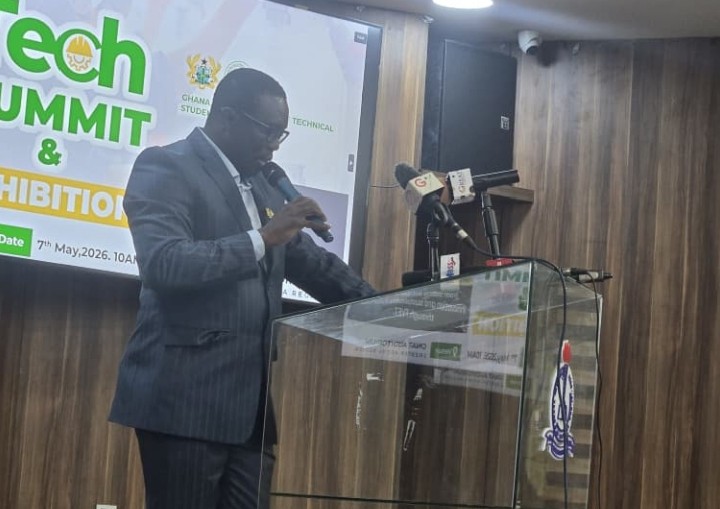
Delivering the keynote address, Dr. Patrick Essien declared that Ghana’s development would not rest on theory alone.
“The future does not belong only to those who hold certificates; it belongs to those who can solve problems, create value, and build solutions,” Dr. Essien said, urging students to see themselves as national assets rather than job seekers.
Dr. Essien challenged long-held misconceptions about Technical and Vocational Education and Training, asserting that TVET is not a second option but a first-class driver of industrial growth, entrepreneurship, and national transformation.
“A nation that ignores technical skills cannot industrialize. Every developed country we admire today was built on the foundation of practical skills, disciplined workmanship, and continuous innovation,” he noted.
Linking Ghana’s abundant natural resources to the need for skilled human capital, Dr. Essien stressed that wealth is created not by raw materials alone, but by the engineers, fabricators, food technologists, and technicians who convert them into value.
“Gold in the ground does not automatically create prosperity. It takes skilled hands and disciplined training to turn mineral resources into prosperity. Cocoa beans alone do not make Ghana rich; it takes processing, branding, and innovation to unlock their value,” he emphasized.
He positioned TVET as the bridge between raw potential and real prosperity, calling on students to move from “knowing to doing” and from “waiting for jobs to creating jobs.” Students were urged to embrace entrepreneurship, digital tools, and business acumen alongside technical competence.
“Your technical skill is powerful, but when you combine it with entrepreneurship, leadership, teamwork, and integrity, you become unstoppable,” Dr. Essien told the exhibitors.
Industry and government were also called to deepen their partnership with TVET institutions through internships, mentorship, equipment support, and sustained investment in modern training infrastructure. Parents and society were urged to accord technical education the respect it deserves, moving beyond the fixation on office jobs.
“The dignity of work is not in the title one carries, but in the value one creates,” he said.
Concluding the address, Dr. Essien described the exhibition as more than a display of projects—it was a glimpse of Ghana’s future manufacturing sector and the birthplace of the next generation of engineers, inventors, and entrepreneurs.
“May we move from learning to producing, from certificates to competence, and from raw materials to finished products. May TVET become the practical engine that drives innovation, sustainable livelihoods, and the economic transformation of Ghana,” he concluded.
The conference featured exhibitions across welding, electrical installation, fashion design, catering, ICT, and robotics, with students demonstrating prototypes aimed at solving real-world challenges in agriculture, health, energy, and manufacturing.