

By Lawrence Odoom
President John Dramani Mahama has affirmed that Ghana’s diplomatic relations with South Africa remain intact despite a fresh wave of xenophobic violence that has compelled the voluntary evacuation of Ghanaian nationals.
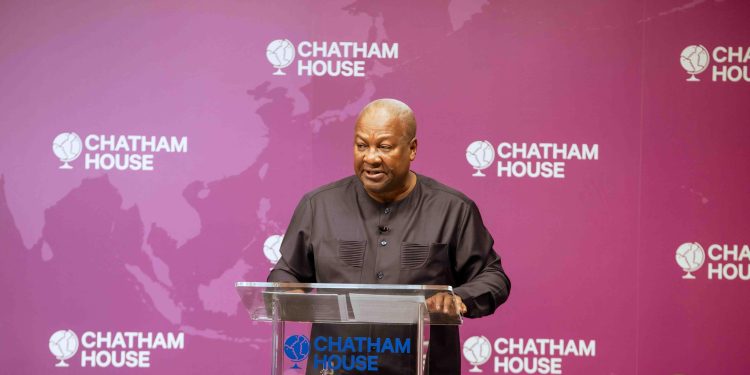
Speaking at Chatham House, the renowned policy institute in London, during his official visit to the United Kingdom, President Mahama decried the attacks as regrettable and voiced deep concern over the escalating hostility toward African migrants.
He stressed that despite recurrent spasms of anti-foreign violence in South Africa, bilateral relations between Accra and Pretoria had not fractured.
“We do not have any breach in our diplomatic relations,” he said, adding that such attacks were not new in South Africa.
“They say we shouldn’t call it xenophobia. I don’t know what else you can call it, but there have been surges in anti-foreign attacks.”
The President observed that while earlier outbreaks had predominantly targeted nationals from Mozambique, Malawi, Zimbabwe and Nigeria, Ghanaians have now been drawn into the crosshairs.
“Lately, Ghanaians have gotten involved. This is the first time we’ve really had Ghanaians getting part of the direction of attacks,” he said.
President Mahama explained that deteriorating security conditions and systematic assaults on foreign-owned enterprises necessitated government-organized evacuations for endangered citizens.
He noted that many Ghanaians in South Africa were self-reliant entrepreneurs engaged in skilled vocations , barbering, hairdressing, beauty services and other micro-enterprises.
According to him, during the unrest, foreign-owned shops were forcibly shuttered while migrants lived in apprehension, reluctant to move freely for fear of identification and assault.
He also referenced distressing accounts of medical discrimination.
“And if you were not South African, you were asked to leave the hospital. Even if you were ill, it created a very toxic atmosphere,” he said.
President Mahama added that displaced Ghanaians from Durban and surrounding areas sought sanctuary at Ghana’s High Commission in Pretoria, with nearly 200 nationals sheltering at the mission at the height of the crisis.
He said the decision to initiate evacuations was prompted by mounting safety concerns and what he described as an inadequate response from South African authorities.
“It didn’t look like the South African authorities were doing anything to try to quell what was happening and also to provide protection,” he said.
He confirmed that evacuation flights had commenced, with additional airlifts scheduled for Ghanaians who opted to return home voluntarily.
“We asked, do you want to stay or you want to leave? And many of them said they feel threatened, so they want to leave,” he added.