

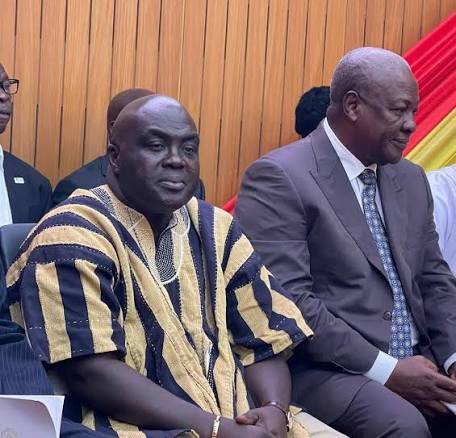
John Dramani & Julius Debrah-An Unyielding Compact for National Renewal Through Coordinated Execution
President John Dramani Mahama’s audacious blueprint to recalibrate the country and inaugurate a new chapter of progress has received resounding ratification from the apex of the Presidency.
Chief of Staff Julius Debrah has declared, with granite conviction, his absolute fealty to the President’s agenda of transformation.
In an epoch that demands decisive stewardship and seamless institutional alignment, Mr. Debrah stands as the linchpin of governmental cohesion. His focus is undiluted, his resolve unshaken, as the chief engineer of administrative synchrony. His mandate is crystalline thus to harmonize every organ of state, to accelerate delivery, and to transmute presidential vision into measurable, citizen-centered outcomes.
“Neither detour, nor disruption, nor dilution of purpose will be tolerated,” confidants of the Chief of Staff aver. “His disposition is one of constant vigilance – poised to direct, galvanize, and implement every strategic directive with forensic precision and bureaucratic exactitude.”
The convergence of Mahama’s doctrine of reset and Debrah’s custodianship signals an administration calibrated for performance. It is an alliance anchored on strategic symmetry: the President sets the cardinal direction for national rebirth, while the Chief of Staff engineers the institutional machinery to propel it forward.
This cohesion amplifies public trust. It broadcasts to Ghanaians and to the global community that governance under this dispensation will be adjudged not by ornate pronouncements, but by disciplined execution, integrated delivery, and an inexorable march toward development.
Undeniably, as the country embarks upon this season of renewal and repositioning, the signal from the Jubilee House is unambiguous , the command is united, the objective is defined, and the apparatus of state is primed for productivity.
Ghana’s advancement is no longer an aspiration postponed. It is a mandate already in motion.
By Lawrence Odoom