

By Lawrence Odoom
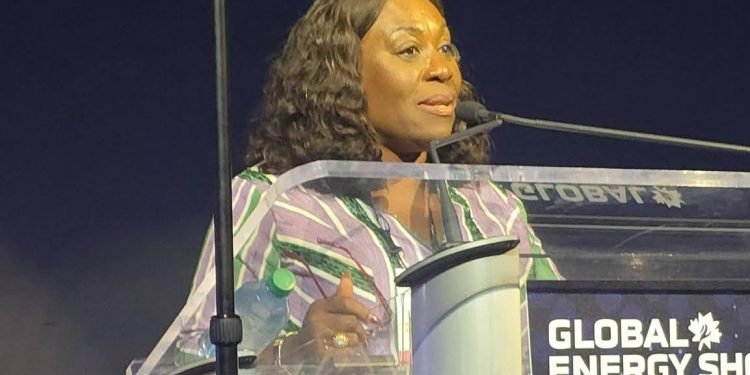
Chief Executive Officer of Ghana National Gas Company Limited, Judith Adjobah Blay, has projected Ghana’s burgeoning investment appeal in the natural gas sector to a global audience of investors and industry leaders at the ongoing Global Energy Show in Calgary, Canada.
Addressing one of the world’s foremost energy conclaves, Ms. Blay spotlighted Ghana Gas’ instrumental role in fortifying the nation’s energy security, catalyzing economic expansion, and advancing regional energy integration. She unveiled strategic initiatives and lucrative investment prospects that firmly position Ghana as an ascendant energy nexus in West Africa and across the continent.
Ms. Blay noted that Ghana Gas manages the country’s principal midstream infrastructure, overseeing the gathering, processing, and transmission of natural gas to power plants and industrial centers.
According to her, the company supplies approximately 84 percent of the fuel consumed by thermal power plants, which constitute at least 60 percent of Ghana’s electricity generation matrix. This intervention yields an estimated annual fuel cost saving of about US$1.3 billion, complemented by an additional US$60 million saved through Liquefied Petroleum Gas (LPG) supply.
She further elaborated that the Gas Processing Plant, built by SINOPEC in collaboration with Canada’s Thermo Design Engineering Ltd. (TDE), also produces condensate, or naphtha, used as a blend stock for premix fuel in the fisheries sector. This innovation, she said, has driven down premix fuel costs and slashed government subsidy outlays by more than 60 percent.
On regional energy integration, Ms. Blay underscored Ghana Gas’ strategic alliance with the West African Gas Pipeline Company (WAGP).
Through an interconnection at Takoradi, Ghana’s gas supply hub, the partnership enables reverse gas flow to Tema, the nation’s dominant industrial and thermal power generation enclave.
She explained that the successful integration of Ghana Gas’ infrastructure with the West African Gas Pipeline in 2018 enabled bidirectional transmission, transitioning Ghana from a terminal gas-importing state to a pivotal player in the regional gas transmission architecture.
Beyond WAGP, Ms. Blay revealed that Ghana Gas is also a stakeholder in the proposed African Atlantic Gas Pipeline Project, envisioned to link Nigeria and Morocco with several African nations, including Ghana. Under this grand initiative, Ghana Gas will provide pipeline interconnections and compression stations, unlocking substantial investment opportunities while deepening Africa-Europe energy trade.
The Ghana Gas CEO emphasized that Liquefied Natural Gas (LNG) remains pivotal to Ghana’s long-term energy security blueprint.
She stated that future LNG investments will be anchored on commercial viability, affordability, and the imperative of preserving stable electricity tariffs. Ghana, she noted, has already deployed LNG regasification infrastructure and terminal facilities and stands ready to receive LNG imports when market dynamics become economically advantageous, particularly on pricing and payment terms.
Highlighting the next phase of growth, Ms. Blay invited investors to partner on Ghana Gas’ ambitious expansion portfolio.
Key projects include the construction of a Second Gas Processing Plant (GPP II), a 300-kilometre onshore gas transmission pipeline, and the Pentane Monetization Project.
She observed that while the existing Gas Processing Plant has ably served national demand, escalating consumption necessitates expanded processing capacity. The proposed onshore pipeline, she added, will interconnect major industrial zones and resource corridors, further consolidating Ghana’s energy infrastructure.
She also announced that, in contrast to conventional facilities where pentane is flared, Ghana Gas is resolutely eliminating hydrocarbon flaring through advanced stabilization and conditioning technology. This initiative, she said, will convert volatile hydrocarbons into safe, commercially viable products, representing a transformative leap aligned with the company’s Environmental, Social and Governance (ESG) commitments.
Ms. Blay expressed unwavering confidence in Ghana’s investment climate, citing robust legal frameworks, an independent judiciary, a competitive deregulated market, and political stability. She stressed that Ghana’s strategic geographic positioning makes it an ideal transit and aggregation hub within the regional gas value chain, with property rights firmly protected and zero expropriation risk.
Concluding her address, Ms. Blay reaffirmed Ghana Gas’ dedication to powering Ghana’s energy security, industrialization, and regional energy transformation.
“Ghana Gas is committed to creating value for investors while advancing Ghana’s energy security and strengthening regional energy integration across West Africa,” she declared