

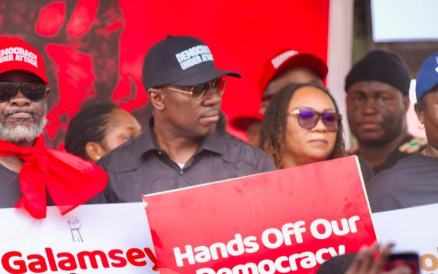
Minority Leader Alexander Afenyo-Markin has called for an end to what he describes as selective justice and political retaliation, insisting that the opposition is not against accountability but opposed to the unequal application of the law.
Speaking at the “Democracy Under Attack” demonstration on Thursday, August 6, Afenyo-Markin argued that Members of Parliament are being subjected to investigations after making contributions on the floor of Parliament.
“We are not against accountability, but we are against selective justice,” he said.
He claimed that an MP makes a contribution on the floor of Parliament and is subsequently invited by investigative agencies, questioning what he described as the selective application of the law.
He also referred to concerns raised by some members of the governing National Democratic Congress (NDC) over the conditions under which suspects are held.
According to him, former Minority Leader Haruna Iddrisu has complained on the floor of Parliament about what he described as unlawful conditions, while Interior Minister Muntaka Mohammed-Mubarak has also raised concerns on the matter.
Afenyo-Markin maintained that the opposition is merely expressing its views on the way the country is being governed and stressed that criticism of government should not be met with intimidation.
He urged political leaders to end what he called the “you do me, I do you” approach to politics, saying Ghana’s democracy would only thrive if successive governments resisted the temptation to target political opponents.
“As a country, we must end this vicious cycle of ‘you do me, I do you.’ I’ve been talking about this for quite some time now,” he said.
The Minority Leader said his position was not influenced by the fact that members of his party were currently affected but by his long-held belief that politics should be conducted with decency and mutual respect.
“I don’t say this because it is my people who are going through this situation. I say this because all my life I’ve believed that we can do politics in a very decent way. I believe in that decent approach to politics.”
He further urged politicians to shift their attention from partisan disputes to addressing the country’s development challenges.
“If you leave Accra and go deep into the hinterlands, you see the serious underdevelopment in our country. That should be what should occupy our minds as political leaders,” he said.
Afenyo-Markin warned that if the alleged cycle of political persecution continues, it could make it difficult for moderate voices within the New Patriotic Party (NPP) to restrain more hardline elements when the party returns to power.
“For me, if they don’t stop, it will be difficult for the moderates in the NPP to calm the nerves of the extremists when the NPP comes to office tomorrow. But is that what we want as a country? No. That’s not what we want.”
He concluded by stressing that the demonstration was not against Ghana but a call for fairness, justice and the protection of democratic principles.