

By Prince Ahenkorah
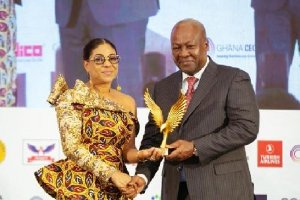
The exchange lasted barely ten seconds. At the Ghana CEO Summit in May, President John Dramani Mahama spotted Angela List, the embattled chief executive of Adamus Resources, and asked: “Ohh Angie, how are your troubles? Have you been sorted?” Her response was a shake of the head. “Find time and let’s talk,” the President replied.
For the mining executive, the unsolicited acknowledgment from the nation’s highest office was a lifeline and for Ghana’s mining sector, a revealing signal.
Officially, the Ministry of Lands and Natural Resources, backed by the Minerals Commission, is still prosecuting the case against Adamus Resources. Unofficially, President Mahama is now personally offering to broker a solution.
List’s “troubles” are not minor. In April 2026, Lands Minister Emmanuel Armah-Kofi Buah revoked three mining leases held by Adamus Resources covering the Akango, Salman, and Nkroful concessions citing “extensive breaches” of the Minerals and Mining Act (Act 703).
According to Minerals Commission CEO Isaac Tandoh, Adamus had been guilty of “systematic and flagrant violations” including unlawful assignment of mineral rights without ministerial approval, mining outside approved concession areas, and most damaging engagement of foreign nationals, including Chinese operators, in illegal mining (galamsey).
The Commission’s findings were damning. Heavy machinery was found operating far from approved infrastructure. The illegal activity had caused significant environmental degradation and deprived the state of legitimate revenue.
Tandoh declared that the “era of impunity is over” and hinted at criminal prosecution against the company’s directors.
List has denied all allegations, insisting that Adamus is a responsible large-scale operator that has consistently combated illegal mining on its concessions.
In May, she petitioned the Lands Minister for an administrative review, thanking President Mahama and the Minister for agreeing to revisit the matter. A committee was duly formed, but the revocation remains in force pending its outcome.
Then there is the fraud allegation. In July 2025, businessman Michael Benziecie petitioned the Economic and Organised Crime Office (EOCO), accusing List, Minerals Commission CEO Martin Ayisi, and Adamus board member Rebecca Donkor of defrauding him of $100,000.
According to the petition, Ayisi introduced Donkor to Benziecie at the Commission’s office, describing her as someone who could facilitate access to an Adamus concession.
Benziecie said he paid $50,000, then another $50,000 plus a $10,000 “facilitation” fee. Instead of gaining access, he was blocked by Adamus security and told that others had been promised the same land. When he reported to both the Minerals Commission and the Takoradi police, nothing was done, he claimed.
List has consistently denied the allegations, telling The Herald that the matter was already before the Takoradi Police. No charges have been brought, but EOCO is reportedly digging into financial records and internal documents from both the Commission and Adamus Resources.
List’s legal team has fought a running battle with the media. In January 2026, they dismissed as “completely fabricated” reports that she had been arrested and granted bail over an alleged multi-million-dollar embezzlement at BCM International, a company she jointly owns with her former husband.
The lawyers noted that the same allegation had been dismissed in civil proceedings and called the media recycling of the claim “irresponsible”. The CID confirmed that List had never been arrested, and the National Media Commission ordered offending outlets to retract. But the damage to her public standing was done.
Mahama’s personal intervention raises awkward questions for his own government. The Lands Minister’s committee is supposed to be independent, yet the President has signalled a willingness to bypass the process. For critics, this looks like executive meddling in a regulatory matter. For List’s supporters, it is evidence that the revocation was politically motivated from the start.
List has deep connections in both the NDC and NPP. She was the 2nd Vice President of the Ghana Chamber of Mines and has cultivated relationships across the political divide. In a country where mining concessions are awarded and revoked with alarming frequency, her ability to access the President personally is itself a form of power.
The committee’s review is ongoing, and the revocation remains in force. But the President’s invitation to “find time and let’s talk” suggests that the outcome may be negotiated rather than adjudicated.
For List, the stakes could not be higher: a restoration of her leases would vindicate her; a confirmation of the revocation would effectively end her tenure as a large-scale mining operator and potentially open the door to criminal proceedings.
For Mahama, the calculus is political as well as legal. His administration has promised to reset Ghana’s mining sector and crack down on galamsey. Yet here he is, offering a quiet pathway for one of the sector’s most controversial figures.
The President’s farewell term he has told NDC elders he will not run again gives him room to dispense favours without electoral consequence. Whether that indulgence extends to clearing List’s troubles remains to be seen.
But as one mining sector insider put it: “When the President asks about your troubles at a public event, it is not a casual inquiry. It is a signal. And signals in Ghana’s mining sector move mountains.”