

By Leo Nelson
President John Dramani Mahama has called for a global commitment to addressing the enduring consequences of the transatlantic slave trade, insisting that while present generations are not personally responsible for the atrocities of the past, they nevertheless have a duty to confront the inequalities and structures that emerged from that history.
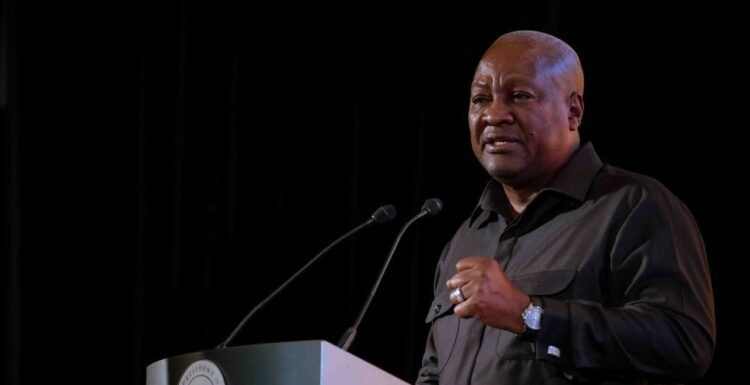
Speaking at the Next Step High Level Consultative Conference on Reparatory Justice in Accra, the President stressed that the global conversation on reparations must move beyond questions of blame and focus on collective responsibility for the lasting impact of slavery and racialized oppression.
Addressing delegates from across Africa, the Caribbean, the diaspora, and the international community, Mahama said historical justice requires an honest recognition of the systems and institutions that continue to shape societies centuries after the end of the transatlantic slave trade.
According to him, the challenge confronting today’s generation is not whether individuals should be held accountable for actions committed hundreds of years ago, but whether societies are prepared to address the consequences that remain evident in contemporary social, economic, and political structures.
“None of us gathered here today is personally responsible for the atrocities of the transatlantic slave trade. We did not build the ships, operate the castles, or design the systems that dehumanised Africans. But while we do not inherit guilt, we do inherit responsibility.”
The President noted that many of the inequalities and institutional structures that exist today were shaped by historical injustices, making it imperative for the international community to acknowledge and address their continuing effects.
“We inherit the institutions, inequalities, and structures shaped by that history, and we must confront their present day consequences,” he said. He added that the central question facing the current generation is not whether people are guilty of the past, but whether they are prepared to tackle what history has left behind.
Growing International Recognition
President Mahama observed that there are encouraging signs that governments, religious institutions, and international actors are becoming more willing to engage openly with the history of slavery and its long term consequences.
He pointed to growing discussions on historical justice across different regions and acknowledged recent initiatives by religious bodies that have begun examining their historical connections to slavery.
According to him, institutions such as the Church of England and the Church of Scotland have contributed to the broader global conversation by engaging with difficult aspects of their historical involvement and responsibilities.
The President also welcomed the increasing participation of world leaders such as President Emmanuel Macron in discussions surrounding reparatory justice, noting that such engagement demonstrates a readiness to confront historical truths rather than ignore them.
President Mahama said these developments are important because they signal a growing willingness among influential institutions and governments to engage constructively with history and support efforts aimed at achieving justice and reconciliation.
He stressed that meaningful progress can only be achieved when nations and institutions are prepared to confront uncomfortable truths with honesty and openness.
Strengthening Africa and Diaspora Ties
A major theme of the President’s address focused on the relationship between Africa and its global diaspora, which he described as one of the enduring legacies of the transatlantic slave trade.
While acknowledging the immense suffering caused by slavery, President Mahama noted that the forced movement of millions of Africans across continents also created lasting cultural, historical, and social connections that continue to unite people of African descent around the world.
The Ghanaian leader emphasized that the progress achieved in advancing the reparatory justice agenda has been made possible through decades of cooperation involving African governments, Caribbean nations, scholars, civil society organisations, activists, and diaspora communities.
“The adoption of the resolution was made possible through decades of collaboration among African states, Caribbean nations, scholars, civil society, and diaspora communities.”
He described the achievement as evidence that meaningful progress can be realised when countries and communities work together toward a common objective.
“Our progress demonstrates what is possible when we act in partnership. The next phase must be guided by the same spirit,” President Mahama said.
Call for a Transcontinental Response
As African Union Champion on Reparations, President Mahama used the platform to reaffirm his support for the establishment of an African Caribbean Joint Mechanism on Reparatory Justice.
He argued that because the transatlantic slave trade affected multiple continents and generations, efforts to secure justice must also be international in scope and ambition.
Per his words, the consequences of slavery cannot be addressed by individual countries acting alone, but require coordinated action among governments, institutions, and communities across Africa, the Caribbean, Europe, the Americas, and the wider diaspora.
The Ghanaian President concluded by urging stakeholders to sustain the momentum generated by recent international developments and continue building partnerships capable of advancing historical justice, strengthening global cooperation, and addressing the enduring legacy of slavery through constructive engagement and shared responsibility.