

By Gifty Boateng
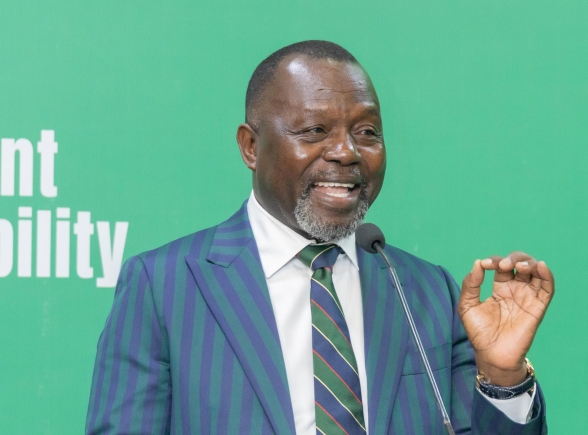
The Attorney-General and Minister for Justice, Dr Dominic Ayine, has objected to defence counsel’s attempts to interrogate a state witness about his extra-judicial press conference on the ongoing prosecution of former National Signals Bureau Executive Director Kwabena Adu-Boahene.
The objection, raised during proceedings at the Accra High Court, has injected a procedural dimension into a case already marked by high political and security stakes.
Dr Ayine argued that the line of questioning by defence counsel Samuel Atta Akyea was directed at the wrong witness. The witness in question, Frank Marshall Cromwell, is an investigator with the Economic and Organised Crime Office (EOCO) and is testifying on the evidence gathered during investigations not on the public statements of other state officials.
“The questions being asked are irrelevant, and the EOCO investigator should not be cross-examined on the contents of the press conference,” the Attorney-General submitted.
The defence had sought to bring the content of Dr Ayine’s April 2026 press conference into the trial, using it to probe the investigator’s testimony. The press conference, held at the time charges were filed, provided the public with an account of alleged financial misconduct at the NSB.
Dr Ayine insisted that the investigator’s role was limited to presenting evidence collected during the investigation, and that questioning him about statements made by another state official outside the courtroom was procedurally improper.
The Attorney-General formally filed 11 charges against Adu-Boahene in April 2026, along with his wife Angela Adjei Boateng, Mildred Donkor, and Advantage Solutions Limited. The charges include stealing, money laundering, defrauding by false pretences, and wilfully causing financial loss to the state.
At the heart of the case is a $7 million contract signed with Israeli company ISC Holdings Limited for the purchase of cyber defence software. Prosecutors allege that the funds were instead diverted to Adu-Boahene’s personal accounts.
According to court documents, the accused purportedly represented the transactions as payments for the cyber defence systems, but investigators found no evidence that any such system was ever delivered to the Bureau of National Communication or its successor agency, the National Signals Bureau.
The court is now expected to rule on whether the press conference content is admissible for cross-examination purposes. The decision will determine whether the Attorney-General’s public commentary becomes a point of scrutiny in the trial a development that could have implications for how senior state officials communicate about ongoing prosecutions.
For the defence, the attempt to introduce the press conference suggests a strategy of challenging the prosecution’s narrative by highlighting inconsistencies or extraneous commentary. For the prosecution, the objection signals a determination to keep the trial focused on the evidence collected by EOCO rather than political or media discourse.
The Adu-Boahene case is one of the most high-profile corruption prosecutions to emerge from the previous administration’s security sector. The former NSB chief is accused of diverting funds meant for critical national security infrastructure, and the case has attracted sustained public attention.
The Attorney-General’s objection also touches on a recurring tension in Ghanaian jurisprudence: the extent to which extra-judicial statements by state officials can be used in court proceedings. The court’s ruling on this matter may set a marker for future high-profile cases.
Further arguments and rulings are expected as the hearing continues, with the court tasked with determining which lines of questioning are permissible and whether the press conference has any bearing on the core issues before the court.