

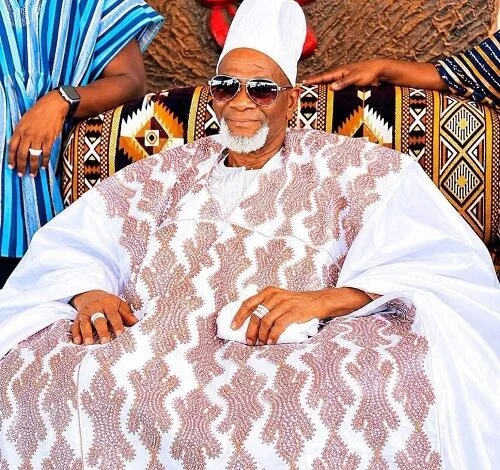
Ya-Naa Abukari II’s death ends a brief, stable interlude in Dagbon’s turbulent history, setting the stage for a high-stakes succession tussle between the Abudu and Andani gates.
The passing of Ya-Naa Mahama Abukari II has emptied the Yendi Skin, removing the central figure who anchored Dagbon’s fragile 2019 peace deal. Seven years after his ascension closed a bloody 16-year vacancy, the kingdom’s kingmakers must now navigate a succession process that historically ignites factional tensions between the Abudu and Andani royal gates.
Although the Traditional Council has yet to disclose official details surrounding his death, insiders describe his departure as the felling of a “mighty tree” one whose primary political utility was the cessation of hostilities.
Abukari, 79, ascended on 18 January 2019, following a painstaking mediation brokered by the Committee of Eminent Chiefs, chaired by Asantehene Otumfuo Osei Tutu II.
That settlement was as much a political imperative as a cultural one, designed to draw a line under the 2002 massacre of Ya-Naa Yakubu Andani II and the subsequent paralysis of traditional governance in Yendi.
Under Dagbon’s rotational system, the next Ya-Naa must emerge from one of the three gate skins with Abukari having previously held the Savelugu Naa title before his elevation. His predecessor’s path from Kpunkpono Naa to Savelugu Naa to the Overlordship now becomes the template for contenders, but the arithmetic is delicate.
The Abudu and Andani gates, whose violent rivalry paralysed the kingdom for nearly two decades, are already recalibrating their strategies.
The 2019 roadmap did not erase the underlying competition; it merely suspended it under the moral authority of the Asantehene and the political weight of the Akufo-Addo administration. With that guarantor framework now tested by a change of national government, the succession is poised to become a proxy for broader political manoeuvring in the Northern Region.
Abukari’s reign was defined less by grand policy than by the quiet, persistent work of rebuilding trust. He revived suspended festivals and royal ceremonies, using cultural symbolism to stitch together a kingdom fractured by grief. His public pronouncements consistently emphasised dialogue: “Peace is the greatest inheritance,” he often stated, framing stability as the prerequisite for development.
Yet beyond the ceremonial, his tenure saw limited structural reform of the traditional council’s finances or administrative reach. His primary achievement and the one for which history will judge him was simply keeping the peace long enough for a generation to grow up without gunfire in Yendi.
The succession vacuum arrives at an awkward moment for the central government. The NDC administration, already facing scrutiny over its handling of traditional conflicts in other regions, cannot afford a relapse into Dagbon’s dark past. Crucially, the Asantehene’s role as chief mediator remains pivotal; Otumfuo’s willingness to re-engage will signal whether the 2019 accord retains its binding force.
Funeral arrangements are expected shortly, in accordance with custom. But for Dagbon’s power brokers, the real clock is already ticking on the selection of the next occupant of the Yendi Skin a process that, if mishandled, could unravel the very stability Abukari spent his reign preserving.