

By Philip Antoh
The Chief Executive Officer of the Ghana Gold Board (GoldBod), Sammy Gyamfi, has firmly rejected attempts to link his agency to the US$1.7 billion loss recorded by the Bank of Ghana (BoG) under the Domestic Gold Purchase Programme (DGPP) in 2025.
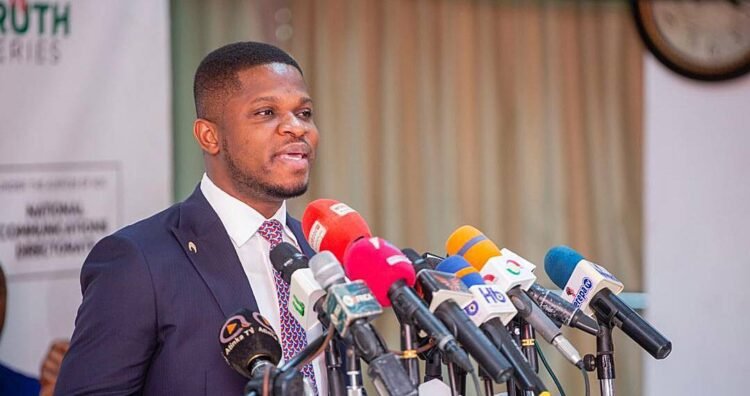
Speaking at the Government Accountability Series at Jubilee House on Wednesday, August 19, 2026, Mr. Gyamfi provided a detailed breakdown of GoldBod’s operational limits under the program, making it clear that the central bank’s deficit cannot be blamed on the gold board.
At the heart of Gyamfi’s explanation was the strict limitation of GoldBod’s mandate during the 2025 DGPP exercise. He explained that GoldBod simply inherited the role of a “buying agent” from the former Precious Minerals Marketing Company (PMMC) under a 2023 agreement with the BoG.
According to Gyamfi, GoldBod’s responsibilities began and ended with purchasing and aggregating gold using the approximately GH₵133 billion advanced to it by the central bank an amount he noted has been fully accounted for.
“The GoldBod had no role in the sale of gold by the BoG under the DGPP. It was not a signatory to off-take agreements… Neither was it involved in determining selling price or sale terms,” he stated emphatically. Explaining the Loss and Defending Fees Gyamfi also dismantled any suggestions that GoldBod’s administrative fees ate into the program’s profits. He pointed out that the 0.258% assay fee and 0.5% service fee collected by GoldBod totaled just 0.758% a fraction of the roughly 17% loss cited by the IMF. He described these as standard, legitimate charges for services rendered.
Rather than mismanagement, Gyamfi pointed to the IMF’s own explanation for the massive shortfall: “valuation effects.” He noted that the loss was largely an accounting discrepancy driven by the difference between the forex bureau exchange rate used to purchase the gold and the BoG’s official reference rate used for accounting purposes. Because these pricing and exchange-rate arrangements were locked into the 2023 agreement long before GoldBod was operational they could not be attributed to the agency.
The CEO further clarified the timeline of GoldBod’s operations to separate the two entities entirely. He stressed that the 2025 DGPP was purely the BoG’s initiative. GoldBod did not launch its own independent, statutory trading model until March 2026, after receiving its revolving seed capital in December 2025 and finalizing its internal systems.
Addressing the broader economic rationale, Gyamfi argued that judging the DGPP solely on its accounting loss misses the point. The programme, he explained, was designed as a foreign exchange and economic-stabilization intervention, deliberately purchasing gold at spot prices to build national reserves.He pointed to the tangible macroeconomic benefits that coincided with the program’s scaling up: Ghana’s international reserves surged from US$8.9 billion in 2024 to approximately US$13 billion in 2025. This was accompanied by a 41% appreciation of the Ghana cedi and a substantial drop in inflation.
GoldBod’s Own Stellar Financials While the BoG dealt with the DGPP valuation loss, Gyamfi highlighted that GoldBod itself had a highly successful 2025. According to its audited financial statements, the agency recorded an operational surplus of GH₵907 million and an overall surplus exceeding GH₵5.4 billion.
“The GoldBod will remain focused on its mandate. We will continue to account transparently for our stewardship, and we will not be distracted,” he said.Importantly, Gyamfi stopped short of accusing the Bank of Ghana of mismanagement. Instead, he characterized the US$1.7 billion figure as the inevitable result of the program’s policy design and exchange-rate mechanics, executed as part of a necessary strategy to stabilize Ghana’s economy.