

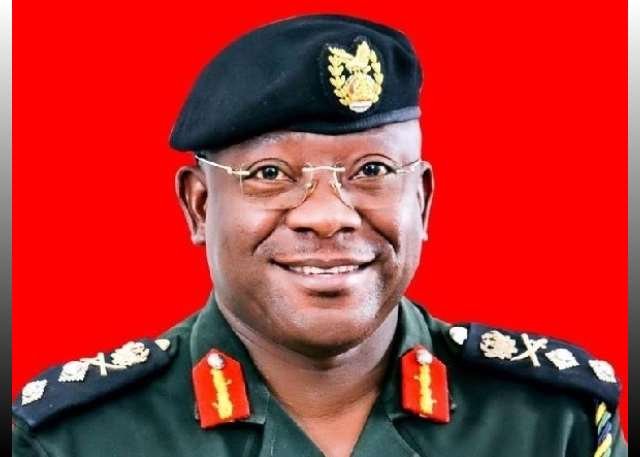
…pays $1.3 Million Cash For Airport Residential House and over $1million to Refurbish the house to a palatial taste
TNR Files
Immediate past Chief of Defence Staff, General Thomas Oppong Peprah, is facing serious allegations of money laundering after he paid US$1.3 million in cash to purchase a mansion while serving as the country’s top military officer, investigations by The New Republic have revealed.
The paper trail on the purchase exposes a convoluted proxy transaction that clearly circumvented the banking system and mandatory asset declaration laws.
After the purchase, the General would arrange for the house to be renovated and upscaled into a Rock Star-style mega-mansion at a cost exceeding US275,000.
Currently Ghana’s Deputy Ambassador to Canada, Gen. Thomas Oppong Peprah was promoted to Chief of Defence Staff by former President Akufo-Addo on February 1, 2024. He would subsequently retire on March 25, 2025.
While in office as CDS, he purchased a mansion located at the upscale Airport Hills Residential Area in Accra.
According to the available paper trail on the transaction, the General used the services of an estate agency called Jardinia to purchase the house from sellers, Finali Ventures.
The asking price for the mansion was originally US1.3 million.
Following this, Gen. Oppong Peprah bundled the US$1.3 million in cash and handed it to the estate agency to deliver to the house owner, evading the banking system and circumventing taxes in the process.
The General would then go on to ask for the house to be fully fitted with a swimming pool, indoor cinema, military museum of achievements and other luxury accessories, tasking the proxy to oversee the renovation and be fully compensated accordingly.
Per a December 14, 2025, full and final invoice, the renovation works had taken 21 months, from March 2024 to November 2025, with the General constantly monitoring and inspecting the progress.
The total renovation cost amounted to approximately US10,000 totalling US$210,000.
There are also outstanding debts owed to vendors, all of which have been well communicated to the Four Star General. Yet all attempts to get him to reconcile accounts have failed as he has ignored all parties.
Gen. Oppong Peprah, however, is refusing to pay the remaining balance of US$275,000.
As part of The New Republic’s investigation, we contacted Gen. Oppong Peprah, who confirmed he has refused to pay the fees accrued but said he did so because there are discrepancies in the calculations.
The General, who is also linked to a long list of properties that make him ideal for a lifestyle audit, also used the opportunity to give The New Republic an earful about how monied he is and does not need to be corrupt to be able to afford his luxury mansions and expensive cars.
According to him, his late father was the owner of a big transportation company called Tommy Brothers Transport, and that after his dad died, he inherited his father’s millions.
What, however, has not been clear from the conversations is whether the General bothered to declare his assets while he was in office as CDS, and even upon his subsequent appointment by President John Mahama as Deputy Ambassador to Canada.
On the face of it, a General’s monthly salary and emoluments do not put him in a position to own more than 12 luxury houses and automobile marques like Range Rovers and bullet-proof Lexus vehicles. The General claims the money is from his late rich father whom he inherited. However true this is, the law requires that he ought to have declared his assets which would include all his properties while serving as CDS and even now as Deputy Ambassador.
Under Ghanaian law, the rules governing how often senior military officers must declare their assets and what happens if they do not are anchored in the 1992 Constitution and the Public Office Holders (Declaration of Assets and Disqualification) Act, 1998 (Act 550).
Under Article 286(1) of the Constitution, the designated senior military commanders (such as the Chief of Defence Staff) must submit a written declaration of all properties, assets, and liabilities to the Auditor-General on three specific occasions:
Before taking office – In a landmark ruling on March 18, 2026, the Supreme Court of Ghana struck down old legal provisions that allowed a six-month grace period, strictly mandating that assets must be filed before the officer officially assumes duty.
Every four years – To ensure ongoing accountability, a periodic declaration is required at the end of every four-year interval.
At the end of their term -A final evaluation must be turned in upon leaving office or completing their service tenure.
The legal mechanisms for punishing non-compliance are notoriously criticised by local transparency organisations for being weak and poorly enforced.
According to Article 286(2), failing to declare assets or knowingly making a false declaration is considered a direct contravention of the Constitution. Non-compliance is not treated as an immediate criminal offence handled by regular police. Instead, under Article 287, it must be referred to the Commission on Human Rights and Administrative Justice (CHRAJ).
There is no evidence whatsoever that Gen. Thomas Oppong Peprah declared his assets, whether as CDS or Deputy Ambassador to Canada.
The purchase of the building with US$1.3 million in cash violates the Foreign Exchange Act, 2006 (Act 723) which explicitly bans individuals, companies, or institutions from pricing, advertising, invoicing, receipting, or accepting payments in any foreign currency within Ghana.
The Bank of Ghana has repeatedly warned that “receiving and/or making payments for goods and services in foreign currency (particularly the United States Dollars) in Ghana, are strictly prohibited” under the Act.
Unless an individual or entity has received explicit authorisation from the Bank of Ghana to quote prices or issue invoices in foreign currency, such practices are prohibited.
The huge sum involved in the cash purchase raises serious questions about money laundering. Under Ghana’s anti-money laundering laws, any transaction exceeding the equivalent of GH¢50,000 in cash is subject to declaration and reporting requirements.
A US$1.3 million cash transaction equivalent to approximately GH¢19.5 million represents a monumental breach of financial regulations.
Furthermore, the routing of the payment through an intermediary (Jardinia) to the seller (Finali Ventures) is a classic structuring technique used to obscure the true source and destination of funds a hallmark of money laundering schemes.
The subsequent US$800,000 in cash payments for refurbishment, according to prepared invoices, further compound the suspicion of systematic cash-based money laundering.
Gen. Thomas Oppong Peprah’s US800,000 cash refurbishment of which US$275,000 remains unpaid reads like a script from a Hollywood thriller.
But this is not Hollywood. This is Ghana.
And the man at the centre of this storm is currently representing Ghana in Canada as Deputy Ambassador.
The evidence raises serious questions:
1. Money Laundering – over US800,000 refurbishment payments far exceed reporting thresholds
2. Asset Declaration – No evidence of compliance with constitutional requirements
3. Foreign Exchange Violation – Payment in US dollars prohibited by Act 723
4. Structuring – Proxy transaction designed to obscure source of funds
5. Lifestyle Discrepancy – 12 luxury properties and bullet-proof vehicles on a military salary
The New Republic will continue to investigate this matter and will not rest until Ghanaians get the full truth about the General’s mysterious millions.
Gen. Oppong Peprah has denied any wrongdoing and insists his wealth is from inheritance from his late father’s transport business. The New Republic will publish his full response in a subsequent edition.