

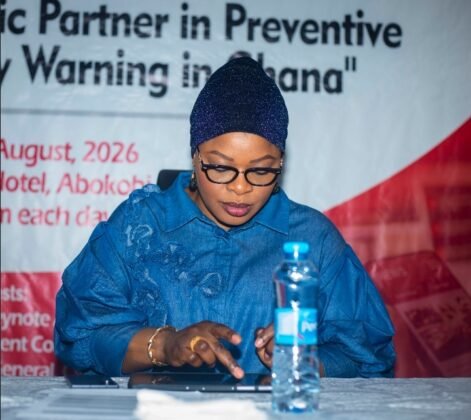
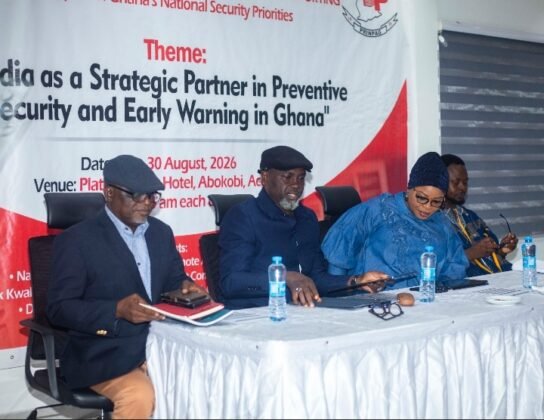
The Minister for Government Communications, Felix Kwakye Ofosu, has called for a strategic partnership between government communicators, national security institutions, and the private media to enhance preventive security and early warning systems in Ghana.
Delivering a speech read on his behalf by the Deputy Presidential Spokesperson, Shamima Muslim, at a PRINPAG capacity-building workshop in Accra, the minister emphasized that effective communication is vital to curbing misinformation and protecting national peace.
The event was themed “Media as a Strategic Partner in Preventive Security and Early Warning in Ghana stressed that the burden of responsible security reporting does not rest on the shoulders of journalists alone.
He warned that when accurate official information is unnecessarily delayed, it creates a vacuum that is quickly filled by speculation and misinformation.
“Responsible security reporting is not the media’s burden alone. Government and the security institutions must communicate in a timely, credible and coordinated manner,” he stated.
He cautioned that contradictory statements from state agencies during crises severely undermine public confidence, noting, “Trust cannot be demanded during a crisis if it has not been cultivated before the crisis.”
To transform the traditionally reactive relationship between the state and the private press into a proactive one, the minister outlined several concrete proposals including establishing a secure verification channel between PRINPAG leadership, the National Security apparatus, and the Government Communications Office to facilitate rapid fact-checking during security incidents.
He clarified that this mechanism would not amount to censorship, but rather a reliable avenue for journalists to verify sensitive information before publication.
Additionally, he proposed quarterly security briefings for editors including off-record engagements to provide deeper context on emerging threats and also advocated for increased support for journalists’ safety, Right to Information (RTI) training, and the development of a specialized PRINPAG Code for Responsible Security Reporting.
Dismissing the notion that a free press is a threat to national security, Mr. Kwakye Ofosu argued the opposite. “Media freedom is a security strategy, not a security threat,” he said, explaining that credible platforms for public grievance reduce the likelihood of violence.
However, he cautioned journalists against sacrificing accuracy for speed. In an era plagued by artificial intelligence, deepfakes and coordinated disinformation, he urged media practitioners to rigorously verify sensitive information to avoid endangering lives, exposing operational details, or inflaming ethnic and religious tensions.
The minister also expressed concern over the declining fortunes of the print media, highlighting its indispensable role as a repository of Ghana’s national memory.
While acknowledging that social media is often faster, he noted that professional newspapers provide the verification, context, and permanent records necessary for historical documentation.
He challenged private media organizations to evolve from merely producing daily news into trusted ‘knowledge institutions.’
By leveraging their extensive archives to identify conflict patterns, he said the media could actively support early-warning efforts.
Mr. Kwakye Ofosu clarified that the goal of this partnership is not to shield the government from criticism, but to collectively protect Ghana from falsehood, division, and institutional decay.
“The old alliance for independence must become an alliance for prevention,” he declared, urging all stakeholders to foster an environment where journalists can investigate without intimidation, security forces can operate without reckless exposure, and citizens can access the credible information necessary to sustain the nation’s democracy.