

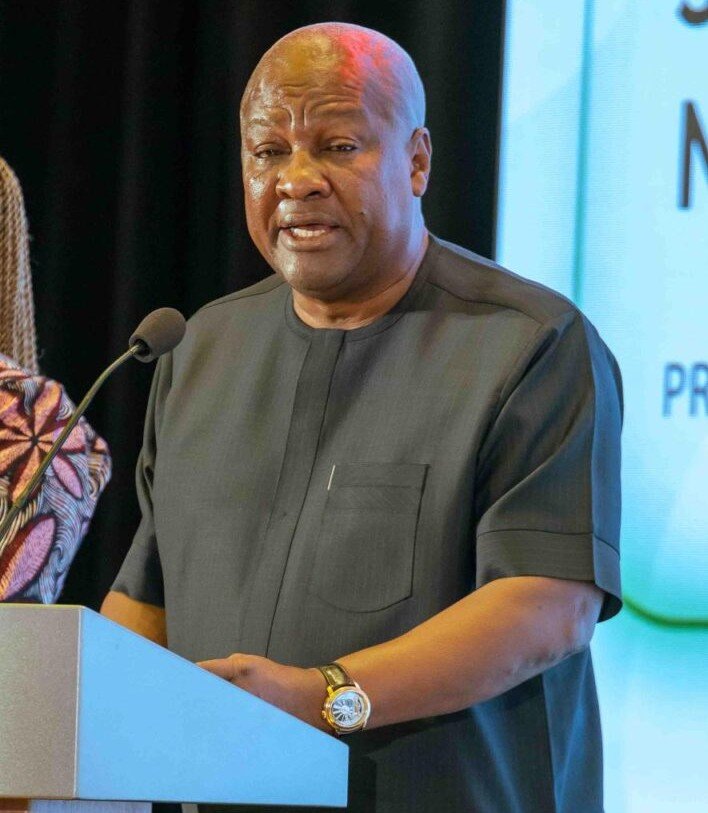
President John Dramani Mahama has declared that the state will no longer quietly absorb persistent losses incurred by State-Owned Enterprises (SOEs), warning that boards and management teams must deliver efficiency, accountability and profitability or face consequences.
Addressing a conference organised by the State Interests and Governance Authority (SIGA) at La Beach Hotel in Accra, the President said his government has “reset” its relationship with state-owned enterprises and will now demand measurable value from those entrusted with managing public assets.
“Persistent losses will no longer be quietly absorbed into the national budget,” President Mahama stated, adding that leadership positions in SOEs must be tied to performance, value creation and profitability.
‘Assets Held in Trust for the People’
The President reminded boards, chief executives and management of SOEs that the assets under their control — from the country’s ports, power infrastructure and factories to water systems, pension funds, lands, buildings, equipment and government shares — belong to the Ghanaian people.
“These assets do not belong to any government, a board, or a chief executive. They belong to the people of Ghana, and you and I hold them only in trust for the people,” he said.
He stressed that the central principle guiding the conference was simple: “Public ownership must produce public value,” challenging every institution present to demonstrate, with credible evidence, the value it has created for citizens.
The President recalled his March 2025 meeting with chief executives, where he announced the reset in government’s relationship with its enterprises, and noted that Vice-President Professor Naana Jane Opoku-Agyemang had reinforced the same message during an engagement with specified entities, emphasising that SOEs must offer an attractive value proposition to Ghanaians, their ultimate shareholders.
Improved Performance, But With Caveats
President Mahama said the latest State Ownership Report showed significant improvement in the aggregate performance of SOEs. Combined revenue rose from $137.71 billion in 2024 to $176.43 billion in 2025 — a growth of about 28.12 per cent — while the sector swung from an aggregate net loss of $2.26 billion to a net profit of $19.8 billion.
Return on assets climbed from 1.3 per cent to 6.31 per cent, and return on equity improved from negative 1.6 per cent to 15.7 per cent.
However, the President cautioned against attributing the turnaround solely to better management. He explained that improved foreign exchange conditions and lower financing costs had lifted both state-owned and private enterprises, with approximately $11.72 billion in net foreign exchange gains and a 42.5 per cent reduction in aggregate finance costs driving much of the improvement.
He urged managers to seize the favourable conditions to strengthen their underlying businesses rather than depend on temporary economic advantages.
Top Performers Honoured
The President commended ten SOEs that posted positive net profits in each of the last five years (2021–2025). The Ghana National Petroleum Corporation (GNPC) led the pack with the highest average annual profit of approximately $2.25 billion, followed by the Ghana Ports and Harbours Authority (GPHA) with $1.41 billion, the Minerals Income Investment Fund (MIIF) with $773.9 million and BOSS Energy with $348.1 million.
He also recognised the consistent profitability of the Bui Power Authority, Ghana EXIM Bank, Ghana National Gas Corporation, TDC Company Limited, Ghana Supply Company Limited and the Venture Capital Trust Fund, noting that five consecutive years of profitability should compel those institutions to strengthen governance further.
Several enterprises also recorded remarkable turnarounds in 2025. The Tema Oil Refinery (TOR) moved from a net loss of about GH¢745 million to a net profit of $1.09 billion — its first profit in nearly a decade. The Ghana Water Company Limited swung from a $3.06 billion loss to a profit of roughly $635 million, while COCOBOD improved from a $5.73 billion loss to a $5.11 billion profit. The Gold Board posted a net profit of about $896.5 million, up sharply from $88.5 million in 2024 — a performance the President said underscored the strategic importance of transparent, accountable structures around Ghana’s gold trade.
‘Sustained Performance Is the Real Test’
Despite the encouraging numbers, President Mahama warned against complacency, insisting that improved financial results must be underpinned by stronger core operations and cannot rely indefinitely on favourable exchange rates or lower financing costs.
He said the State Ownership Report should serve not only as a record of progress but as a diagnostic tool for identifying weaknesses and driving reforms across the public enterprise portfolio.
“A one-year turnaround is encouraging, but sustained performance is the real test,” he declared.
The President’s central message was clear: a profitable year, while welcome, does not by itself constitute a successful turnaround. Boards and chief executives, he said, must focus on strengthening governance, improving efficiency and ensuring that Ghana’s public assets generate lasting value for the citizens who ultimately own them.
By Gifty Boateng