

…Government Introduces Ayalolo BRT Contra-Flow on Three Major Accra Corridors
By Prince Ahenkorah and Philip Antoh
For years, peak-hour commuting in Accra has meant one thing for stranded passengers: pay or perish. Private transport operators, capitalising on traffic congestion and desperation, have routinely charged more than 100 per cent of the usual fare, leaving commuters with little choice but to pay up to get home early and safely.
That regime is now facing its most serious challenge yet.
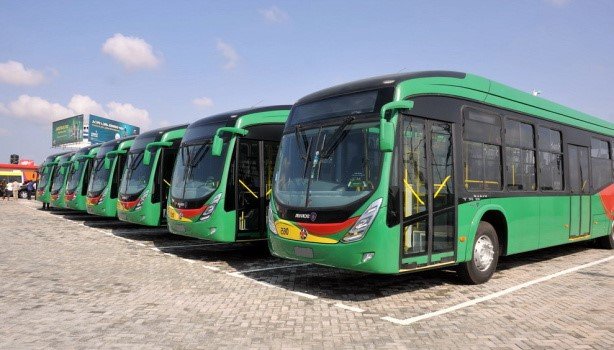
Starting Tuesday, September 29, 2026, the government will introduce a Contra-Flow Bus Priority System for Ayalolo Bus Rapid Transit (BRT) services on four major corridors leading into and out of Accra’s Central Business District (CBD). The intervention is designed to improve the reliability of Ayalolo services, reduce journey times and ease congestion on the city’s most punishing approaches.
The corridors are Amasaman–Accra, Pokuase–Accra, Kasoa–Accra and Adentan–Accra. The system will operate during peak hours only: 6:00 a.m. to 9:00 a.m. and 4:00 p.m. to 8:00 p.m. During those windows, designated sections of the road will be temporarily reconfigured to allow authorised Ayalolo buses to travel in the priority direction against the normal flow of traffic.
The contra-flow lanes will be strictly reserved for Ayalolo BRT buses. Private vehicles, taxis, trotros, okadas, trucks and other unauthorised road users will be prohibited from using them. The Motor Traffic and Transport Department (MTTD) of the Ghana Police Service will provide traffic control and enforcement at strategic points and major intersections, supported by GAPTE Route Wardens.
Announcing the initiative at a press briefing in Accra on Monday, the Managing Director of the Greater Accra Passenger Transport Executive (GAPTE), Lawyer Dawuda Awudu, said the move followed a successful joint traffic simulation exercise with the Ghana Police Service (MTTD), the Department of Urban Roads, the Ministry of Transport and the Accra Metropolitan Assembly.
Awudu said the intervention directly supports the President’s Reset Agenda under the 24-Hour Economy Policy. A round-the-clock economy, he argued, is impossible without a reliable transport network that allows health professionals, security personnel, factory staff and other essential workers to commute safely and affordably outside traditional working hours.
“Transport is the engine of the 24-Hour Economy,” Awudu stressed. “Without reliable public transport, factories cannot run night shifts, markets cannot operate late, and port operations cannot be de-congested. The Contra-Flow system is our contribution to ensuring that mobility does not become the bottleneck to productivity.”
He noted that Accra’s population has exploded from less than one million in the 1970s to nearly five million today, while road capacity has failed to keep pace. The result is a daily gridlock that punishes commuters and strangles productivity. The answer, he said, is to prioritise the movement of people over vehicles.
“For years, we have told commuters to use public transport, but we have not given public transport priority on the road. Today we are correcting that,” Awudu said. “Those 80 people in a bus must be given priority over that 1 person in a car.”
The system is modelled on globally proven contra-flow arrangements used in Tokyo, Bogota, Seoul and Johannesburg. During the morning rush hour, when inbound traffic to the CBD is gridlocked, one outbound lane will be cordoned off and reserved for inbound buses. The dedicated lanes will be clearly marked with cones, reflective dividers and signage, and actively monitored by GAPTE Route Wardens and Police MTTD officers.
The pick-up points for the four corridors are:
Amasaman Corridor: Amasaman, Kwame Nkrumah Circle and Achimota.
Pokuase Corridor: Pokuase, Kwame Nkrumah Circle and Achimota.
Kasoa Corridor: Kasoa Main Station, Tuba Junction, Old Barrier, Weija Barrier and Kaneshie First Light.
Adentan Corridor: Adentan Barrier, Madina Zongo Junction, Legon/Okponglo and 37 Military Hospital.
Outside the peak windows, all lanes will be open to general traffic.
The Ministry of Local Government, Chieftaincy and Religious Affairs, working with the MTTD, GAPTE and the Department of Urban Roads, says the intervention is intended to improve the reliability of Ayalolo services, reduce journey times and ease congestion on major approaches to the CBD. Road users and transport operators have been urged to cooperate with officers and comply with the temporary arrangements to prevent disruptions and ensure safety.
The expected benefits are significant. GAPTE projects that commuters travelling the Kasoa to Tudu stretch, who currently spend up to two and a half hours in traffic, will see their commute reduced to just 40 to 50 minutes. Beyond saving time, the dedicated lanes are expected to improve service reliability, increase transport capacity and enhance passenger safety.
Awudu expressed profound gratitude to the Minister for Local Government, Chieftaincy and Religious Affairs, Mahama Ayariga, for his instrumental role in the initiative. According to him, the Minister recognised traffic congestion as a local governance and productivity issue and was crucial in aligning all Metropolitan, Municipal and District Assemblies along the corridors to make the policy a reality.
The government says it will continue engaging transport operators, road users, local authorities and other stakeholders as the intervention is rolled out.
For commuters who have long borne the double burden of gridlock and extortionate fares, the message is clear: the era of peak-hour transport hikes may finally be doomed. The bus, not the private car, now takes priority.
Peak-Hour Transport Hike Doomed
0Related Posts
Add A Comment
© 2026 THE NEW REPUBLIC GH.
About | Contact | Privacy Policy