

Empty Chair, Crabbe’s U-Turn, Ahiagba’s Defeat Expose Bawumia Camp’s Tightening Grip
By Stanley Assor
The New Patriotic Party’s carefully choreographed attempt to project unity after its national executives election has done little to conceal the divisions, competing loyalties and unresolved tensions still stalking the opposition party ahead of the 2028 general elections.
The party’s National Delegates Conference in Kumasi on October 3, 2026, produced a new crop of national executives, many of them regarded as close to the party’s 2028 presidential candidate, former Vice President Dr Mahamudu Bawumia.
On the surface, the outcome appeared to complete a political consolidation that began with the controversial internal process through which Dr Bawumia was retained as the party’s presidential candidate despite leading the NPP to its worst electoral defeat in its history in 2024.
But beneath the carefully managed spectacle of an orderly transition, the conference exposed fault lines that the party’s leadership may find difficult to paper over as it prepares for another presidential contest.
Agyapong’s Empty Chair
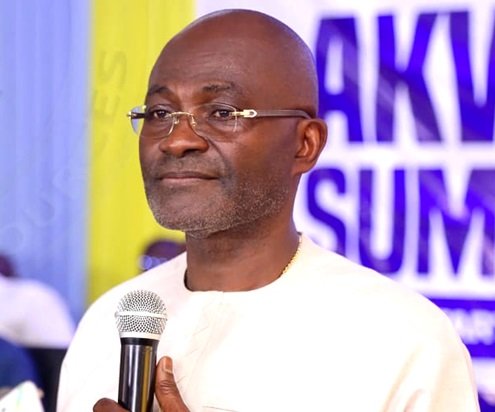
The most conspicuous sign was the absence of Kennedy Agyapong.
Mr Agyapong, Dr Bawumia’s principal challenger in the NPP’s last presidential primary, did not attend the national executives election, despite his prominence within the party and his previous role as one of the most formidable voices in the presidential contest.
His absence immediately became a subject of discussion among journalists and party watchers at the conference.
What made the development particularly significant was the apparent absence of a convincing explanation from the party.
Nobody at the conference appeared willing or able to provide a definitive account of why Mr Agyapong stayed away.
The development is unlikely to be dismissed easily, particularly given Mr Agyapong’s own warnings in recent months that he could expose damaging information if he felt provoked or pushed too far by elements within the party.
For a party attempting to present itself as having closed ranks behind Dr Bawumia, the conspicuous absence of one of his principal presidential rivals was therefore difficult to reconcile with the image of unity being projected from the conference platform.
Crabbe’s Sudden Withdrawal
The events surrounding the chairmanship race also raised questions about the depth of the reconciliation being advertised within the NPP.
Sammy Crabbe, a former National Organiser who had been associated with the camp of former presidential candidate Alan Kyeremanten, had returned to active party politics and entered the race for National Chairman.
His candidacy was therefore being watched closely as a possible indication of whether the various factions that have battled for influence within the NPP could finally coexist under one leadership.
But Mr Crabbe unexpectedly withdrew from the contest and threw his support behind John Boadu, who eventually won the chairmanship.
Mr Crabbe has explained his decision on the basis that he and Mr Boadu were broadly aligned in their thinking after meeting during a pre-election gathering.
That explanation, however, has been challenged by former NPP National Chairman Peter Mac Manu.
According to Mr Mac Manu, Mr Crabbe had privately communicated a different position to him, indicating that his preferred candidate for chairman was Boakye Agyarko, another politician associated with the Alan Kyeremanten camp.
Mr Mac Manu has said Mr Crabbe personally sent him a message explaining why he had settled on Mr Agyarko as his preferred candidate.
The conflicting accounts have inevitably raised questions about whether Mr Crabbe’s withdrawal was simply an act of reconciliation or whether the factional calculations within the party remain very much alive beneath the surface.
Ahiagba Defeat Raises Volta, Oti Questions
Then came the defeat of Richard Ahiagba in the race for First Vice Chairman.
Mr Ahiagba, a former Communications Director of the NPP and one of the most prominent party figures from the Volta Region, was the only candidate from the region contesting for the position.
His defeat was therefore regarded by some party observers as significant, particularly because the NPP has historically struggled to establish a stronger electoral foothold in the Volta Region.
The position instead went to Kojo Fosu Boadu, popularly known as Kojo Bamba.
Mr Ahiagba has since expressed concern about the composition of the new national leadership, with remarks attributed to him suggesting that neither the Volta nor Oti regions has representation among the new national executives.
That, he reportedly argued, presents a serious problem for a party seeking to broaden its electoral appeal ahead of 2028.
The issue is not merely about one defeated candidate.
For critics of the election outcome, the rejection of Mr Ahiagba is being cited as part of a broader pattern in which experienced professionals and established party figures failed to secure key positions.
The list of defeated candidates has also been used to question the quality and breadth of the new leadership, with names such as Dr Mustapha Hamid and businessman Paul Afoko featuring prominently in discussions about the election.
Bawumia Loyalists Dominate
At the centre of the emerging debate is the extent to which the new executive reflects a genuine cross-section of the NPP or, instead, represents the consolidation of the Bawumia camp.
John Boadu won the chairmanship with 2,888 votes, while Justin Frimpong Kodua retained the General Secretary position with 4,486 votes.
Kojo Fosu Boadu won the First Vice Chairman position with 3,116 votes, followed by Henry Nana Boakye, popularly known as Nana B, as Second Vice Chairman with 3,061 votes, and Nana Akomea as Third Vice Chairman with 2,981 votes.
Daniel Nii Kwartei Titus-Glover emerged as National Organiser with 2,964 votes, while Alfred Kojo Thompson won the treasurer position with 2,243 votes.
In the party’s specialised wings, Abanga Fuseini Yakubu became National Youth Organiser with 1,550 votes; Mavis Hawa Koomson won the National Women’s Organiser position with 783 votes; and Alhaji Mohammed Ali Suraj was elected National Nasara Coordinator with 372 votes.
The results have strengthened the perception that the faction around Dr Bawumia has succeeded in extending its influence from the presidential nomination process into the party’s formal administrative structure.
That is precisely where the NPP’s unity narrative begins to look vulnerable.
A Unity That Isn’t
The party can point to a successful conference, a newly elected leadership and the absence of any major public confrontation at the venue.
But unity is not necessarily demonstrated by the absence of an open fight.
It is tested by whether the losing factions accept the outcome, whether the defeated candidates remain engaged, whether influential figures such as Mr Agyapong continue to participate in the party’s activities, and whether regional and ideological grievances are addressed rather than merely suppressed.
The NPP’s internal history suggests that such grievances rarely disappear simply because an election has ended.
Indeed, the party’s current predicament is that the same political machinery that delivered Dr Bawumia the presidential nomination and subsequently produced a largely familiar leadership configuration must now somehow convince the wider party that the 2028 campaign will not simply be an extension of the factional battles that have characterised its internal politics.
For a party attempting to recover from its historic 2024 defeat, that is a potentially dangerous contradiction.
The NPP therefore looked to have left its national conference with a new executive structure, but not necessarily with the political reconciliation that the carefully staged appearance of unity was intended to convey.
Agyapong’s Absence Steals Show
0Related Posts
Add A Comment
© 2026 THE NEW REPUBLIC GH.
About | Contact | Privacy Policy