

-NPP Man Working with Aviation Security absconds
-Security footage allegedly exposes the path that led from Accra to a major cocaine seizure in Brussels
By Stanley Assor
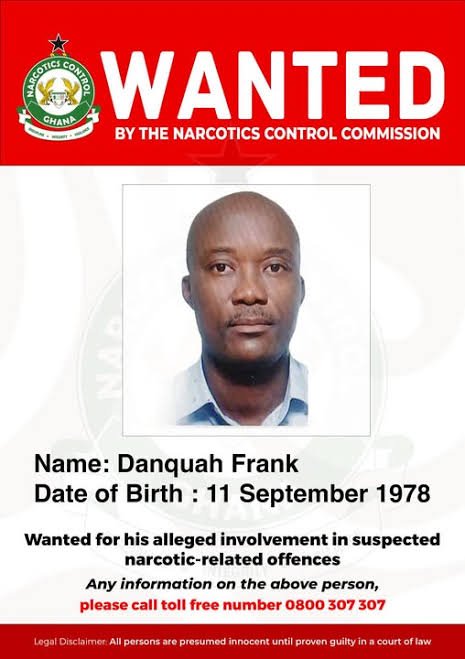
The Narcotics Control Commission (NACOC) on Tuesday, September 22, 2026, declared a 47-year-old man, Frank Danquah, wanted in connection with an alleged drug-trafficking incident.
A typical notice bordering on drug trafficking, the declaration was decidedly obscurantist, only listing Danquah’s date of birth September 11, 1978 and emphasizing that the then mysterious Frank Danquah was only a person of interest in connection to a drug trafficking incident. The terse notice then urged the public to alert NACOC if Danquah is ever encountered.
With the scanty information, The New Republic started digging after Danquah and soon outed him as a member of the opposition New Patriotic Party (NPP) at the Dome/Kwabenya Constituency branch. Our investigations also threw up the fact that Frank was a security staff at the Accra International Airport, formerly the Kotoka International Airport (KIA), and that he was apparently deployed there during the immediate past Akufo-Addo administration.
Up until this stage, the exact nature of the drug trafficking incident that Danquah was wanted for was not known but that is until recently.
The New Republic can report that Frank Danquah is wanted in connection with a September 14, 2026, cocaine bust in Brussels, the capital of Belgium, involving a Guinea-Bissauan drug mule called Seco Umaru Djau.
Djau had been arrested in Brussels with 9 kilograms of cocaine, with a street value of between US1.4 million, in a backpack that he had managed to smuggle through security checks at Ghana’s KIA through the instrumentality of Frank Danquah.
Per what investigation is throwing up, Danquah helped orchestrate the evasion by concealing the drugs in a toilet cubicle for Djau, so that the Guinea-Bissauan could go through checks with an empty bag, and then fill the bag with the cocaine after leveraging privacy to use the washroom at the airport.
Excerpts of a report from the Bureau of National Investigation (BNI), show clearly that the trafficking of the 9 kilograms of cocaine was due to a security lapse at the KIA that had been created by the Akufo-Addo government’s removal of NACOC from port security surveillance in 2018.
On September 6, 2026, Seco Umaru Djau, bearing passport number C00358166, arrived in Ghana on board a Royal Air Maroc Flight AT515 from Casablanca. He lived in the country for approximately eight (8) days.
Then, on September 13, 2026, at about 20:58 hours, he departed the Accra International Airport (AIA), formerly KIA, on board Brussels Airlines Flight SN277.
The next day, September 14, 2026, upon arrival in Brussels, Djau was intercepted by Belgian authorities in possession of approximately 9 kilograms of a substance suspected to be cocaine, with an estimated street value of between US1.4 million, contained in his backpack which he had carried with him from KIA.
The bust prompted investigation in Ghana by the BNI which, among other things, reviewed relevant CCTV footages at KIA. It was during the review that it became clear that CCTV had captured the Guinea-Bissauan passing through passport control with a black backpack worn on his back.
With the bag, he had proceeded through the central screening point without being detected or intercepted by Aviation Security personnel and was later engaged by officers of NACOC stationed along the departure corridor. At this stage, no prohibitive substance was found on him because the backpack was empty.
Subsequently, he entered one of the toilet rooms within the boarding-gate area of the airport where he is said to have spent a considerable period. At approximately 20:58 hours, Djau emerged from the washroom dressed entirely in black as he boarded the Brussels Airlines flight with flight number SN277 through Boarding Gate C3.
Apparently, the cocaine had been concealed in the toilet room for Djau by Danquah, who as an Aviation Security staff, had also used his official pass to clear the way for the Guinea-Bissauan to board the flight with the cocaine.
This is how close to 9 kilograms of cocaine was ferried through the Accra International Airport without detection until the mule, Djau, was busted in Brussels by Belgian officials.
The bust provoked immediate investigation in Ghana and when Danquah realized that an incriminating CCTV footage capturing him as facilitator existed, he went into hiding.
Meanwhile, the recent cocaine busts, including the 3.9 tonnes bust in Dunkirk, which was traced to Ghana, have since led to President John Mahama reversing the erstwhile Akufo-Addo government’s decision to remove NACOC from port surveillance and security duties.
On Wednesday, September 17, 2026, NACOC was ordered to be reinstated to joint container inspection and security duties at Ghana’s ports. President John Dramani Mahama issued the directive with immediate effect during a high-level emergency meeting at the Presidency. The decision was prompted by heightened scrutiny over port security following a massive drug bust in France, where French Customs intercepted 3.9 metric tonnes of cocaine hidden inside a shipping container that had originated from Ghana.
The reinstatement effectively reversed a 2018 port reform policy that had previously excluded NACOC from routine physical container inspections.
NACOC has since returned with a vengeance, beefing up surveillance and security checks that will now delay passengers by an estimated 3 hours.
The new development has provoked protest from the traveling public and also led to friction between NACOC and Aviation Security. However, NACOC’s Deputy Director General, Alexander Twum-Barima, has said that the new measures are a necessary evil, as inconveniencing as they may seem. Consequently, he has vowed that NACOC will not stand down.