

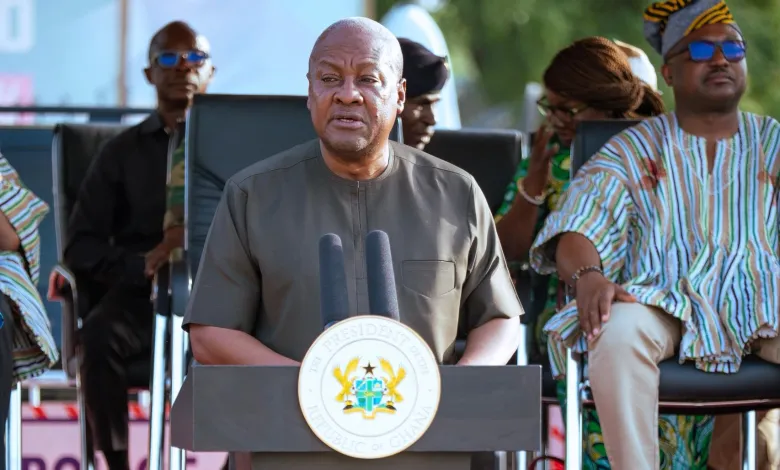
President John Dramani Mahama has launched the Ghana Cedi Heritage Series, a commemorative line of banknotes the Bank of Ghana says celebrates the nation’s history, culture and natural endowments, describing the currency as a “quiet ambassador” that introduces the country to the world before visitors ever set foot on its soil.
Speaking at the launch at the Bank of Ghana headquarters in Accra — on the same day Finance Minister Cassiel Ato Forson presented the 2027 Budget to Parliament — the President commended Governor Dr. Johnson Pandit Asiama, the Bank’s Board, Management and Staff, as well as international partners whose expertise supported the project.
“The story of the Cedi begins in our own heritage,” Mahama said, tracing the currency’s name to the Akan word for the cowry shell, which served as money in pre-colonial trade networks stretching from the markets of Salaga to coastal communities, exchanging goods such as salt and kola across the savannah, forest and coast.
He also recalled the gold dust trade, in which value was measured using carved gold weights — including the famous image of two crocodiles joined at the stomach, sharing one stomach.
“Whatever either eats nourishes both of them, so their common survival depends on recognising their shared interests,” he said, describing the symbol as a lesson in national unity that “remains relevant in Ghana today.”
“We may approach questions from different perspectives, but the consequences of our choices extend beyond ourselves,” the President said. “When our economy is strong, opportunity can spread. When our economy falters, families and businesses across the country are the ones that bear the burden.”
A Currency That Knows No Party
Mahama said the Cedi connects Ghanaians of every region, faith and political persuasion — from the Kente weaver in Bonwire and the fishermen of Elmina to the yam seller in Techiman, students buying gobe at Legon, and a grandmother in Bolgatanga helping to pay for her grandchildren’s uniforms.
“The Cedi knows no political parties. Its usefulness rests on the confidence that we Ghanaians place in it. Our heritage is shared equally,” he said, urging citizens to protect the unity the currency represents and to conduct public affairs with tolerance.
He said the new notes would also serve as a teaching tool, bringing national figures, historic places and cultural symbols “closer to our children” and prompting questions that deepen understanding of the country’s journey. “History belongs to our classrooms and museums, and it also deserves a place in our everyday lives,” he said.
Design and Rollout
According to the Bank of Ghana, the Heritage Series is a premium, collector-grade line whose designs draw on gold dust and weights, Adinkra symbolism, pre-colonial gold kingdoms, the independence era and highlights of the Fourth Republic, with themes honouring the nation’s founders.
The series features redesigned GH¢50, GH¢100 and GH¢200 notes and a new GH¢500 denomination.
Governor Asiama said the notes are printed on reinforced cotton paper designed to last longer than the notes they replace, and are smaller and easier to handle.
President Mahama assured the public that the new notes will circulate side by side with existing currency and are “not displacing” the old notes. “The banks will withdraw the old notes gradually until the new notes take over completely,” he said.
Currency and the Economy
Linking the symbolic launch to economic policy, the President said the Cedi “has travelled with us through difficult seasons” yet remains “an enduring expression of our economic sovereignty.”
He said the government’s response is the new economy programme anchoring the 2027 Budget presented to Parliament later in the day — a $10 billion, four-year programme aimed at transforming the structure of the economy so that Ghana “produces more of what we consume, processes more of what we grow, and earns more from what we export to the world.”
“Expanding and diversifying our exports can bring in more foreign exchange. Producing more at home can reduce our dependence on imports,” he said, adding that disciplined public finance and credible monetary policy would create the conditions for “a stronger, more stable Cedi, better able to withstand any global shocks.”
“For the trader, it should mean greater certainty when ordering their next consignment of supplies. For the manufacturer, it should give greater confidence when planning their production. For the family, it must give greater confidence that income and savings will meet their needs,” he said.
The launch comes as the Bank of Ghana approaches seven decades of service since its establishment in 1957. The President singled out the Ghanaian expertise behind currency-management systems the Bank developed in-house, encouraging it to “continue nurturing that expertise in service of our country.”
“From the cowry to the Cedi, the story of our currency reflects the journey of our people,” Mr. Mahama said. “May the Cedi build prosperity amongst all Ghanaians.”
By Gifty Boateng