

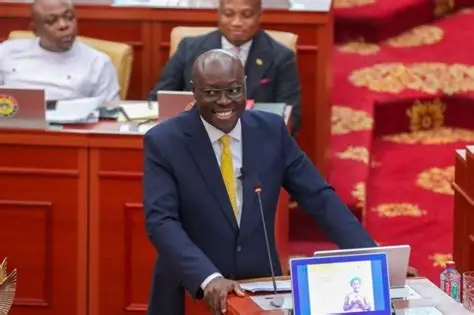
Finance Minister Dr. Cassiel Ato Forson has told Parliament that the fiscal buffers built during 2025’s painful adjustment protected Ghana from four major shocks that struck the economy in 2026 — shocks that, in previous years, would have derailed the country’s recovery.
Presenting the 2027 Budget Statement to the House on Thursday, the Minister said the economy was hit by a collapse in world market cocoa prices, a fire that gutted the Akosombo switchyard, devastating floods in June, and trade disruptions stemming from United States reciprocal tariffs on Ghanaian exports.
“In April, fire tore through the Akosombo switchyard and destroyed its control room. In a single blow, the entire 1,020 megawatt capacity of the Akosombo plant was stranded,” Dr. Forson recounted. He added that in June, unprecedented rains brought floods that claimed lives, displaced families, destroyed businesses and damaged public infrastructure.
Resilience, not crisis
Despite the four shocks, the Minister said Ghana did not slip back into crisis, as it may have done in the past.
“In years past, any one of these shocks would have sent us back into crisis. This time, it did not,” he declared.
He noted that inflation remained in single digits at 5.5 percent by October 2026, while the economy grew strongly at 6.2 percent by half-year — even as government increased investment in the economy.
Government responded to the June floods by reallocating resources within the budget already approved by Parliament, Dr. Forson said, insisting that the state neither resorted to Bank of Ghana financing of the budget nor allowed new expenditure arrears to build up.
“In the year it would have been easiest to abandon the fiscal rules, we held on to our discipline,” he stressed.
2025 built the buffers
According to the Minister, the resilience was no accident.
The “discipline of 2025” — which saw government create over GH¢16 billion in fiscal space through expenditure cuts and revenue measures, run a primary surplus of 3.7 percent of GDP, and grow gross international reserves to US$8.3 billion (more than four months of import cover) — created the cushion that absorbed the 2026 shocks.
“A strong primary surplus and healthy external reserves meant that when the shocks came, we absorbed them rather than passing them on to Ghanaian families,” he said.
Dr. Forson told the House: “Stability is not proven in calm years. It is proven in years like this — like 2026. We weathered the storm.”
By Gifty Boateng