

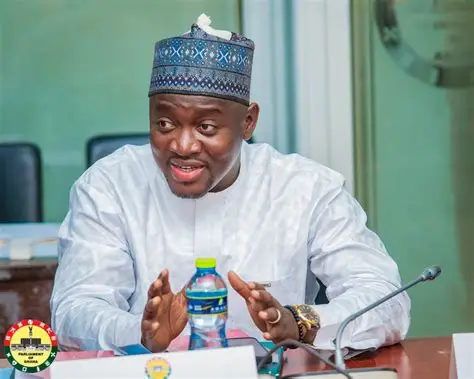
Member of Parliament (MP) for Tamale North and Deputy Minister for Roads and Highways, Alhassan Suhuyini, has provoked a fresh internal debate within the governing National Democratic Congress (NDC), questioning whether the party rather than the government is to blame for the growing disconnect between the two.
In a write-up shared on his social media pages, the deputy minister acknowledged concerns by party comrades that, while the Mahama-led government is performing well on the economy and infrastructure, it risks drifting away from the party that brought it to power.
But he argues that responsibility for closing the gap lies, in part, with party leadership itself.
Suhuyini opened with a characteristically wry reflection on his history of raising contentious issues within the party.
“It’s been a long time since I stirred an unpopular intellectual conversation in our party,” he wrote.
“The last time I did so in opposition, I received an invitation to our party’s FEC meeting. My younger brother did the same this year and was invited too. So this should surprise no one; it’s in our genes to be unconventional sometimes, regardless of the circumstances.”
He conceded that there is “some merit” to complaints of a growing gap between government and the party — a feeling he says he senses even in his own constituency — but went on to ask: “Whose responsibility is it to fix that?”
Suhuyini traced the origins of the current arrangement to the start of the administration, when party leadership successfully argued for a say in appointments.
“At the inception of this government, party leadership rightly argued that it should have a hand in choosing some members of the government,” he noted. “That was granted, and the party became responsible for choosing MMDCEs and regional ministers.”
He explained that the party settled on constituency and regional executives as the base of that process — some 216 plus 16 appointees — while the President’s own appointments were limited to fewer than 40 ministers, alongside some CEOs and board members.
According to him, the government has matched that arrangement with historic funding to local government the very level the party was responsible for staffing.
He cited figures showing that while district assemblies received a total of GH¢390 million for the whole of 2024, the first quarter of 2025 alone saw allocations of GH¢987 million. By the end of 2025, assemblies had received over GH¢6 billion, and by the third quarter of this year, about GH¢5.7 billion had been released.
“In two years, local government has been resourced by over GH¢11 billion,” he stated.
With those facts laid out, Suhuyini posed what he described as the central question of his argument.
“After party leadership rightly argued for and supervised the appointment of party people at the local government level, how have they ensured that these appointees have used these unprecedented resources to carry the party along, alongside their foremost responsibility of nation-building?”
He asked whether party leadership designed any system to orient and monitor the appointees it secured positions for, to ensure proper use of government resources and to bridge the recurring disconnect between party and government.
“Did the party ever organize an orientation for the appointees it selected? After all, all politics is local,” he wrote.
The deputy minister then offered a conclusion he admitted could prove explosive: that the apparent disconnect may stem from ambitions within the party itself.
“Would I be wrong, therefore, to conclude that the seeming disconnect may be because some who chose to remain and serve at the party level subtly wish to take over the government, instead of truly working with the comrades they appointed at the local level who have been so well resourced by the government to advance the cause of the party through effective and efficient governance?”
He signed off with a warning of sorts: “I mean well, but I fear it may come across as war.”