

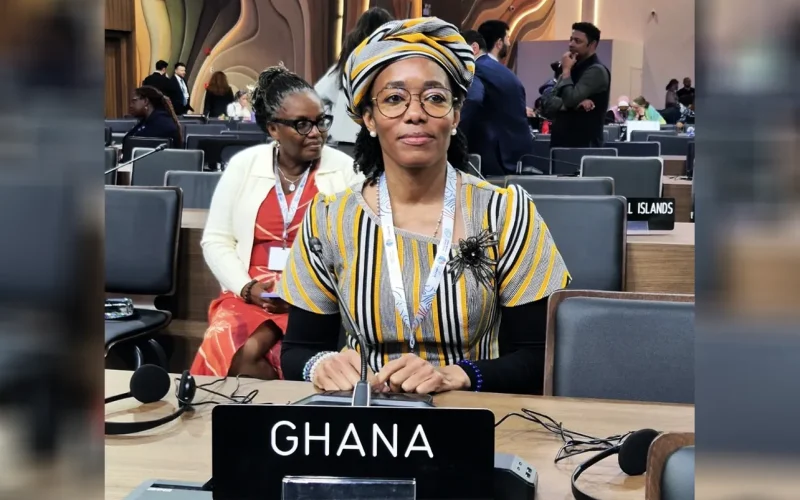
Dr Zanetor Agyeman-Rawlings issues the warning at the national launch of the Water Restoration and Management Framework in Ho, as EPA and regional authorities pledge to move the framework “from legal mandate to lasting environmental recovery.”
The Minister for Environment, Science and Technology, Dr Zanetor Agyeman-Rawlings, has described illegal mining as an act of criminal terrorism, warning that perpetrators must not be shielded from prosecution and calling on traditional authorities and politicians to stop interceding on their behalf.
Dr Zanetor was speaking at the national launch of the Water Restoration and Management Framework in Ho, the Volta Regional capital an initiative the government says will set clear standards for rehabilitating water bodies destroyed by illegal mining, popularly known as galamsey.
“As we launch this framework, our objective is clear: stop the pollution at its source, restore the degraded water bodies and protect the gains we make,” she said.
She said the destruction of forest reserves and the pollution of water bodies caused by illegal mining pose serious threats to public health and national security — and the time for euphemism was over.
“Whatever the case might be, it is time for us to accept the fact that these are criminals engaged in criminal terrorism. That is what this is,” she stressed.
In a direct message to chiefs, politicians and other influential figures, the Minister demanded that those arrested for poisoning water bodies and lands face the full rigours of the law — without intervention from above.
“When those who are engaged in these criminal activities of poisoning our water bodies and our lands are apprehended and arrested, please don’t go and beg for them,” she said. “They are killing you; they are killing us.”
She also urged Metropolitan, Municipal and District Chief Executives (MMDCEs) to take the lead in the fight against illegal mining by identifying and dealing with perpetrators at the local level.
The Water Restoration and Management Framework is expected to establish clear criteria for approving restoration projects, prescribe approved methods and logistics, and strengthen monitoring and enforcement to ensure the sustainable restoration of degraded water bodies.
The Acting Chief Executive of the Environmental Protection Authority (EPA), Professor Nana Ama Browne Klutse, said the Authority is committed to ensuring that restoration initiatives deliver lasting environmental recovery rather than symbolic action.
“We want to move from legal mandate to sustainable restoration. This is a vision we are looking to achieve,” she said. “We want a shared goal strong regulation, shared responsibility and to ensure we have lasting environmental recovery.”
The Volta Regional Minister, James Gunu, cautioned against allowing the framework to become yet another policy document without practical implementation, calling for the resources and institutional support needed to translate its objectives into tangible results.
“We must avoid the situation where important policy documents are launched, discussed and disseminated, only for them to remain on the shelves without producing the desired results,” he said.
Gunu also called for a change in public attitudes towards environmental protection, saying responsible environmental practices must become part of everyday life, institutional operations and the country’s national development agenda.
Participants at the launch underscored the need for stronger collaboration among government agencies, traditional authorities, civil society organisations, local communities and other institutions to ensure the successful restoration of degraded water bodies.
Speakers from the Minerals Commission, the Water Resources Commission, private dredging and remediation firms, faith-based groups and civil society organisations pledged support for the framework while also pressing for political will, the resourcing of frontline enforcement bodies such as NAIMOS and the Forestry Commission, and accountability for duty-bearers at all levels.