

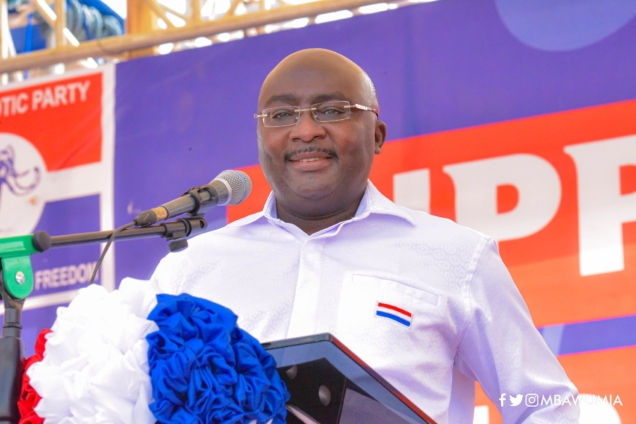
…Claims Ato-Forson’s Budget is a spin
By Gifty Boateng
When Finance Minister Dr. Ato Forson stood before Parliament on July 23 to present the 2026 Mid‑Year Budget Review, the message was one of recovery: inflation tamed, the cedi stable, debt‑to‑GDP down from 61.8% to 45%. The government painted a picture of a nation turning a corner.
And a new poll, released just days later by GlobalInfo Analytics, suggests the public agrees: 60% of voters say Ghana is moving in the right direction, and 72% approve of President John Mahama’s performance.
But in a country where economic data is often as contested as the election results themselves, a group of academics some with deep ties to the opposition New Patriotic Party and its 2028 flagbearer, Dr. Mahamudu Bawumia is asking a pointed question: Are the numbers too good to be true?
The ‘Hit Squad’ Goes to Work
The Institute for Economic Research and Public Policy (IERPP), a think tank composed of senior lecturers from the University of Ghana, GIMPA, and UPS‑A, has issued a detailed critique of the budget review. In a statement released on July 26, the IERPP acknowledged improvements in key indicators but argued that the government’s accounting is selective and that critical obligations have been left unexplained.
The Institute’s members are not neutral observers. Several have direct ties to the NPP: Dr. George Domfe is a former NPP parliamentary aspirant; Dr. Kwasi Nyame‑Baafi serves as the party’s National Deputy Director for Research and a technical advisor to Dr. Bawumia. The group has been dubbed “Bawumia’s Hit Squad” by political observers, and just two weeks ago it gave President Mahama a score of 4.9 out of 10 in a performance tracker report.
Yet their latest critique is not easily dismissed as partisan sniping. It is grounded in data, documents, and a series of specific, unanswered questions many of which are precisely the kind that a responsible government should be prepared to answer.
What the Budget Left Out
The IERPP’s main grievance is that the review glossed over several flagship programmes and fiscal details that matter to ordinary Ghanaians.
1. The 24‑Hour Economy
The government’s signature jobs initiative received GH¢110 million in the 2026 budget. The mid‑year review did not mention it. How many jobs have been created? How many companies are participating? The IERPP says there is no data.
2. Nkonko‑Nkitinkiti
A poultry industry programme allocated GH¢245 million to boost local production and reduce imports. The review was silent on its progress. The Institute’s statement: “Citizens deserve transparency, not silence.”
3. The Debt‑to‑GDP Mirage
The government touted a drop from 61.8% to 45% of GDP. But the IERPP cites Bank of Ghana data showing that absolute public debt rose from GH¢663.4 billion in January to GH¢720.8 billion in May an increase of nearly GH¢57 billion in five months. The absolute debt is essentially unchanged from December 2024’s GH¢726 billion. The Institute argues that “a gloomier reality is masked beneath a seemingly attractive ratio.”
4. The Missing Billion
Parliament approved a US$1 billion financing facility in recent months, but the budget review did not explain its purpose or how it fits into the debt stock. The Institute: “An account of the debt that leaves out a recently approved billion‑dollar facility is not yet a full account.”
5. Free SHS and the ‘No Loans’ Pledge
The review allocated GH¢1.8 billion to Free SHS, but the IERPP points to a separate US$300 million World Bank/IDA loan for school infrastructure. The government insists the loan is only for buildings, not recurrent costs. But as the Institute asks: “Ghanaians who were told ‘no loans’ deserve to know plainly whether that now means ‘no loans for the parts we choose to count.’”
6. The Frozen Contingency Fund
The Emergency Fund has been frozen by a High Court garnishee order, yet the budget review did not explain the underlying liability or the court action. “A national emergency fund, frozen by a court over an unexplained judgement, is not a footnote; it is the headline,” the statement reads.
7. Floods and Delayed Solutions
The government has reallocated GH¢226 million for interim flood mitigation, but a permanent solution has been deferred until the 2027 budget. The Institute’s sharp retort: “A promise to fix the roof next year, made while standing in this year’s rain, is not yet a solution; it is a plan to plan.”
8. SOEs and the Bank of Ghana
The review acknowledged that state‑owned enterprises have accumulated liabilities equivalent to about 3% of GDP annually over a decade, and that a GH¢5 billion bond was issued to recapitalise the central bank in March 2026. But it did not disclose the total value of SOE liabilities or the Bank of Ghana’s overall capital shortfall.
The Poll Paradox
The contrast is striking: while the IERPP picks holes in the official narrative, the GlobalInfo Analytics survey suggests that voters are not troubled. At 72% approval, President Mahama’s numbers are among the highest for any president in recent memory. The poll, conducted on July 27, shows that 60% of voters believe the country is on the right track.
But polling in Ghana has been notoriously volatile, and the IERPP’s questions are not about public sentiment they are about public accountability. As the Institute puts it: “Progress and transparency are not rivals; they are partners. A government confident in its record should embrace both achievement and disclosure in equal measure.”
What the Government Hasn’t Said
The Ministry of Finance has not yet responded to the IERPP’s detailed critique. When asked by this newspaper for clarification on the US$1 billion facility, the frozen Contingency Fund, and the absolute debt figures, a ministry spokesperson said they would “address these issues in due course” but offered no timeline.
In the absence of clear answers, the IERPP’s questions hang in the air. They are not partisan attacks; they are legitimate demands for transparency from a sovereign state that is asking its citizens to trust its economic stewardship. And they come at a time when the government’s own fiscal space is shrinking.
The Real Story Behind the Recovery
The 2026 Mid‑Year Budget Review may have painted a picture of recovery, but the IERPP’s analysis suggests that the picture is incomplete and perhaps misleading. The drop in the debt‑to‑GDP ratio is largely a function of GDP growth and currency revaluation, not a reduction in absolute obligations. The GH¢1 billion loan is on the books, but its terms and purpose remain opaque. And the Free SHS policy, a cornerstone of the government’s social agenda, is being partly financed by a loan that the public may not fully understand.
For now, the government enjoys high public approval. But as the IERPP notes, “A credible accounting requires more than a catalogue of achievements; it demands an honest reckoning with the gaps and unexplained figures that remain.” If the government cannot provide that reckoning, the gap between perception and reality may eventually close — and when it does, the political consequences could be severe.