

By Leo Nelson
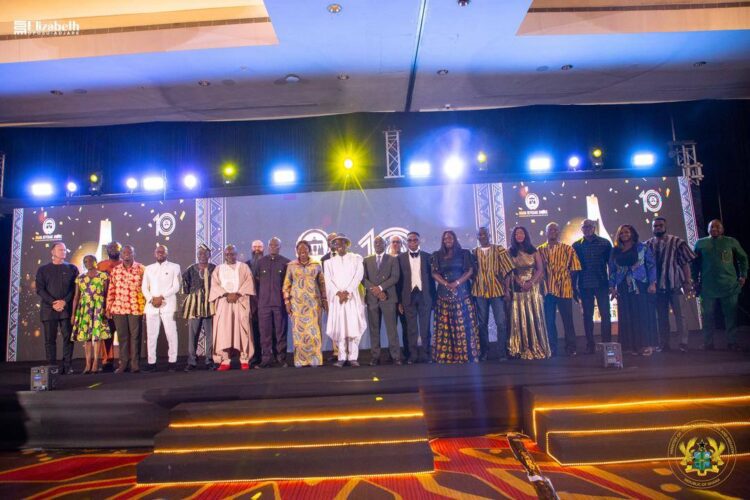
In a landmark celebration of industrial resilience and homegrown innovation, the Minister for Trade, Agribusiness, and Industry, Hon. Elizabeth Ofosu-Adjare, has announced the revival of the “Made-In-Ghana Fair,” at the 10th-anniversary edition of the Ghana Beverage Awards (GBA) recently held in Accra.
Speaking at the event on behalf of President John Dramani Mahama, the Minister positioned the fair as a cornerstone of the government’s strategy to elevate local beverage brands to global standards. Her remarks underscored a sovereign commitment to transforming the beverage sector into a powerhouse of job creation and economic stability.
The event, themed “A Toast to Ten,” served as both a retrospective of a decade of growth and a launchpad for aggressive new industrial policies.
“The fair will serve as an important tool for promoting local products and enhancing the image of Ghanaian brands, both locally and internationally. It is a vital platform that will allow Ghanaian beverage producers to showcase their products and boost consumer confidence in homegrown brands.”
For the Ministry of Trade, Agribusiness, and Industry (MoTAI), the beverage sector is no longer viewed as a peripheral industry but as a critical intersection where agriculture, manufacturing, and retail converge – and the government aims to bridge the gap between production and consumer confidence, ensuring that “Made in Ghana” becomes synonymous with premium quality.
Ofosu-Adjare’s address highlighted the beverage industry’s multifaceted role in the Ghanaian economy. From the smallholder farmers supplying raw materials to the high-tech manufacturing plants and the expansive hospitality networks, the sector’s footprint is vast.
She emphasised that the industry’s strength lies in its ability to “support livelihoods across the entire value chain,” noting that the government’s renewed focus is being established to protect these livelihoods while scaling the sector’s contribution to the Gross Domestic Product (GDP).
Central to this scaling effort is the “Feed the Industry” initiative, which is expected to create ironclad linkages between the agricultural heartlands and urban manufacturing hubs by ensuring that beverage producers have a consistent, high-quality supply of local raw materials, to reduce import dependency and insulate the industry from global price shocks.
This initiative, paired with the upcoming Agribusiness Policy, according to the Trade Minister, will provide a strategic framework for local businesses to expand their footprint beyond domestic borders.
The most significant takeaway from the 10th Ghana Beverage Awards was the official disclosure of the Made-In-Ghana Fair’s return. For years, the fair served as a vital marketing engine for local producers, and its revival is seen as a direct response to the industry’s need for better visibility.
The Minister noted that the fair would not only serve as a promotional tool but also as a platform to test consumer trends and refine product branding for the international market. It is intended to act as a catalyst for consumer confidence, showcasing the sophistication and diversity of Ghanaian beverages.
Ranging from traditional brews to modern carbonated drinks and spirits, the Ministry hopes to shift the “status quo” of consumer preference toward homegrown brands. This push is part of a larger “sovereign brand” strategy that seeks to make Ghanaian products competitive under the African Continental Free Trade Area (AfCFTA).
The 10th edition of the awards also brought a forward-looking perspective on technology, with Ernest Boateng, CEO of Global Media Alliance, challenging industry players to move beyond traditional manufacturing methods and embrace the digital revolution.
Specifically, he highlighted Artificial Intelligence (AI) as a transformative tool for the beverage sector. In an era of shifting consumer tastes and volatile global markets, AI offers the predictive power necessary for local brands to stay ahead of the curve.
Boateng argued that AI-driven tools could revolutionise how Ghanaian beverage companies operate, particularly in predicting market trends, managing complex supply chains, and tailoring products to specific consumer preferences.
The integration of AI into the “Feed the Industry” framework could allow manufacturers to better synchronise their production schedules with harvest cycles, further reducing waste and improving operational efficiency.
The Minister’s remarks made it clear that the Mahama administration views value addition as the primary metric for success. The upcoming Agribusiness Policy is expected to provide incentives for beverage companies that invest in local processing and packaging.
Ghanaian companies can capture a larger share of the profits that are currently lost to the export of raw materials and the import of finished goods by moving further up the value chain.
The Ghana Beverage Awards has, over the last decade, become the ultimate audit of the industry’s progress. As the sector enters its second decade under the “Toast to Ten” banner, the focus shifts from mere participation to global dominance.
Ofosu-Adjare urged industry leaders to maintain high standards, noting that the government’s role is to provide the infrastructure and policy “wind in their sails,” but the industry’s role is to innovate and maintain the quality that will make Ghanaian brands household names across the continent.
As the curtains fell on the 10th Ghana Beverage Awards, the message from the Ministry of Trade, Agribusiness, and Industry was one of aggressive optimism.
The combination of the Made-In-Ghana Fair, the Feed the Industry initiative, and the adoption of AI-driven technologies paints a picture of an industry ready for its next evolutionary step.
By aligning local production with global technological trends, Ghana is positioning its beverage sector as a flagship of African industrialisation.