

…as Ghartey Takes Aim at Chief Justice
TNR Files
The political temperature surrounding the Ghana Bar Association (GBA) has risen sharply after its President, Efua Ghartey, publicly criticised Chief Justice Paul Baffoe-Bonnie over remarks he made praising the performance of state institutions under the Mahama administration.
What might have been a routine professional intervention has quickly evolved into a wider debate about the perceived politicisation of the country’s oldest legal professional body, placing the GBA leadership under intense scrutiny.
Addressing the opening session of the GBA Annual Conference in Ada, Ghartey questioned the propriety of comments made by the Chief Justice during a recent visit to the Minerals Income Investment Fund (MIIF), where he reportedly commended developments under the current government. The GBA President argued that members of the judiciary must avoid creating any impression of alignment with the executive arm of government.
Her intervention immediately ignited controversy across the political divide.
For critics, the comments were not merely about judicial independence. They were seen through the prism of Ghartey’s own political associations and the increasingly contentious debate over the GBA’s neutrality.
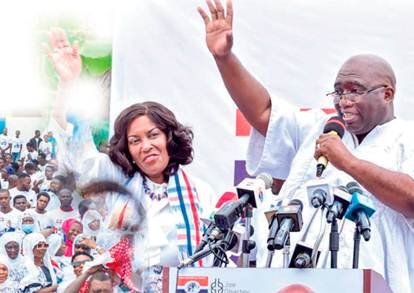
Ghartey is married to Joe Ghartey, a former Attorney-General, former Railway Development Minister, long-time New Patriotic Party (NPP) stalwart and former presidential aspirant. Her political opponents frequently point to her public appearances at key NPP activities and events as evidence of what they describe as her closeness to the party.
Supporters reject suggestions that her marital ties or past political associations should diminish her professional independence. Critics, however, insist that the optics have become increasingly difficult to ignore.
The controversy has been further amplified by claims from sections of civil society and political observers that the GBA has become more vocal since the NPP’s departure from power. Those accusations have intensified following the Association’s criticism of the Chief Justice while simultaneously raising concerns about what detractors describe as selective interventions on national issues.
Adding another layer to the political intrigue is the fact that Ghartey had long been perceived by some observers as being close to the previous judicial administration led by the suspended Chief Justice. While no evidence has been presented that such relationships influenced official decisions, opponents have seized on those perceptions to question the GBA’s posture in the ongoing political environment.
The backlash reached government circles almost immediately.
Attorney-General and Minister for Justice Dr Dominic Ayine, through Deputy Attorney-General Dr Justice Srem-Sai, launched a forceful rebuttal, cautioning the GBA against straying into partisan politics and calling on the Association to preserve its independence.
Srem-Sai argued that the Bar had displayed inconsistency in its interventions, accusing it of becoming increasingly selective in determining when to speak and when to remain silent. He questioned why earlier commendations of state institutions by senior judicial figures had not generated similar responses from the Association.
The dispute has exposed deeper tensions within the legal fraternity at a time when confidence in national institutions remains under pressure.
Beyond the controversy over the Chief Justice’s remarks, Ghartey also used her conference address to criticise government’s handling of illegal mining, warning that campaign promises would amount to little unless matched by sustained and impartial enforcement. She stressed that politically connected individuals must not be shielded from accountability.
Yet it is the growing debate about the GBA itself that is now dominating headlines.
Within legal and political circles, questions are increasingly being asked about whether the Association is drifting away from its traditional role as an independent professional body and becoming entangled in partisan battles. Critics say the perception alone is damaging, while supporters argue that robust interventions on public matters are precisely what the Bar is expected to undertake.
Whatever the answer, the episode underscores the mounting pressures facing Ghartey’s leadership. As political divisions deepen and the NPP adjusts to life in opposition, the GBA President finds herself at the centre of a fierce national debate over judicial neutrality, professional independence and the increasingly blurred lines between law and politics.
For an institution that has historically positioned itself above partisan combat, the storm now engulfing the Bar may prove to be its most significant credibility test in years.