

After 10years of Missing Targets
Front Desk Report
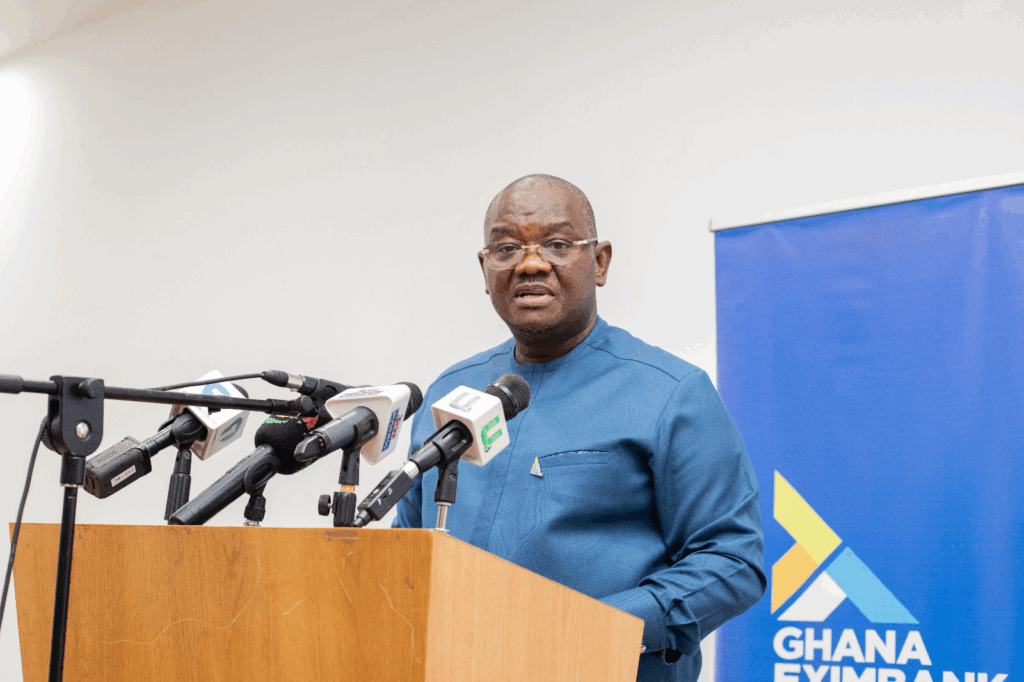
The Ghana Export-Import Bank (GEXIM) launched a year-long celebration this week to mark its 10th anniversary, framing the milestone as a chance to “reset” its role in boosting the nation’s exports.
But the fanfare for “GEXIM@10” arrives as Ghana’s broader trade imbalance remains stubbornly entrenched, raising questions about the state-backed lender’s impact and its future direction.
Established in 2016 with a mandate to transform Ghana from a raw material exporter to a producer of value-added goods, GEXIM has positioned itself as a provider of “patient capital” for local businesses.
At a press launch, CEO Sylvester Adinam Mensah described export-led growth as “a system” requiring finance, risk-mitigation, and market intelligence. Board Chairman Dr. Joseph Nyarkotei Dorh called the bank a “strategic enabler.”
Yet, a decade on, concrete, publicly available data on the bank’s performance how many jobs its financing has created, the exact value of non-traditional exports it has enabled, or the repayment rates on its loans remains scarce.
This anniversary “reset” highlights the perennial challenge for Ghana’s development finance institutions: balancing ambitious public mandates with the hard metrics of commercial viability and demonstrable economic impact.
“GEXIM has played a critical role in strengthening this system by supporting Ghanaian enterprises to expand production, improve quality, diversify exports and access new markets,” Mensah told reporters.
The centerpiece of the anniversary is a high-level international conference scheduled for late March, themed “A Decade of Enabling Export Trade and Industrial Transformation: Resetting GEXIM for the Next Frontier.”
The event aims to gather export credit agencies, investors, and businesses to discuss blended finance, digital tools, and unlocking capital for small and medium-sized enterprises (MSMEs).
Sessions will focus on priority sectors like garments, poultry, rice, and oil palm industries long identified as having export potential but which have struggled against cheaper imports and production constraints. The agenda suggests an acknowledgment that past strategies require overhaul.
This introspection comes as GEXIM begins a new five-year strategic plan. The bank’s leadership is calling for “bold collaboration” and urging the media to help shift national discourse toward value addition and competitiveness.
However, development finance analysts note that GEXIM operates in a difficult ecosystem. Ghanaian exporters often face high production costs, unreliable power, and stiff competition in regional markets.
The bank’s ability to “reset” growth may be less about its own policies and more about its capacity to navigate these systemic hurdles that have stifled local industry for decades.
“Anniversaries are a moment for branding and vision,” said Ama Serwah, an independent trade policy analyst. “The real test for GEXIM’s next decade will be transparency and targeted efficacy.
Can it move from being a lender of last resort to a catalyst that demonstrably changes the export profile of specific sectors? The conference themes are right, but the proof will be in the disbursements and their outcomes.”
For now, GEXIM@10 is a promise of a more assertive future. The bank has announced plans for an AGROTECH fair and corporate social responsibility projects alongside the conference.
But as the celebrations unfold, the key metrics to watch will be those not on the anniversary agenda: the dollar value of new exports financed, the survival rate of supported businesses, and whether Ghana’s trade balance begins to reflect a decade of the bank’s work.