

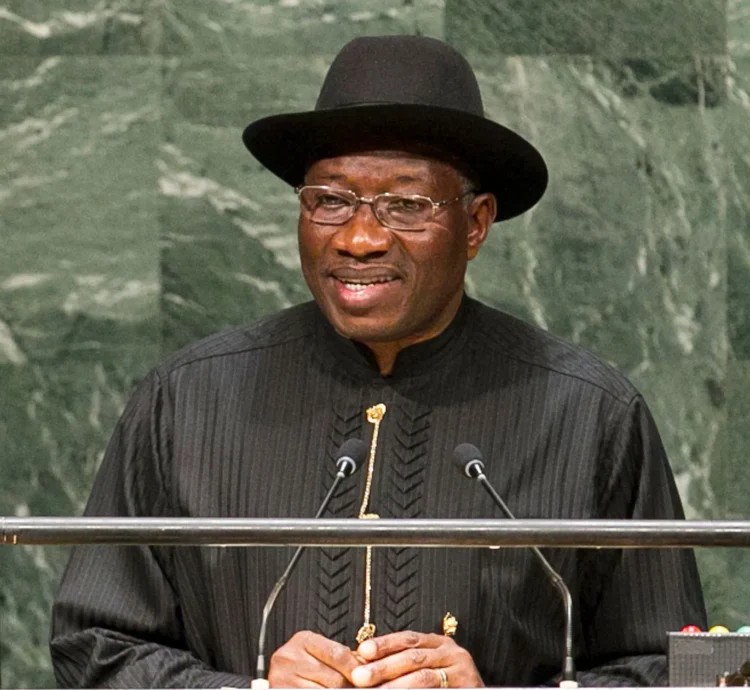
Former Nigerian President Goodluck Jonathan has strongly defended his time in office, maintaining that his administration acted in the best interests of the country despite renewed criticism over his leadership record.
His defence come after former Vice President Atiku Abubakar described Jonathan as inexperienced during a recent televised interview, triggering fresh debate within Nigeria’s political space over past administrations and leadership performance.
The Former Vice President, revisited Jonathan’s presidency and questioned his capacity to manage national challenges at the time.
Speaking at the Association of Retired Career Ambassadors of Nigeria awards ceremony in Abuja, Nigeria’s former President, Goodluck Jonathan indicated that public office inevitably involves mistakes, stressing that governance should be assessed in its entirety.
“If I made mistakes, yes, nobody who becomes a governor or a president will say you did not make mistakes. Even when you promote yourself to the level of a god, you become a deity. All human beings must make mistakes. I became president in 2010 at the age of 53. I left in 2015 at the age of 58, and they say I was too young. Must it have been 100 years before I ran the affairs of the state?”
Goodluck Jonathan maintained that his administration was not defined by errors alone but by its efforts to govern under complex national and international conditions. He added that leadership experience should be viewed in context, especially in countries facing multiple political and security pressures.
He also defended his record in foreign relations, pointing to Nigeria’s visibility on the global stage during his tenure. “I’m talking to diplomats, so I can say that during my period, I knew what I did for us to appear in the UN Security Council two time. If I were so naive, I don’t think I would have been able to navigate through that process,” he stated.
Beyond the political conversation, Jonathan utilised the event to emphasise the value of regional cooperation in West Africa and to call for increased cooperation among ECOWAS members in order to guarantee long-term political stability and economic integration.
The Economic Community of West African States (ECOWAS) generally seeks to foster economic integration in a variety of areas, including industry, transportation, telecommunications, energy, agriculture, natural resources, trade, monetary and financial challenges, and social and cultural concerns.
According to Gooduck Jonathan, the success of regional development efforts depends on sustained institutional strength and coordinated political will across West African governments. He added that socio-economic development cannot be achieved without stable democratic systems capable of supporting regional ambition.
Jonathan also encouraged Nigerian diplomatic institutions to strengthen documentation of foreign policy experiences, arguing that preserving institutional knowledge is essential for guiding future decision-making in international relations.
The event also featured reflections on the origins of ECOWAS by former Head of State Yakubu Gowon, who revisited the early diplomatic processes that led to the creation of the regional bloc in the 1970s.
Gowon explained that ECOWAS was the result of extensive consultations among West African leaders following a period of regional political and economic challenges. He emphasised that its formation was rooted in collective effort rather than individual leadership “This would not have been possible without the support of all the staff of the Ministry of External Affairs and the Ministry of Economic Development,” he stated.
The former head of state added that the organisation’s creation reflected a shared vision among West African states seeking closer cooperation and long-term regional integration.
Additionally, Lt Gen Waheed Shaibu, Chief of Army Staff, paid tribute to Yakubu Gowon, describing his leadership as a model of unity, discipline and national duty.
He added that the Association of Retired Career Ambassadors of Nigeria continues to play an important role in shaping dialogue on governance, diplomacy and Nigeria’s engagement with the international community, emphasising its relevance in today’s evolving global landscape.
Moreover, the President of the Association of Retired Career Ambassadors, Joe Keshi, indicated that “diplomacy is one profession where success is often invisible, reflected not by news coverage, but by maintained stability, prevented conflicts, cultivated partnerships.”
Keshi further described ECOWAS as a “bold experiment in regionalism,” particularly as it marks its 50th anniversary, and stressed the importance of adapting diplomacy to emerging global challenges including insecurity, climate change, and economic transformation.
He also paid tribute to diplomats and public servants whose contributions, he said, are often “unrecognised despite their impact on peace and cooperation across the region.”