

…as Ghana Posts Record Gains
By TNR Files
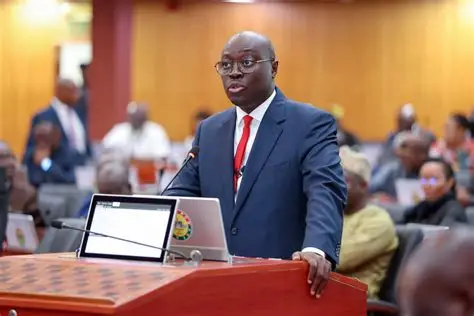
Ghana’s 2026 Mid‑Year Fiscal Policy Review landed in Parliament on Thursday with the force of a political audit and the confidence of an administration convinced it has engineered an economic turnaround few thought possible. Finance Minister Dr. Cassiel Ato Forson, presenting on behalf of President John Dramani Mahama, delivered a speech that read less like a routine fiscal update and more like a verdict on two years of economic repair.
At its core, the Review is a simple message: the crisis is over, the recovery is real, and the Mahama administration wants the country to remember how bad things were and how quickly they claim to have fixed them.
Forson opened with a reminder of the floods that devastated parts of Ghana and the wider West African coastline, but quickly pivoted to the economic catastrophe inherited in January 2025. In language unusually blunt for a mid‑year review, he accused the previous administration of “wrong policy choices… reckless spending… binge borrowing… and a failure to level with the people of Ghana about the true state of the economy.”
The consequences, he said, were historic:
• inflation above 50%,
• a cedi in freefall,
• investor confidence “collapsed”,
• reserves “extremely low”,
• and a debt restructuring that imposed “painful haircuts” on domestic and external bondholders including pensioners.
The Minister’s refrain “Never again!” was not subtle. It was political, deliberate, and aimed at cementing the narrative of a government that rescued a sinking ship.
Africa Confidential readers will recognise the architecture: Forson laid out three Key Transformational Policy Reforms (KTPs) that he says explain Ghana’s rapid rebound.
1. Fiscal Correction The Hard Reset
Government slashed primary expenditure from 18.7% of GDP in 2024 to 13.2% in 2025, restored a primary surplus, and amended the Public Financial Management Act to impose a legally binding minimum 1.5% primary surplus and a 45% debt‑to‑GDP ceiling by 2034.
A new Commitment Authorisation regime now forces Ministries and State‑Owned Enterprises to spend only what is budgeted a direct response to SOEs whose liabilities added 3% of GDP annually to public debt over the past decade.
2. Modernising the Tax Regime Relief, Not Rates
The government abolished the E‑Levy, Betting Tax, COVID‑19 Levy, Emissions Levy and VAT on motor insurance. Yet non‑oil tax revenue rose from 12.6% to 13.1% of GDP in 2025 a counterintuitive outcome Forson attributes to compliance reforms and AI‑powered customs systems that boosted monthly collections by 15%.
3. Complementary Fiscal Policy for Inflation & FX Stability
The creation of the Ghana Gold Board (GoldBod) is arguably the administration’s most consequential reform. By formalising gold flows and curbing smuggling, Ghana generated US$15 billion in additional FX inflows, pushing the current account surplus from 1.9% to 8.3% of GDP in a single year.
Forson framed GoldBod not as a mining policy but as a macroeconomic stabilisation tool designed to strengthen the cedi and rebuild reserves.
The Review’s data points were delivered with prosecutorial precision:
• Real GDP growth: 6.0% in 2025; 6.4% in Q1 2026.
• Non‑oil GDP: 7.6% highest in 14 years.
• Inflation: down from 23.8% (Dec 2024) to 5.4% (Dec 2025), holding at 5.7% in June 2026.
• Debt‑to‑GDP: collapsed from 61.8% (2024) to 44.7% (2025), hitting 45.0% by June 2026 meeting the statutory target eight years early.
• Cedi performance: appreciated 40.7% against the USD in 2025.
• Interest rates: 91‑day T‑bill down from 11.09% to 5.73%; Monetary Policy Rate slashed from 27% to 14%.
• Poverty: 950,000 Ghanaians moved out of multidimensional poverty in one year.
Forson’s argument is clear: these are not statistical coincidences but the fruits of “superior economic management”.
The speech’s closing tone was unmistakably electoral though carefully framed within the boundaries of a fiscal review.
Forson addressed traders, entrepreneurs and workers directly, insisting that improved purchasing power, lower interest rates and a stable cedi are “the dividends of sound and competent economic management.”
He added: “Under the leadership of His Excellency President Mahama, Ghana is not going back. Ghana is moving forward.”
Africa Confidential readers will recognise the pattern: a technocratic narrative deployed to justify political continuity.
The Mid‑Year Review is both a fiscal document and a political manifesto disguised as one. It seeks to lock in a storyline: Ghana was broken, Mahama fixed it, and the numbers prove it.
Whether voters agree is another matter entirely but the administration has now placed its economic record squarely at the centre of the national debate.