

Oceana, the world’s largest international advocacy organization dedicated solely to ocean conservation, has officially established its first African headquarters in Accra, Ghana, marking a landmark development for maritime conservation across the continent.
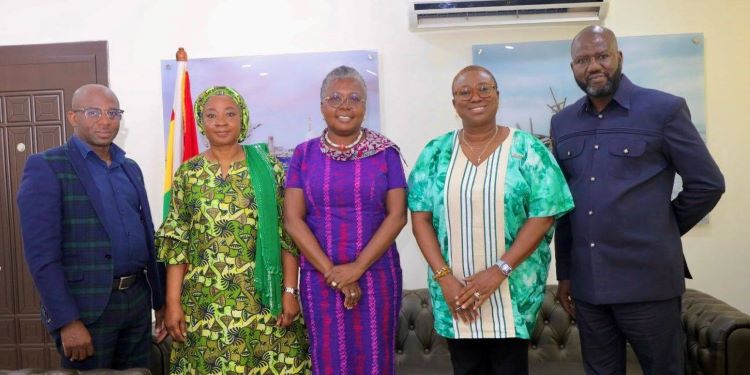
The historic move was solidified during a high-level diplomatic engagement between Hon. Emelia Arthur, the Minister for Fisheries and Aquaculture Development, and the newly appointed Vice President of Oceana’s Ghana Office, Sonia Kwami.
For the Ministry of Fisheries and Aquaculture Development (MoFAD), as Ghana increasingly positions itself as the vanguard of the “Blue Economy,” in West Africa, this partnership signals a transition toward a more rigorous, science-based approach to managing the nation’s precious marine resources.
“Discussions focused on expanding collaboration between the Ministry and Oceana, particularly in key areas critical to the sustainability of Ghana’s marine resources. These included intensified advocacy on fisheries-related issues, strengthening policy implementation, and advancing the implementation of the Inshore Exclusion Zone to protect artisanal fishing livelihoods.”
The selection of Ghana as Oceana’s inaugural African base is no coincidence. With a coastline spanning over 500 kilometers and a fishing sector that supports the livelihoods of over 10 percent of the population, Ghana represents both the immense potential and the critical vulnerabilities of African fisheries.
The establishment of this office is expected to provide the Ministry with a powerful ally in its ongoing battle against illegal, unreported, and unregulated (IUU) fishing, while providing the technical expertise needed to modernize the sector’s regulatory framework.
For years, local small-scale fishers have voiced grievances regarding the encroachment of large industrial trawlers into waters traditionally reserved for artisanal activities. This encroachment not only depletes local fish stocks but often leads to the destruction of fishing gear and increased poverty in coastal villages.
Oceana’s entry into the Ghanaian landscape brings a renewed focus on specific policy advocacy to safeguard the country’s Inshore Exclusion Zones. MoFAD aims to create a more effective “buffer” that ensures the socio-economic wellbeing of artisanal fishers is not sacrificed for industrial output by leveraging Oceana’s global experience in monitoring and transparency.
Combating IUU Fishing
Illegal, unreported, and unregulated fishing remains the single greatest threat to Ghana’s food security, with the “saiko” trade and other forms of maritime lawlessness pushing several species to the brink of collapse.
Hon. Arthur highlighted that the partnership with Oceana will be instrumental in enhancing transparency and accountability. Unlike traditional diplomatic partnerships, Oceana’s model relies heavily on science-based decision-making – utilizing data to track vessel movements, assess stock levels, and identify “red zones,” where overfishing is most prevalent.
This data-driven approach is expected to bolster the capacity of the Fisheries Commission and other regulatory bodies, integrating Oceana’s monitoring tools with Ghana’s existing maritime security infrastructure.
MoFAD revealed that the government intends to create a “very hostile environment,” for illegal operators, to ensure that every vessel operating in Ghanaian waters is accounted for and that its catch is accurately reported and regulated.
Beyond high-level policy and maritime policing, the partnership will explore proper fisheries management, as a significant portion of the new roadmap focuses on co-management strategies.
This involves empowering local fishing communities to take an active role in the governance of their own resources, with a key component of the strategy being the institutional strengthening of Landing Beach Committees (LaBECs).
MoFAD and Oceana hope to decentralize fisheries management, ensuring that those closest to the water have the authority and the resources to enforce sustainable practices, by formalizing the role of these committees.
Furthermore, the collaboration aims to address the chronic issue of post-harvest losses, as improving post-harvest handling and value addition within the fisheries value chain is a critical step toward increasing the profitability of the sector without necessarily increasing the volume of the catch.
The appointment of Sonia Kwami to lead the Ghana office marks a significant moment for Oceana’s regional strategy. Kwami, a seasoned advocate, has reiterated the organization’s readiness to work not just with the Ministry, but with a broad spectrum of stakeholders, including NGOs, traditional authorities, and international partners.
Her professed mandate is to protect marine ecosystems while improving the socio-economic well-being of those who depend on them. The broader impact of her office is expected to be felt across West Africa and beyond.
As a regional headquarters, Oceana’s Accra office will help strengthen blue economy strategies, proving that sustainable policies can lead to both ecological recovery and economic growth.