

By Leo Nelson
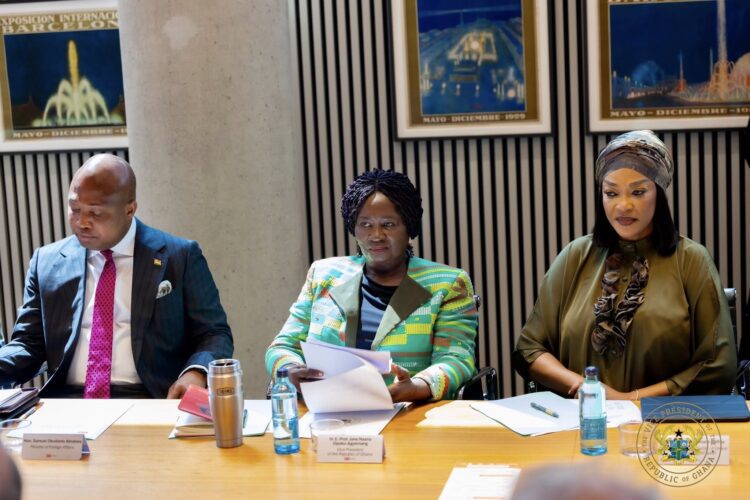
In a strategic mission to Barcelona, Spain, Vice President Professor Jane Naana Opoku-Agyemang has initiated high-level negotiations with GB Foods, a subsidiary of the Spanish conglomerate Agrolimen, to fundamentally restructure Ghana’s tomato value chain
The engagement, held on the sidelines of her arrival for the 4th High-Level Meeting of the “In Defence of Democracy” initiative, marks a decisive move by the government to transition from import dependency to sovereign agro-processing by targeting the tomato sector – a flashpoint for Ghana’s trade deficit.
“Discussions focused on opportunities within Ghana’s tomato value chain, in alignment with Government’s broader agenda to promote agro-processing, value addition, and job creation. Particular emphasis was placed on integrating Ghanaian tomato farmers into the value chain to enhance sustainable livelihoods, boost local production, and reduce import dependence.”
The Vice President’s mission in Spain was dual-pronged: securing the technical and fiscal commitment of one of the world’s leading food processing firms while representing Ghana’s democratic credentials on the global stage.
Received by H.E. Kalsoume Sinare Baffoe, Ghana’s Ambassador to Spain, Prof. Opoku-Agyemang’s arrival signaled an aggressive pursuit of “mutually beneficial partnerships” that move beyond traditional aid, with a clear focus on integrating Ghanaian farmers into the global industrial supply chain.
For the Vice President, this is to ensure that the cedi remains at home while jobs are created in the local manufacturing sector.
The center of Prof. Opoku-Agyemang’s economic agenda in Barcelona was the securing of the tomato sector, as Ghana remains one of the world’s largest importers of tomato paste, a reality that has long drained foreign exchange reserves and left local farmers vulnerable to post-harvest losses.
In her discussions with GB Foods, the Vice President emphasized that the government’s agenda is no longer just about production, but about integration, to create a seamless link between the Ghanaian farm gate and the Agrolimen processing plant.
With this strategy requiring a sophisticated enabling environment that can support the rigorous quality standards required by global giants like GB Foods, Opoku-Agyemang highlighted the government’s commitment to providing the necessary logistical and technical infrastructure to make local sourcing viable.
For Ghana, this is not merely a request for investment; it is a strategic proposal for agro-processing at scale, intended to boost local production and provide sustainable livelihoods for thousands of smallholder farmers who have historically been sidelined by cheaper, subsidized imports.
While the economic stakes were centered on agro-processing, the Vice President’s presence in Barcelona was equally anchored in the 4th High-Level Meeting of the Initiative, as the diplomatic engagement provides the political capital necessary for all economic negotiations.
Global investment from firms like GB Foods is inextricably linked to a nation’s democratic stability and its adherence to the rule of law. By joining global leaders to safeguard democratic values, Prof. Opoku-Agyemang is expected to reinforce Ghana’s status as a stable, low-risk destination for long-term capital.
Ambassador Kalsoume Sinare Baffoe briefed the Vice President on the high-level discussions aimed at strengthening governance. For the Ghanaian delegation, “Democracy” is the prerequisite for the strategic cooperation Prof. Opoku-Agyemang is seeking in the boardroom.
The Vice President’s argument for a resilient democracy is the only sustainable foundation for the just transition of the economy, where industrial growth and democratic governance work in tandem to protect both the investor and the citizen.
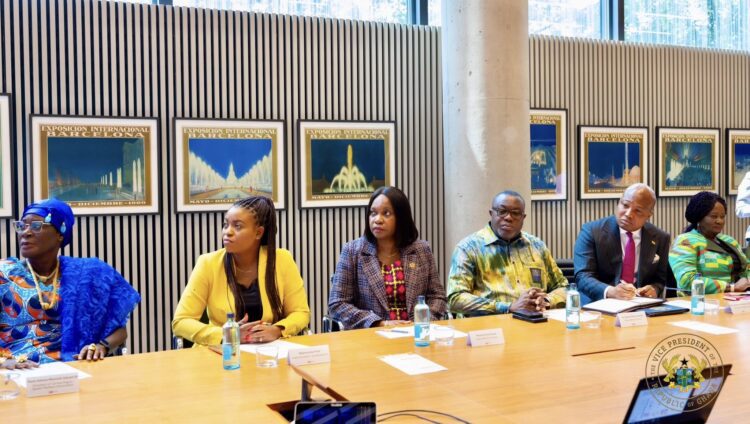
The industrial stake in the Barcelona mission cannot be overstated. For a long time, the tomato crisis has been a symbol of Africa’s fragmented value chains – where raw materials are exported or left to rot while finished products are imported at a premium.
Prof. Opoku-Agyemang’s engagement with GB Foods is a direct attempt to reverse this trend through Value Addition, fostering a partnership that prioritizes local processing and capture the missing middle of the economy – the manufacturing jobs that sit between the farm and the consumer.
The commitment to an enabling environment involves a pledge to deepen strategic cooperation. This means the government is prepared to align its trade and agricultural policies with the operational needs of industrial partners to drive industrial growth.
The takeaway is the shift toward sovereign industrialization, as the Vice President hopes to build Ghana’s internal capacity to eventually own its entire food security narrative by integrating local farmers into a Spanish-owned processing framework.
According to the Presidency, the meeting in Barcelona also served to reaffirm the “longstanding bilateral relations,” between Ghana and Spain. Beyond the immediate tomato value chain, these ties provide a framework for broader economic transformation.
Spanish investment in Ghana has traditionally been a cornerstone of the nation’s European outreach, and Prof. Opoku-Agyemang is leveraging this history to secure future-ready partnerships. The engagement with Agrolimen is expected to encourage other Spanish firms looking to enter the West African market through a reliable democratic partner.
The involvement of the Ghanaian community in Spain, led by the Ambassador, adds a layer of “diaspora diplomacy” to the mission, with the briefing to the Vice President tailored to maximize strategic visibility.