

By TNR Files
It is over.
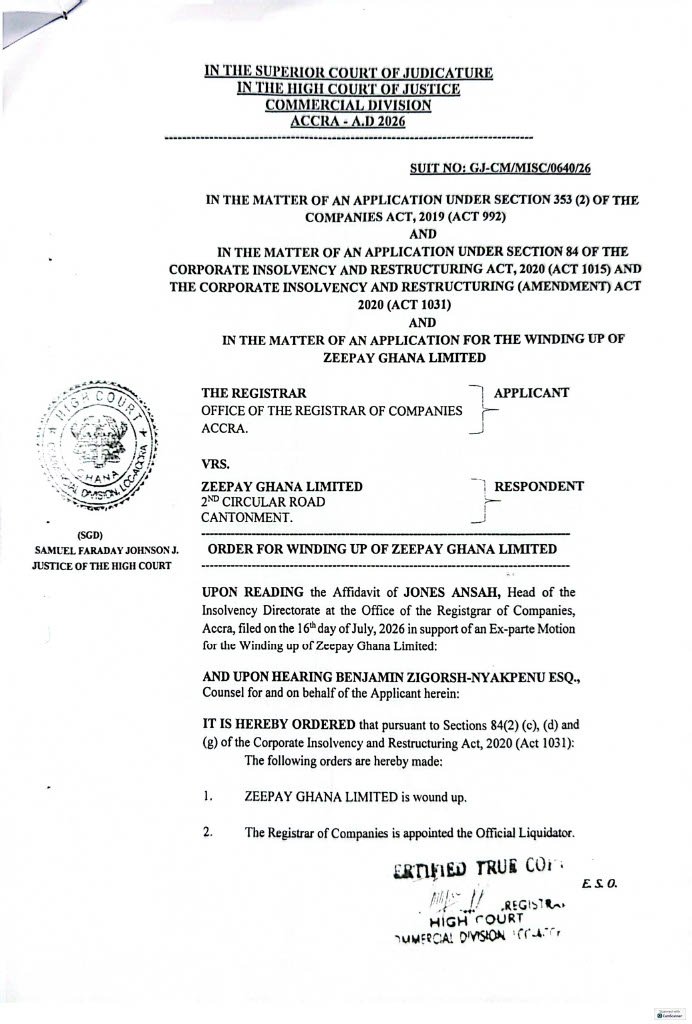
This morning of July 28, 2026, Justice Samuel Faraday Johnson of the High Court signed an order winding up Zeepay Ghana Limited formally ending the corporate existence of a company that once processed over GHS 12 billion in transaction value and promised to connect Africa’s unbanked to the global financial system.
The order, obtained exclusively by The New Republic, was granted on an ex-parte application filed by Jones Ansah, Head of the Insolvency Directorate at the Office of the Registrar of Companies. The court acted under Sections 84(2)(c), (d) and (g) of the Corporate Insolvency and Restructuring Act, 2020 (Act 1031) provisions that allow for winding up where a company is unable to pay its debts, where it is just and equitable to do so, and where the Registrar determines that the public interest so requires.
The Registrar of Companies has been appointed Official Liquidator.
For the thousands of customers, agents and merchants whose funds remain frozen in Zeepay’s mobile money wallets, the order marks the end of a grim waiting game. For Andrew Takyi-Appiah, the founder and CEO who once posed with presidents and spoke at Davos, it marks the final act of a spectacular fall from grace.
The winding-up order is the culmination of a collapse that has unfolded across three continents with breathtaking speed.
On July 14, the Bank of Ghana revoked Zeepay’s Dedicated Electronic Money Issuer (DEMI) licence with immediate effect. The central bank’s findings were damning: Zeepay had issued electronic money without maintaining the required cash backing, creating what the regulator called a “negative variance” that exposed customers and the payment system to significant financial risk. The company had failed to inject sufficient funds to fully back customer balances despite repeated regulatory directives. It had ignored instructions to wind down its e-money issuance operations.
The regulator concluded that the company’s continued operation “threatened the stability of the payment system”. That is not bureaucratic language. It is a finding that customer wallet balances the core obligation of any mobile-money issuer were not fully backed.
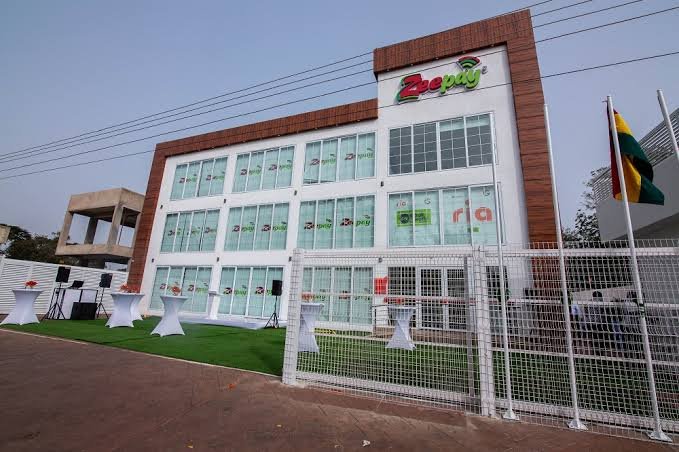
Within hours of the revocation, Bank of Ghana officials and police restricted access to Zeepay’s headquarters. The Economic and Organised Crimes Office (EOCO) had already frozen all accounts linked to the company. Takyi-Appiah and several directors had been arrested and spent days in EOCO custody a fact that Zeepay’s public statements have carefully omitted.
The Personal Wallet
The most troubling revelations have emerged from the courts.
In April 2026, the Commercial Division of the High Court ordered Zeepay and Takyi-Appiah personally to pay more than US$11.6 million, plus €8,500 and GH¢1.4 million with interest, to a customer. The court found that client funds had been “mostly made into [the] Defendant Respondent’s personal mobile money wallet” Takyi-Appiah’s personal phone number, not a corporate account.
Court documents show that the wallet in question was registered under the name “ZeepayCIN” with Takyi-Appiah’s Ghana Card used for registration. Zeepay wrote to MTN Ghana in November 2023 requesting that the wallet’s registered name be changed from “Andrew Takyi-Appiah (ZeepayCIN)” to “Zeepay Ghana Limited”. That request appears never to have been carried out.
The Court of Appeal has refused a stay of execution. On July 6, court bailiffs and police seized Takyi-Appiah’s residence to enforce the judgment.
Zeepay’s collapse is not confined to Ghana.
In Barbados, subsidiary Zeemoney had its licence suspended by the Central Bank of Barbados from May 5 to June 4, 2026, over “critical concerns regarding financial condition, governance, and operational continuity”. The company chose to permanently close its four branches rather than resolve the regulator’s concerns.
In the United Kingdom, both Zeepay UK Limited and Zeepay JV UK Ltd have failed to file financial statements. Companies House records show repeated compulsory strike-off notices, suspended only after last-minute filings. The Financial Conduct Authority is now reviewing the group’s entire regulatory position.
The Ghost Lawyers
When The New Republic first published details of Zeepay’s collapse in June under the headlines “Zeepay Collapses in Barbados” and “‘Ponzi Zeepay’ Casts in NAM1 Playbook” Takyi-Appiah did not issue a point-by-point rebuttal. He did not supply contrary documents.
Instead, he sent lawyers.
The letter, dated June 12, demanded an immediate retraction, a takedown from all platforms, and a “prominent apology with equal or greater visibility” within 48 hours. It accused the paper of publishing “complete falsehoods, fabrications, misrepresentation”.
There was only one problem: the lawyers refused to name themselves. The letterhead read “BLG Practice… The Business Law Group”. But the signature line was blank no name, no partner, no responsible solicitor. When the firm called the newspaper, a woman named Pearl said her boss wanted to speak. The managing editor was connected to a male voice who introduced himself only as “Alex”.
Nowhere in the two-page demand did the ghost lawyers identify a single factual error. They did not dispute the High Court’s finding that Zeepay routed client money through the CEO’s personal wallet. They did not deny the CFO’s resignation which had warned of “material weaknesses and abuse” in treasury operations. They did not challenge Ernst & Young’s withdrawal from the 2024 audit over “serious concerns over the quality and reliability of information”.
Instead, they complained of “reputational damage”. That is the language of a man who has run out of arguments.
The Unbridgeable Gulf
Throughout this cascade of disasters, Takyi-Appiah has maintained a calm, conciliatory public tone. “Zeepay Ghana Limited is working closely with the Regulator and all relevant stakeholders to ensure an orderly, transparent and responsible approach,” the company said in a statement following the licence revocation.
But the facts tell a different story.
EOCO has frozen accounts, not “cooperated.” The Bank of Ghana has revoked licences and taken operational control, not “partnered.” Directors have been arrested, not “engaged.” Barbados has liquidated, not “remediated.” UK regulators are scrutinising, not “supporting”.
The gulf between public messaging and documented reality is now unbridgeable.
With the winding-up order granted, the Registrar of Companies now appointed Official Liquidator will begin the process of selling Zeepay’s assets and distributing proceeds to creditors. The company will cease to exist as a legal entity.
But for the thousands of customers whose funds remain frozen in Zeepay’s mobile wallets, the real question remains unanswered: Will any of that money ever see the light of day again?
The answer, if it comes at all, will not come from Andrew Takyi-Appiah. It will come from the liquidator’s office and from the courts that now hold the final say over what remains of a fintech empire that once promised to build “Africa’s fintech future, one brick at a time”.