

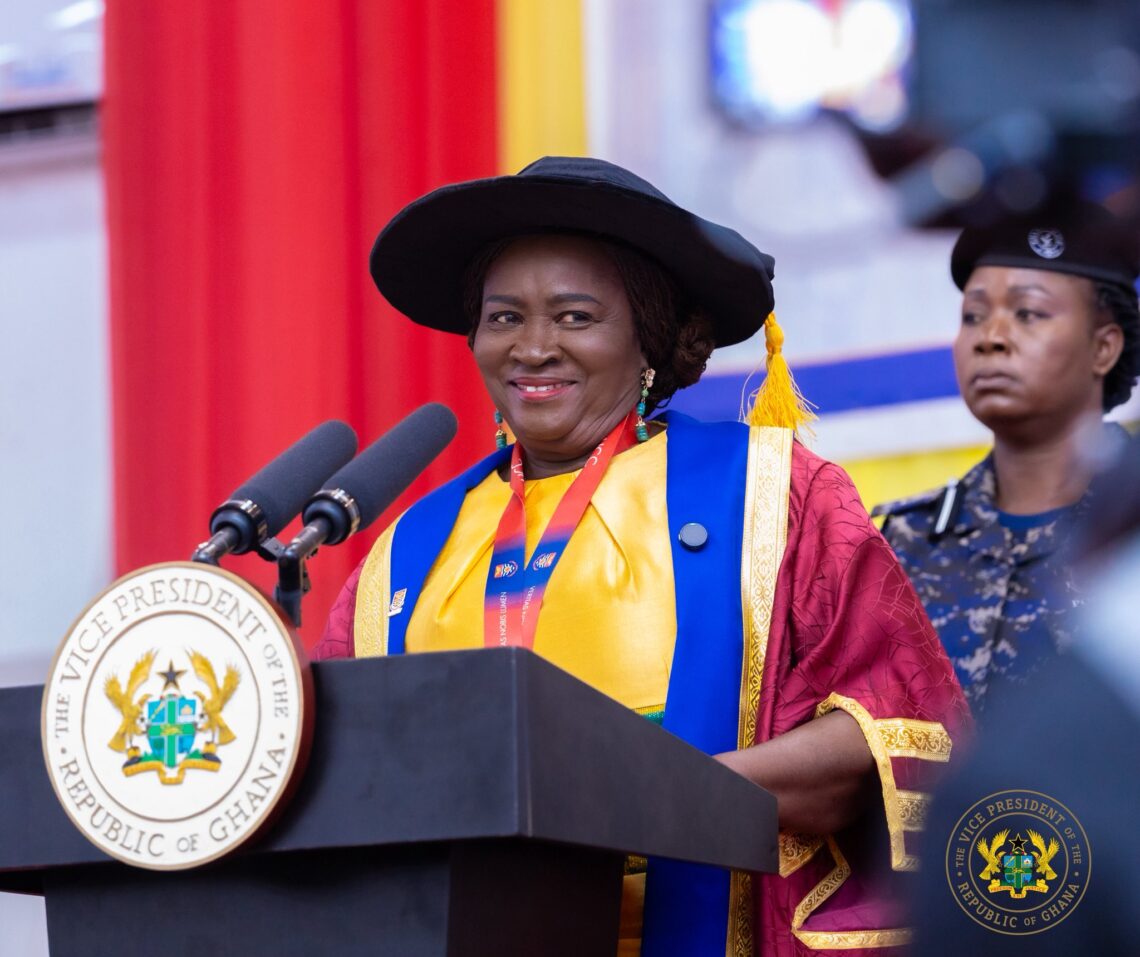
Ghana’s Vice President, Prof. Jane Naana Opoku-Agyemang has emphasised the responsibility that comes with higher education, stating that knowledge must ultimately serve society and contribute to national development.
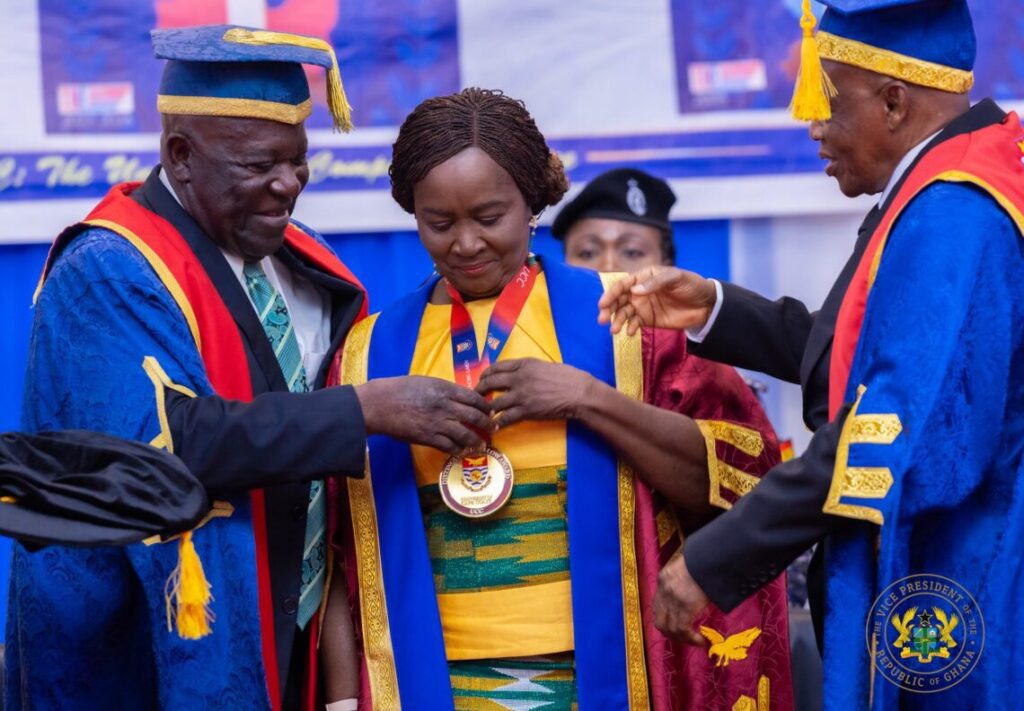
She made the remarks at the University of Cape Coast where she was honoured with a Distinguished Fellow award in recognition of her academic leadership and contribution to public service.
Addressing the university community during the ceremony, the Vice President expressed appreciation to the Chancellor, the Governing Council, the organisers of the event, and members of the university for the recognition.
“It is always a joy to be back at the University of Cape Coast. Let me begin by sincerely thanking the Chancellor, the Governing Council, the organisers of this event, the entire university community and everyone who is here today for this great honour.”
She also acknowledged the presence and support of colleagues, family members, friends, former students, and current students who joined the ceremony to celebrate the occasion.
Professor Opoku Agyemang described the honour as particularly meaningful because of her long standing relationship with the University of Cape Coast, noting that the institution played a central role in shaping both her academic journey and professional life.
“This is where my higher education began and where my professional life took shape,” she said. The Vice President recalled her years on campus as a student, a national service personnel, a lecturer, a professor, and later as Vice Chancellor of the university.
“This campus was the backdrop of my life as a student, a national service person, a lecturer with different appointments and responsibilities, a professor, a vice chancellor and, of course, as a mother too.”
According to her, the lessons learned during those years continued to influence her work even after leaving the university to take up roles in public service. “When I left the university, I did my best to carry its lessons into my non academic roles,” she added.
Professor Opoku Agyemang stressed that education should not only focus on personal achievement but must also contribute to the improvement of society, explaining that institutions of higher learning should guide students to use knowledge as a tool for positive change.
“The pursuit of knowledge is meant to bring illumination, not only for personal edification,” she stated. According to her, modern societies must increasingly rely on research and evidence in addressing social and economic challenges.
“Now more than ever, our societies must rely on meticulous research and evidence, as well as the conviction that knowledge and facts can be buried but never extinguished,” she said, adding that truth must remain central to the academic mission.
The Vice President also highlighted Ghana’s long standing commitment to education, noting that the establishment of the University of Cape Coast reflected the country’s belief in the transformative power of learning.
She pointed out that the institution was founded by Kwame Nkrumah as part of national efforts to invest in human development. “Since this university was founded by Dr Kwame Nkrumah, it has served as a reminder that Ghana has always invested heavily in the education of her people,” she said.
Professor Opoku Agyemang said those who benefit from such opportunities must recognise that higher education remains a privilege made possible by the nation. “Those of us who benefit from this investment understand that higher education, even today, is a privilege,” she said.
She added that scholars and graduates should continually reflect on whether the knowledge they gain contributes to the development of the society that supports them.
According to the Vice President, the physical location of the University of Cape Coast offers a constant reminder that academic institutions must remain connected to the communities around them. She observed that the campus is surrounded by several towns, which highlights the relationship between academia and society.
“At UCC, that question is never abstract. This campus is surrounded by seven towns which offer a daily reminder that academia exists within a living community.”
Opoku-Agyemang encouraged students and scholars to ensure that their work produces practical benefits that improve lives and strengthen the nation.
“Our education tasks us to go beyond theoretical knowledge and make tangible improvements in our nation so that we can take genuine pride in our identity and capabilities.”
The Vice President also spoke about the importance of stewardship in education, urging individuals to strengthen the institutions and ideas they inherit.
“We all inherit established systems, ideas and institutions. We must examine them carefully, strengthen them where possible and contribute something of ourselves to improve them.”
She described this responsibility as a shared duty among citizens, not only those within academic institutions, while also encouraging people to pass knowledge on to others through mentorship and guidance.
“One of the lessons of our community is to pass out and pass on, to find out and pass on,” she said. According to her, the true value of education lies in the long term impact it has on society.
“The value of our work should be judged not so much by how loudly it is praised but by whether what it leaves for Ghana is stronger, clearer and more valuable than what we received.”
The Vice President concluded by encouraging scholars and professionals to ensure that their work leaves a lasting legacy for future generations. “If knowledge is meant to light our way, our role is to carefully do the work of discovery and leave the path clearer than we found it,” she said.
She added that when knowledge is shared and applied in service to society, institutions grow stronger and nations move forward.
Professor Opoku Agyemang ended her remarks by thanking the University of Cape Coast once again for the recognition, describing the honour as both humbling and deeply appreciated.