

Raphael Ofori-Adeniran
If you’ve been following the escalating tensions in the Middle East, you’ve likely seen the headlines: Iran threatens to close the Strait of Hormuz. The US and Israel vow to “obliterate” Iran’s oil infrastructure. Iran allows only ships accepting Yuan, not US dollars. Iran allows ships through the Strait of Hormuz, except ships belonging to the US and its allies.
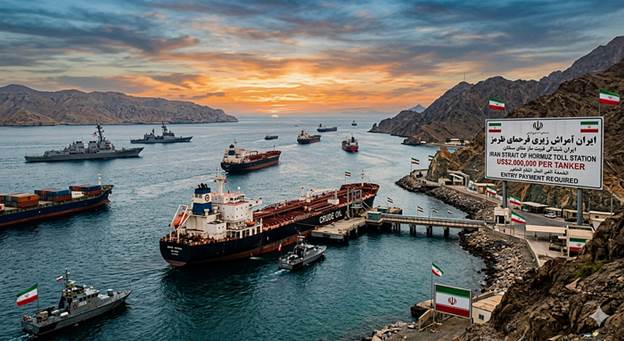
Finally, the latest development is that Iran has decided to charge a US$2 million toll on every oil tanker that passes through the trade chokepoint.
But what if all the shenanigans point to an audacious economic move by Iran—a move so clever and so devastating to its enemies, that it renders the entire adventure to fight the biggest military miscalculation that worked out in Iran’s favour?
Welcome to the $2 million toll booth at the mouth of the Persian Gulf.
In this article, we’re going to break down the numbers. We’ll explore the geopolitical chess match unfolding. And by the end, you’ll understand why—regardless of what Washington or Tel Aviv throw at it—Iran may have already won the war.
The Stage: Why the Strait of Hormuz Matters
It is important to establish why this narrow but strategically positioned waterway is the most important chokepoint in the world.
The Strait of Hormuz separates the Persian Gulf from the Gulf of Oman. It is, at its narrowest, just 21 miles wide. Through this corridor traverses approximately 20% of the world’s daily oil trade.
Every day, around 150 oil tankers transit the Strait, carrying a combined 20 million barrels of crude oil. For context, that’s more than the entire daily output of Saudi Arabia, Iraq, and the UAE combined.
For decades, the United States has guaranteed the “free flow of navigation” through the Strait. The US Fifth Fleet is based in Bahrain precisely to patrol these waters. Iran, meanwhile, has always maintained that it can close the Strait—or make passage extraordinarily difficult—if it feels threatened.
But until now, the threat has been theoretical. A red line nobody wanted to cross.
But the situation changed immediately after the coalition of Israel and the US decided to preemptively start a war with Iran, giving Iran the opportunity to turn the whole fracas into a war of attrition.
First of all, Iran’s response to the aggression was to target all of America’s military bases in the Gulf region, particularly the 5th Fleet in Bahrain.
Iran successfully rendered all the major bases inactive, thereby clearing the path for its own domination of the region, particularly taking control of the Strait of Hormuz with no more existential threat to its claim.
Afterwards, Iran closed the Strait to garner global trepidation and negotiations. Later, Iran decided to open the Strait to all ships, except those of the US and its allies (the EU was exempted from Iran’s ban).
When it was clear Iran had achieved the necessary effect of threatening the economic chokepoint, it slammed a toll on the Strait.
This was Iran’s endgame for the Strait of Hormuz all along, and the war just made it easy to implement. The US$2 million toll is just a natural result of that game plan.
A Numbers Game: Iran’s $90 Billion Toll Booth
Press enter or click to view image in full size
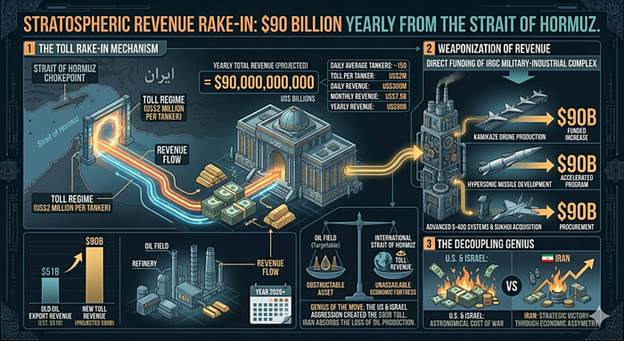
Let’s do the maths—because the numbers are staggering and the windfall is astounding:
Every day, approximately 150 oil-laden tankers pass through the Strait of Hormuz. If Iran is charging each a $2 million toll per tanker, Iran would be smiling to the bank with $300 million potential revenue every day.
And when the numbers are stacked up, you see the picture even more clearly:
· Every month (25 operating days): $300 million × 25 = $7.5 billion per month.
· Every year: $7.5 billion × 12 = $90 billion annually.
That’s $90 billion—collected not from drilling a single oil well, not from exporting a single barrel, but simply by controlling a 21-mile stretch of water.
Now, let’s compare that to Iran’s current oil export revenue.
Iran currently exports approximately 1.5–1.6 million barrels of crude oil per day. At global prices hovering around $100 per barrel, that yields roughly $51 billion in annual revenue.
Do you see where this is going?
The Masterstroke: Why Iran No Longer Needs to Pump Oil
Press enter or click to view image in full size
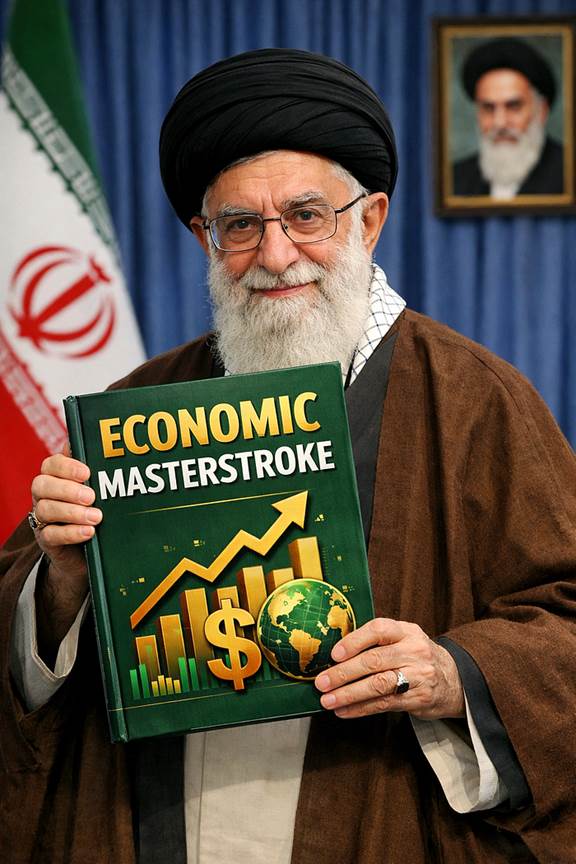
Here’s the genius of the move: Iran’s leadership has effectively decoupled its economic survival from its oil fields.
If the United States and Israel follow through on their threats to “obliterate” Iran’s oil production infrastructure—striking refineries, pipelines, export terminals—Iran can simply absorb the loss.
Why? Because even without producing a single barrel of crude, Iran would still be raking in $90 billion a year from transit fees alone.
That’s $40 billion more than it currently makes from selling its own oil.
Let that sink in.
The very act of threatening Iran’s oil fields hands Iran a financial incentive to stop producing and start collecting tolls instead.
And if Washington and Tel Aviv don’t carry out their threats? Iran continues producing oil and collecting tolls. Combined annual revenue: $141 billion!
That’s nearly triple its current oil revenue!
In one stroke, Iran has transformed its greatest vulnerability—dependence on oil exports—into an unassailable economic fortress.
When Washington, in yet another hasty decision, decided to “unsanction” 140 million barrels of Iranian oil, it was easy for Iran to reject the offer, because the Strait of Hormuz will rake in more revenue than that.
5D Chess: What Iran Does With the Money
Press enter or click to view image in full size
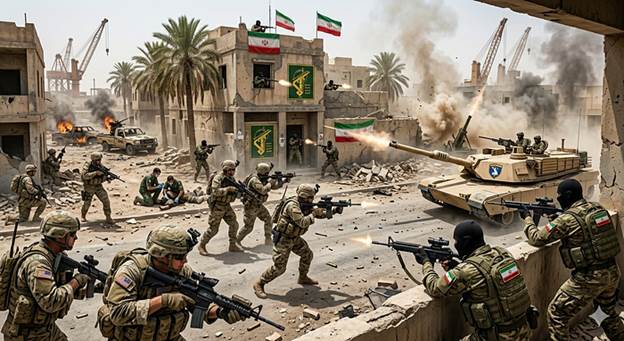
Now, let’s talk about where that money goes.
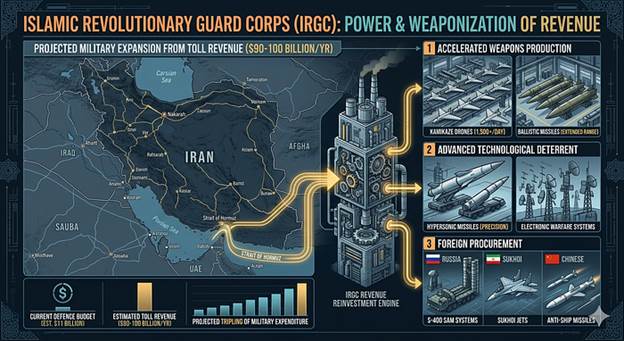
Iran’s annual defence budget is estimated at around $11 billion. That’s modest by regional standards—Saudi Arabia, for comparison, spends over $70 billion annually.
But with an additional $90–$100 billion flowing into state coffers, the calculus changes entirely.
Iran could triple its defence spending overnight.
What does that buy?
· Kamikaze drones: Iran currently produces around 500 per day. Tripling defence spending could push that to 1,500 per day—enough to overwhelm any air defence system in the region.
· Ballistic missiles: Iran already possesses the largest missile arsenal in the Middle East. More funding means more precision, more range, and more volume.
· Hypersonic missiles: Iran unveiled its first hypersonic missile in 2023. With additional resources, these could become a game-changing deterrent against US and Israeli defences.
· Foreign weapons: Iran could accelerate purchases of advanced systems from Russia (Sukhoi jets, S-400 air defences) and China (anti-ship missiles, electronic warfare capabilities).
This isn’t just about defence. It’s about transforming Iran into a military-industrial powerhouse—and the IRGC, Iran’s Islamic Revolutionary Guard Corps, is the engine behind it.
The IRGC: More Than a Military Force
Press enter or click to view image in full size
It’s crucial to understand the IRGC’s role here.
Unlike Iran’s regular army (the Artesh), the IRGC is not purely a military institution. It is also a business empire. Through its conglomerate, Khatam al-Anbiya, the IRGC controls vast swathes of Iran’s construction, energy, telecommunications, and infrastructure sectors.
In short, the IRGC has a direct financial stake in controlling the Strait of Hormuz.
This means the IRGC’s motivation to resist US/Israeli aggression isn’t just ideological or strategic—it’s economic. Losing control of the Strait would cost the IRGC billions in revenue. And an institution with that much skin in the game is not going to back down easily.
Global Economic Implications: What Happens to Oil Prices?
Press enter or click to view image in full size
Meanwhile, from the perspective of global oil markets:
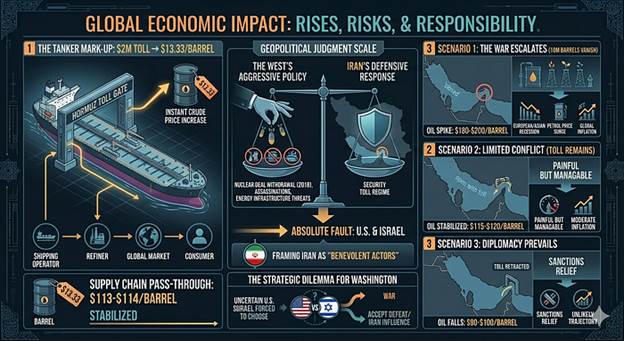
Each oil tanker passing through the Strait carries approximately 150,000 barrels of crude oil. To cover the $2 million toll, shipping companies and oil producers must pass that cost down the supply chain.
The mark-up per barrel would look like this:
2,000,000 divided by 150,000 barrels equals US13.33 per barrel.
With crude oil currently trading around 100 per barrel, the direct cost of the toll would push prices to US113–$114 per barrel.
But here’s where market dynamics diverge from simple arithmetic.
The actual price of oil is not determined solely by the toll. It’s determined by risk, uncertainty, and fear of disruption.
Scenario 1: The War Escalates
If the US or Israel sends ground troops into the region—or launches sustained airstrikes on Iranian territory—the Strait could be effectively closed for weeks or months. In that scenario, 10 million barrels per day of global supply would vanish from the market.
Analysts have warned that under prolonged closure, oil prices could spike to $180–$200 per barrel.
That would trigger:
· Soaring petrol prices globally
· A surge in inflation across Europe, Asia, and the Americas
· Potential recessions in oil-importing nations
· Political instability in vulnerable economies
Scenario 2: Limited Conflict, Toll Remains
If the conflict remains contained—naval skirmishes, cyberattacks, but no full-scale invasion—the Strait stays open, but the toll stays in place.
In this case, global oil prices would likely stabilise in the $115–$120 per barrel range.
That’s painful for consumers, but not catastrophic. Inflation would rise moderately, but central banks could manage it through interest rate adjustments.
This appears to be Iran’s preferred scenario: enough pressure to hurt the West, but not enough to provoke an existential confrontation.
Scenario 3: Diplomacy Prevails
In the unlikely event of a negotiated settlement, the toll could be reduced or removed in exchange for sanctions relief. Oil prices would fall back toward $90–$100 per barrel.
But given the current trajectory, this scenario seems increasingly remote.
Who Bears the Blame?
Here’s where the narrative becomes politically charged.
Iran’s official position—and the framing of this article—is that Iran is acting defensively. From Tehran’s perspective:
· The US withdrew from the nuclear deal in 2018, imposing crushing sanctions on Iran.
· Israel has conducted covert operations inside Iran, including assassinations of nuclear scientists and attacks on facilities.
· The US and Israel have repeatedly threatened military action against Iran’s nuclear and energy infrastructure.
In this context, Iran’s decision to charge tolls—rather than close the Strait entirely—is framed as a benevolent act. It keeps global oil flowing, but ensures Iran is compensated for the security it provides.
Therefore, any disruption caused by continued war in the region would be the absolute fault of the US and Israel, not Iran.
Whether you agree with that framing or not, it’s the lens through which Iran’s leadership and much of the Global South view the conflict.
Iran is playing a long game—and it’s winning
Now, stepping back and looking at the strategic picture, one conclusion becomes crystal clear:
- Economically, Iran has diversified its revenue stream away from vulnerable oil production toward a resource that no airstrike can destroy.
- Militarily, if the coalition of Israel and the US insists on war, Iran has already built a network of proxies across Lebanon, Syria, Iraq, and Yemen that contribute to an endless asymmetric war. Indeed, these proxies can now be further armed by Iran to inflict more costs on the US and Israel without Iran needing to fire a single missile from its own soil.
- Politically, Iran has positioned itself as a leader of the “Axis of Resistance,” gaining legitimacy among populations across the Middle East, China, Russia, and some parts of the Global South, who view US and Israeli policy as aggressive and destabilising.
- Strategically, Iran has forced the US into a dilemma: escalate to a war with uncertain outcomes, or accept defeat and acknowledge Iran’s growing influence in the region.
The toll at the Strait of Hormuz is not just a revenue measure. It’s a declaration. A statement that Iran no longer needs to play by the rules the US established after 1979.
Conclusion: The End of an Era of Occupation
Numbers don’t lie. The maths behind Iran’s $2 million toll is brutal in its simplicity. Whether you view this as genius statecraft or reckless provocation depends entirely on which side of the Strait you stand.
What’s undeniable is this: the global energy order is shifting. The era of guaranteed free passage through Hormuz—backed by American carrier strike groups—has practically ended.
And for the first time, Iran has found a way to profit from the crisis, regardless of whether the bombs fall or the diplomats talk.
Will the US and Israel accept Iran’s toll regime, or will they risk a wider war to break it?
Disclaimer: This article is a geopolitical and economic analysis based on publicly available data and stated assumptions. It does not constitute financial or investment advice. Oil price projections are estimates and subject to rapid change based on real-world events.