

Turns From Economic ‘Messiah’ To Digital ‘Evangelist’
By Prince Ahenkorah
When former Vice President Dr Mahamudu Bawumia stepped onto the stage at the London School of Economics on March 28, he was returning to familiar territory. The lecture circuit had served him well once before: between 2012 and 2016, his public lectures on the economy helped establish him as a technocratic force, culminating in the New Patriotic Party’s (NPP) capture of political power.
But his keynote address at the Africa Summit carried a telling omission. The subject was not the economy. It was artificial intelligence.
For the man who was appointed head of the Economic Management Team and marketed to voters as the solution to Ghana’s fiscal woes, the silence on economic matters is now a consistent pattern. Since leaving office, Bawumia has not delivered a single major public address on Ghana’s economy. Instead, he has embraced a new identity: digital transformation advocate, AI evangelist, and architect of a digital future.
The timing coincides with an uncomfortable reality: the economy he once claimed to have mastered is now showing signs of recovery under his successor, Finance Minister Dr Ato Forson. Inflation has fallen from 54% at its peak under the Akufo-Addo administration to 3.2% in March 2026. The cedi has stabilised. The IMF programme is on track.
Bawumia, meanwhile, was in London with a delegation that read like a shadow government: former Majority Leader Osei Kyei Mensah Bonsu, Minority Chief Whip Frank Annor Dompreh, former Youth and Sports Minister Mustapha Ussif, and former NHIA boss Dr Aboagye Dacosta, among others. The entourage suggested a political operation in motion, but the message was conspicuously detached from the fiscal realities confronting Ghanaians.
The economy he left behind
Bawumia’s record on the economy is a matter of public record. When he was appointed vice president in 2017, Ghana’s fiscal deficit stood at 6.3% of GDP. By 2024, the country had defaulted on its external debt, inflation had soared to 54%, and the government was in a three-year IMF bailout.
During those years, Bawumia chaired the Economic Management Team. Yet in public, he rarely addressed the worsening numbers. His most memorable interventions were on digitalisation: the Ghana Card, mobile money interoperability, the digital address system. By 2024, he was campaigning as the candidate of “digitalisation” rather than economic stability.
Now, in opposition, the shift is complete. The London lecture was titled “Artificial intelligence and unifying borders in Africa”. Not a word on debt restructuring, exchange rate volatility, or the cost of living.
A digital record under scrutiny
Bawumia’s new identity as a digital pioneer rests on claims that merit closer examination.
In his LSE address, he cited Ghana’s robust digital pillars the national biometric identity system, the digital address system, and interoperable digital payments as foundations he significantly contributed to. He referenced a National Identification Authority report stating that as of February 2026, more than 19.3 million Ghanaians had been enrolled for the Ghana Card.
But the timeline raises questions. Mobile money interoperability was launched in 2017, shortly after the NPP took office, but its foundational work began under the previous administration. The Ghana Card project was also initiated before 2017. Bawumia’s role, while visible, was often that of a public champion rather than a technical architect.
More striking is the composition of his inner circle. Political watchers note that during his eight years as vice president, none of his special aides or advisors had a background in ICT or digitalisation. The man now positioning himself as Ghana’s foremost digital expert built no team of digital specialists around him while in power.
Then there is the matter of the Terminal 3 electronic gates. In the run-up to the 2024 election, Bawumia visited the terminal – built under John Mahama’s administration to commission new electronic gates he claimed his government had installed. The gates failed to function during the event, an episode that became a symbol of the gap between the digital rhetoric and its execution.
The politics of a pivot
Why has Bawumia abandoned the economy? The strategic calculation appears straightforward. The NPP’s eight years in office left a difficult economic legacy, and the party lost the 2024 election in large part due to the cost-of-living crisis. For Bawumia to continue speaking on the economy would mean confronting that record or ceding credibility by ignoring it.
By pivoting to digitalisation and AI, he positions himself as forward-looking, untainted by the fiscal turbulence of the Akufo-Addo years. His LSE lecture warned that “there can be no AI without digitalisation” and praised Ghana as one of the few African countries on track to embrace AI. He framed himself as the man who laid the groundwork for that future.
Yet the numbers tell a different story. Ghana’s digital infrastructure remains uneven. The digital address system is widely acknowledged to be underutilised. The Ghana Card, while widely issued, is still not fully integrated across government services. And the AI readiness strategy Bawumia cited is still in its consultation phase.
The man who doesn’t talk about the economy
For now, Dr Ato Forson, the 47-year-old Finance Minister, occupies the ground Bawumia has vacated. Forson’s public profile is low; he does not lecture on international stages. But the economic indicators under his watch have steadily improved.
Bawumia, by contrast, was in London with a message that avoided the one subject Ghanaians most want addressed: the state of their pockets. His delegation sat in the audience as he spoke of digital public infrastructure and AI-enabled services. Not one of them raised the economy.
Political watchers are left with a central question: if Bawumia was brought into politics to fix the economy as former President Akufo-Addo himself once said why has he now abandoned it entirely? And if the economy is indeed recovering under the current administration, why is he allowing Forson to own that success without challenge?
The answer may lie in the 2028 election. By then, Bawumia hopes voters will remember him not as the chairman of the Economic Management Team during Ghana’s worst fiscal crisis in a generation, but as the visionary who brought AI to Africa.
Whether that rebrand survives the scrutiny of the voters and of the facts remains an open question.
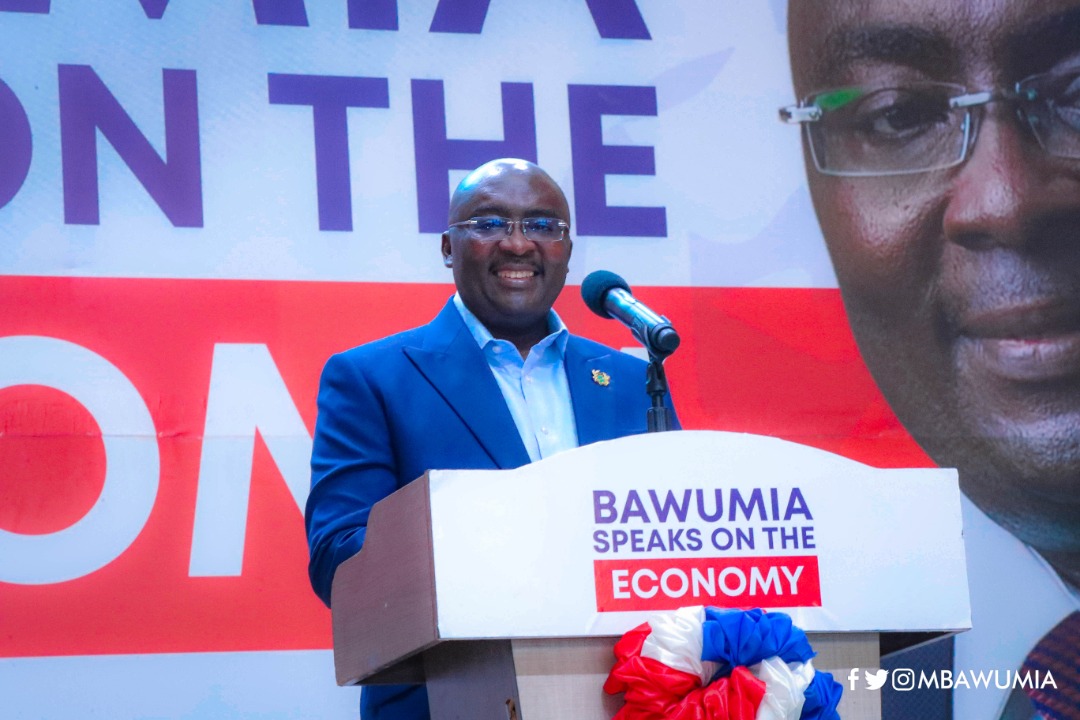
Former Vice President Dr. Mahamudu Bawumia
Bawumia on Faulty ‘Reset’
0Related Posts
Micro-Minority NPP Faces New Threat
3 Mins Read
Bloggers Snub Bawumia’s Return Bid
4 Mins Read
High‑income Voters Flee NPP
2 Mins Read
Add A Comment
© 2026 THE NEW REPUBLIC GH.
About | Contact | Privacy Policy