


By Leo Nelson
New polling data from Global InfoAnalytics has revealed signs of declining grassroots support for the National Democratic Congress in the Volta and Oti regions, traditionally considered strongholds of the party.
The analysis, presented by the Executive Director for the Global InfoAnalytics, Mussa Dankwah, suggests growing voter dissatisfaction that could reshape the political landscape ahead of the 2028 elections.
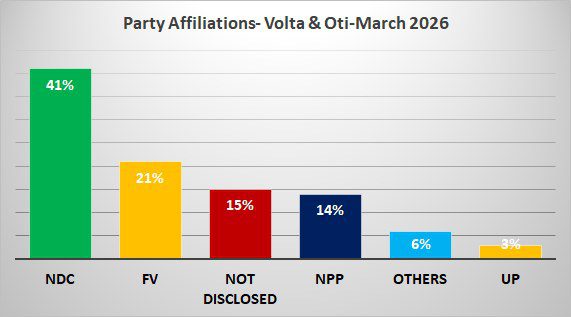
According to the March tracking poll, NDC’s support in the Volta Oti bloc stands at 41 percent, falling below its national average of 45 percent. The data also shows a notable presence of floating voters at 21 percent, alongside 15 percent of respondents who declined to disclose their party affiliation.
The New Patriotic Party trails with 14 percent, while other political groupings account for smaller shares. The findings point to what analysts describe as an emerging shift in voter sentiment, with both major parties struggling to consolidate support in the region.
Fractures in Core Support Base
The poll highlights what appears to be a weakening of the NDC’s traditionally strong base, with a significant portion of its supporters expressing willingness to back alternative candidates. This trend is particularly evident in voter preferences for the 2028 presidential race.
In a hypothetical contest between Dr Ato Forson and Mahamudu Bawumia, Dr Forson leads with approximately 45 percent, while Dr Bawumia records 22 percent. Independent candidates, including Alan Kyerematen and Nana Bediako, each secure about 5 percent, with others collectively attracting 8 percent.
Despite this lead, the underlying dynamics reveal deeper concerns for the NDC. Only 58 percent of its own supporters indicate they would vote for Dr Forson, while 12 percent would support Dr Bawumia and others shift toward alternative candidates.
Analysts interpret this as a sign of dissatisfaction within the party’s base, with some voters exploring options beyond the two dominant political parties.
NPP Struggles to Capitalise
While the NDC faces internal challenges, the New Patriotic Party has not significantly benefited from the shift. Although Dr Bawumia commands strong loyalty among NPP supporters, securing 68 percent of their votes, his overall appeal in the region remains limited.
The data shows that even as NDC support declines, a portion of voters is gravitating toward smaller parties and independent candidates rather than the NPP. This trend suggests a broader search for alternatives among the electorate.
Among floating voters, Dr Forson dominates with 50 percent support compared to Dr Bawumia’s 10 percent. This indicates that while the NDC retains an advantage among undecided voters, it is not translating into strong internal cohesion.
Rise of Third Force Candidates
One of the most notable developments in the poll is the growing appeal of third force candidates. Combined support for figures such as Alan Kyerematen and Nana Bediako reaches 21 percent, reflecting increasing interest in alternatives outside the traditional two party system.
This shift is particularly evident among NDC supporters, where a segment of voters appears to be moving toward these candidates. Analysts suggest that this trend could reshape the competitive landscape if sustained over time.
Among voters who do not disclose their party affiliation, Dr Forson leads with 37 percent, followed by Dr Bawumia at 22 percent, while other candidates collectively attract a significant share.
Head to Head Dynamics
The poll also examined a potential contest between Johnson Asiedu Nketia and Dr Bawumia, revealing a similar pattern of fragmentation within the electorate. Asiedu Nketia leads with 44 percent compared to Dr Bawumia’s 20 percent, but the data again shows limited consolidation among NDC supporters.
Within the NDC base, Asiedu Nketia performs slightly better than Dr Forson, securing 64 percent support. However, a notable proportion of voters still opt for other candidates or remain undecided.
Among floating voters, Asiedu Nketia records 47 percent support, while Dr Bawumia trails with 8 percent. This suggests that the NDC retains a competitive edge among undecided voters, even as internal divisions persist.
Unpredictable Voter Behaviour
The poll reveals increasingly complex voter behaviour in the Volta and Oti regions. Among supporters of other political parties, preferences are widely distributed across multiple candidates, indicating a lack of clear alignment.
Similarly, among voters who do not disclose their party affiliation, support is spread across several contenders, with significant levels of indecision. This fragmentation underscores the fluid nature of the electorate and the potential for rapid shifts in voter sentiment.
Dankwah described the findings as indicative of “unusual behaviour” among voters, suggesting that the region could become a key battleground in the 2028 elections.
Implications for 2028 Elections
The emerging trends in the Volta and Oti regions carry significant implications for both major political parties. For the NDC, the data signals the need to address internal concerns and rebuild confidence among its core supporters.
For the NPP, the challenge lies in expanding its appeal beyond its traditional base and capitalizing on dissatisfaction within the NDC. However, the current data suggests that this opportunity has not yet been fully realized.
The rise of third force candidates adds another layer of complexity, potentially fragmenting the vote and altering traditional electoral dynamics.
Analyst Perspective
Dankwah emphasized that the poll reflects early indicators rather than definitive outcomes. He noted that voter sentiment remains fluid and could evolve significantly as the election approaches.
“I am just the messenger,” he remarked, underscoring the importance of interpreting the data within the broader context of Ghana’s political environment. The analysis highlights the need for political parties to engage more effectively with voters, particularly in regions where traditional loyalties are showing signs of strain.
As Ghana moves closer to the 2028 elections, the Volta and Oti regions are emerging as areas of heightened political interest. The combination of declining party loyalty, rising alternative candidates, and shifting voter preferences suggests a more competitive and unpredictable electoral environment.
The ability of parties to respond to these trends will likely play a crucial role in shaping the outcome of the next election. For now, the data points to a region in transition, where voter expectations are evolving and political dynamics are being redefined.